Houseblend Article
NetSuite Solution Providers: Types, Tiers & Vetting
Inside this article
- 01Executive Summary
- 02Introduction and Background
- 03The NetSuite Partner Ecosystem
- 04Solution Providers and Tier Structure
- 05Vetting and Selecting a NetSuite Partner
- 06Partner Selection: Questions and Red Flags
- 07Data and Analysis: Success, Costs, and ROI
- 08Future Trends and Implications
- 09Case Study Examples
- 10Conclusions
Executive Summary
Oracle NetSuite relies on a structured partner ecosystem to deliver its cloud ERP solution. Partners are classified by role (e.g. Solution Provider, Alliance Partner, BPO, SDN) and performance tiers (e.g. 5-Star reseller). Understanding these categories is critical: solution providers are the licensed resellers and implementers, alliance partners handle implementation/consulting only, BPOs run outsourced business processes, and SDN partners build SuiteApps (add-ons) [1] [2]. Partners are further “tiered” by sales volume and competence (e.g. 5-Star vs. 4-Star) – higher tiers denote larger teams, more certifications and volume, though not necessarily better implementation quality [3] [4]. For companies selecting a partner, careful vetting is essential. We outline a research-backed framework: assess the partner’s industry experience, certified staff and methodology; check customer references and post-go-live support practices; and watch for red flags like no demo, opaque quoting, or undue pressure [5] [6]. Empirical data emphasize the ROI of choosing wisely – for example, ~85% of NetSuite projects succeed with experienced consultants versus far higher failure rates without them [7] [8]. We also synthesize cost and engagement trends: boutique specialists often deliver implementations 30–60% cheaper and ~43% faster than large SIs, albeit with tradeoffs in “big corporate” governance [9] [10]. This report provides an in-depth analysis of the 2026 NetSuite partner landscape – historical context, current tiers, vetting criteria, real case examples, and forward-looking considerations (e.g. AI in ERP – to guide organizations in matching with the right NetSuite solution provider.
Introduction and Background
Oracle NetSuite is a leading cloud ERP/Finance suite, with roughly 40,000+ organizations on the platform worldwide (Source: www.anchorgroup.tech). Most mid-market companies deploy NetSuite through certified partners because these firms bring specialized expertise in implementation, customization, and ongoing support [1] [11]. As Oracle reports, NetSuite’s partner community encompasses hundreds of firms globally [12] [13] – in fact, NetSuite officially cites “800+ partners worldwide,” ensuring local and industry know-how [12]. By 2026 the NetSuite partner network includes major global integrators, regional consultancies, industry-specialists, and niche developers, all tapped to help customers maximize value from the cloud ERP.
The rise of cloud ERP and digital transformation has driven explosive partner growth. NetSuite revenue growth was ~18% YOY (hitting $1.0B in Q4 FY2025 (Source: www.anchorgroup.tech), and partner programs have correspondingly expanded (e.g. SuiteLife initiative attests continued investment [14]). For organizations, engaging a qualified partner is mission-critical: industry data show standard ERP implementations fail 55–75% of the time if goals aren’t met [15] [7]. With e.g. 85% success achievable when using experienced partners [7] (Source: www.anchorgroup.tech), choosing the right NetSuite solution provider can make the difference between a smooth go-live and an expensive failure. This report examines the NetSuite solution provider landscape in detail, including tier structures, partner roles, vetting criteria, and future trends, with extensive data and case examples.
The NetSuite Partner Ecosystem
Oracle NetSuite’s partner community is organized into distinct categories, each fulfilling different roles in the NetSuite delivery model [1] [2]:
-
Solution Provider (Reseller/Implementer) – Authorized firms that resell NetSuite licenses and deliver end-to-end implementation and support services [1] [16]. Solution Providers handle everything from requirements analysis to system configuration, customization, data migration, training, and post-go-live support. In practice they are the primary point of contact for new NetSuite customers (one-stop shops for licensing + deployment) [17] [16]. The Solution Provider program employs a “star” tier system (5-Star, 4-Star, etc.) to recognize top resellers by volume and performance [17] [18].
-
Alliance Partner (Consulting Firm) – Firms that do not resell licenses; instead, they focus on consulting and implementation [19] [20]. They implement and optimize NetSuite when the company purchases subscriptions directly from Oracle. Alliance partners often include large system integrators and specialist consultancies with deep process or vertical expertise [19] [20]. Oracle actively refers customers to Alliance partners for projects that require niche industry knowledge or for large, multi-entity rollouts.All big four and many regional IT consultancies participate as Alliance partners.
-
BPO (Business Process Outsourcing) Partner – These partners operate business processes as a managed service on NetSuite [21]. For example, accounting firms or payroll providers become BPO partners by running clients’ finance/CD operations on a shared NetSuite instance. This model lets small and mid-size companies adopt NetSuite at lower cost by outsourcing the back-office workload, without having to hire in-house NetSuite specialists [21].
-
SuiteCloud Developer (ISV) Partner – Independent software vendors who build and certify SuiteApps (add-on applications) that extend NetSuite’s functionality [2]. SDN partners are important when businesses need specialized capabilities (e.g. advanced WMS, EDI, vertical niche features) not provided out-of-the-box. These partners create solutions that integrate seamlessly within the NetSuite cloud.
下表 compares these partner types:
| Partner Category | License Resale? | Core Role / Services |
|---|---|---|
| Solution Provider | Yes | Resells NetSuite subscriptions; full implementation and support (ERP, CRM, e-commerce, etc.) [17] [16]. Acts as a one-stop shop from licensing through go-live and beyond. |
| Alliance Partner (Consulting) | No | Implementation and business consulting only [19] [20]. Focused on configuration, customization, integrations and process design. Use when licensing is done direct, or when specialized consulting (often industry-specific) is needed. |
| BPO Partner | No | Provides outsourced back-office processes (e.g. bookkeeping, payroll, HR) using NetSuite [21]. Allows clients to operate critical processes on NetSuite without internal staff. |
| SuiteCloud Developer (SDN) | N/A | Independent developer of SuiteApps (add-ons) [2]. Builds certified extensions to add capabilities (e.g. WMS modules, vertical compliance) when core NetSuite doesn’t cover a need. |
Each category carries vendor vetting: all partners must meet NetSuite’s certification and performance standards. Notably, NetSuite highlights that the partner network collectively covers “over 100 different industries” and enables local support worldwide [12] [16], ensuring customers can find both vertical expertise and geographic reach.
Solution Providers and Tier Structure
Solution Providers form NetSuite’s largest channel segment. They can both sell NetSuite licenses and manage end-to-end implementations under one roof [17] [16]. NetSuite distinguishes top performers via a “star” rating system awarded annually at SuiteWorld:
-
5-Star Partners – Elite resellers achieving very high NetSuite sales and customer success. Typically these firms exceed ~$1 million in annual license revenue [4]. Only a handful of global firms reach this tier. 5-Star partners are characterized by broad technical expertise, large NetSuite consultant teams (often dozens of certified experts), and proven multi-industry track records. Examples include RSM US (a perennial 5-Star partner and multiple-time Global Partner of the Year) and Protelo, Inc. (which touts its recent 5-Star status) [22] [23]. Choosing a 5-Star provider is prudent for complex, international rollouts where deep bench strength is needed.
-
4-Star and 3-Star Partners – High-performing firms that meet significant sales and certification thresholds, though at a more regional or industry-specific scale. These partners still offer full services (sales, implementation, support) [24] [25]. For instance, BrightBridge in the UK is described as a 4-Star partner with 25+ years of ERP experience [26]. Mid-market companies often work with 4-Star partners if their scope is moderate; these vendors may provide more tailored attention or lower-cost solutions. (Newer or smaller NetSuite VARs typically start as “Authorized” or 3-Star partners before growing into higher tiers.)
-
Lower-Tier Authorized Providers – Firms in this entry tier meet minimum requirements to resell and implement NetSuite but have modest sales volumes. They may serve niche regions or smaller customers with straightforward deployments. All partners, even at 3-Star or Authorized level, are vetted to have proven NetSuite competency [27] [17]. However, as BrokenRubik emphasizes, tier is not a guarantee of quality: a 5-Star tag signals scale and certifications, but actual implementation quality can still vary by firm [3] [28].
The following table summarizes the NetSuite partner tiers (as of 2026), adapted from industry analyses [29]:
| Tier (Partner Program) | Typical Requirements | What It Signals |
|---|---|---|
| Solution Provider (Entry-level) | Minimum revenue and trained staff on file [29] | Basic reseller; smaller practice. May have limited ongoing capacity. |
| Five-Star Partner Preferred | ≥5 NetSuite consultant certifications, ~$2M+ annual revenue (ARR), strong CSAT [29] | Established, high-volume NetSuite practice; proven track record of sales and service outcomes. |
| Alliance Partner Enterprise | Enterprise-scale operations; deep vertical focus [30] | Large global integrator or SI (e.g. Deloitte, Accenture) with dedicated NetSuite practice. |
Table: NetSuite partner program tiers as of 2026 [29]. For mid-market buyers, the “Five-Star Preferred” tier is often sweet spot – it guarantees certified staff and resources, yet firms remain more agile than colossal global SIs [29]. (Alliance partners can achieve higher NetSuite revenue but often focus on mega-projects rather than mid-market rollouts.)
Across all tiers, the key point is that NetSuite itself vets partners on certifications, revenue and customer satisfaction. The star rating merely reflects volume and scale. As one partner commentary notes, “a higher tier tells you one thing: that partner sells a lot of NetSuite licenses. It does not tell you how good their implementations are” [31]. Thus, prospective customers should use tier level as one data point, but also carefully consider a partner’s track record and fit for the project.
Vetting and Selecting a NetSuite Partner
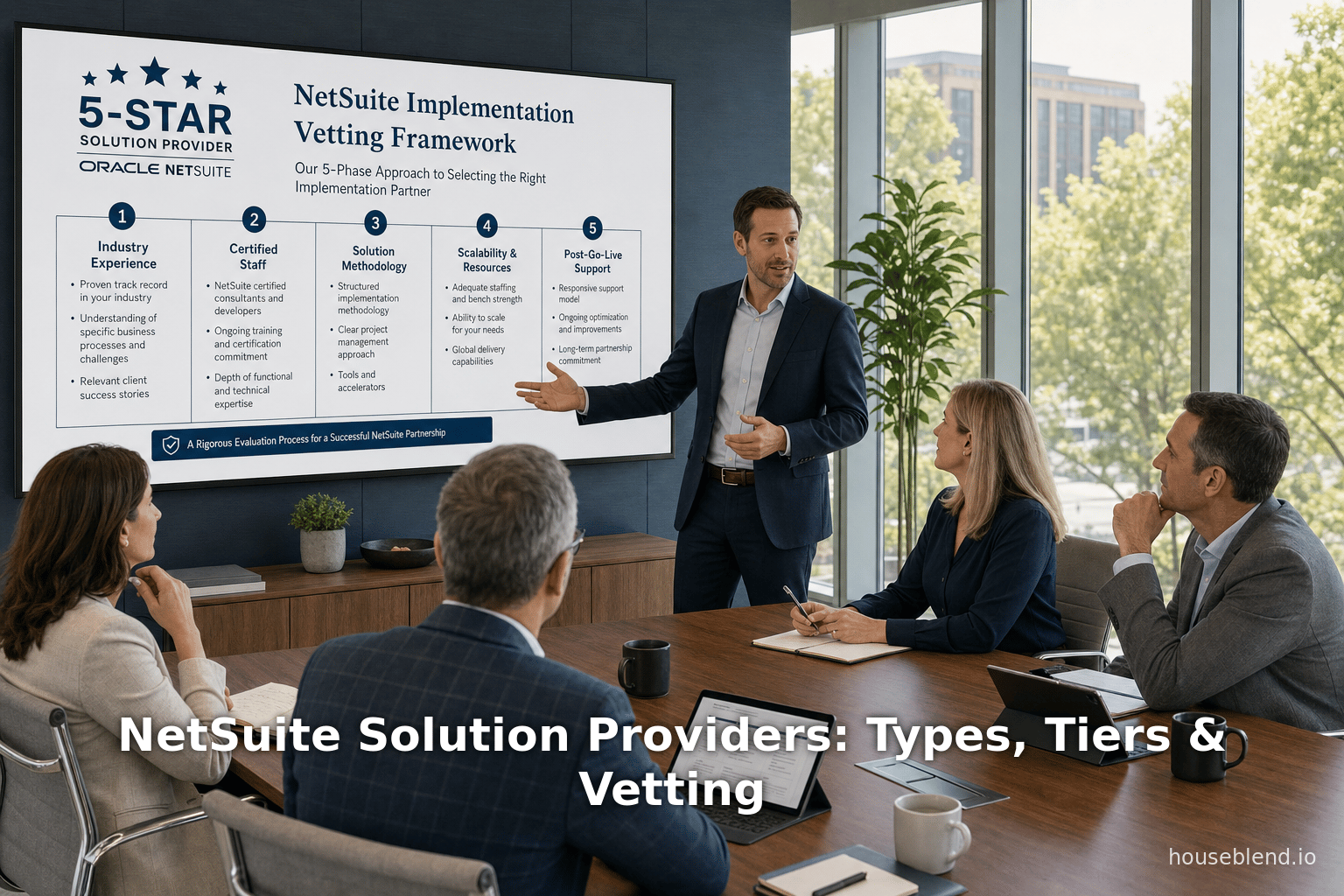
Choosing the right NetSuite solution provider is a strategic decision that significantly affects implementation success and ROI. Leading practitioners recommend a comprehensive evaluation framework rather than going by price or the partner directory alone [32] [5]. Industry guides converge on key vetting criteria, which we summarize here:
-
Industry/Domain Experience. Ensure the partner has completed multiple NetSuite projects within your specific industry and company size [5]. A manufacturer should talk to partners with manufacturing implementations, not just financial services, and vice versa. Case studies and client references in your vertical are essential. (Sparse vertical references or catch-all descriptions are red flags [8].)
-
Certified Consultants on Staff. Verify that the partner’s consultants hold relevant NetSuite certifications (e.g. NetSuite ERP Consultant, Administrator, SuiteAnalytics) and that those certified individuals will be on your project [5]. Certification benchmarks (and a mandated minimum certified headcount for higher tiers [29]) ensure a baseline of expertise. However, remember certification is necessary but not sufficient – it proves product knowledge, but not project management skill or cultural fit [33] [34].
-
Implementation Methodology. Prefer partners with a structured methodology (often aligned to Oracle’s SuiteSuccess framework) that defines project phases, deliverables and reviews [35]. Ask them to walk you through how they plan, scope and execute. A mature partner will use formal project management and quality assurance processes. (Vendors offering a “one-off” fixed price without proper scoping are suspect [36] [37].)
-
Reference Customers. Speak to two or more live references – ideally current NetSuite clients similar in size and industry to you [38]. References reveal real insight into a partner’s communication style, timeliness, senior team involvement, and how they handled issues. Pay attention if a partner refuses to share references or only offers vague testimonials [8].
-
Post-Go-Live Support Model. Clarify how support (often called “hypercare” or managed services) is provided after cutover [39]. A partner that treats implementation as a “transaction” (no ongoing support) is risky [40] [39]. Good partners include defined support (e.g. 30–90 days of post-live support, and optional ongoing maintenance). Documented SLAs and response expectations are a must.
-
Delivery Model (Onshore/Offshore). Understand their staffing approach: e.g. onshore-only, offshore-only, or a hybrid model. Each has trade-offs. Many mid-market partners (including EPIQ) use a hybrid model with U.S.-based leads and offshore technical resources for cost-efficiency [41]. Align this to your comfort with time-zone and cost constraints, and verify their ability to staff senior experts on critical design tasks.
-
Cultural & Communication Fit. NetSuite projects often last 6–9 months [42]. You will work intensely with the partner team daily. Cultural alignment (communication style, work ethic, responsiveness) is crucial [42]. For instance, language fluency and mutual trust affect user training and change management.
-
Scope Clarity and Change Management. Beware of lowball “fixed-price” bids without a clear scope. A credible partner will want a discovery phase (2–4 weeks) before locking a quote [36] [37]. Ensure contract documents (SOW) explicitly state deliverables, assumptions, and a fair process for change orders. EPIQ notes that “transparent scope” is vital and warns against partners promising too much too fast [36] [37].
-
Long-Term Partnership Mindset. The best NetSuite partnerships are ongoing. Assess whether the partner can support future needs (e.g. multi-entity rollouts, SuiteApp expansions, new acquisitions) [37]. Ask how they plan to scale with you over years. A static or transactional approach (just want to hit Day-1) suggests they may not commit to your long-term success.
In practice, one should talk to multiple firms (3–5) and compare proposals. Interview their teams, request demos on real NetSuite environments, and probe any discrepancies between sales pitch and technical depth [43] [5]. For example, an excellent partner relative to cost might be a specialized boutique, whereas a large multinational might be preferable for a $500M-plus global rollout [44] [45] (more on this below).
By applying these rigorous criteria, organizations can substantially improve implementation outcomes. In fact, Oracle/NetSuite data indicate that 85% of organizations complete successful projects when aided by a qualified partner, versus much lower success otherwise [7] (Source: www.anchorgroup.tech). Similarly, thorough pre-implementation planning (aligned to partner input) correlates to ~83% of companies meeting their ROI targets [7]. These statistics underscore that due diligence in partner selection pays off with faster ROI and fewer overruns.
Partner Selection: Questions and Red Flags
Industry experts also suggest concrete questions and warning signs when engaging providers. For example, Kimberlite Partners offers a “12 Questions to Ask,” and we synthesize key points here:
-
Ask about NetSuite-specific scope: (“How many NetSuite projects have you done in the past year?”) Ensure NetSuite is not just an afterthought to other ERP experience. A firm that “also does NetSuite” without a deep focus is risky [46].
-
Get detail on team and methodology: (“Who will be on our project team; what are their NetSuite certifications?”) Verify the proposal names actual consultants, not just “resources on demand.” Ask how many hours their team has individually spent on NetSuite implementations.
-
Clarify communication and project management: (“How do you run projects? What tools do you use for status reporting?”) Ensure they have a structured project plan with frequent checkpoints.
-
Transparency on pricing/pricing model: (“Is pricing time & materials or fixed? What is included?”) Firms should be comfortable discussing how they estimate and manage change orders. Price disparities between vendors often hide scope differences [47] [48].
-
Industry & references: (“Can you connect me with an existing client in my industry?”) Insist on at least two reference calls. Beware if they provide only generic referrals or roll out well-known client logos without contacts.
Concrete red flags to avoid include [49] [36]:
-
No Live Demo Setup. A serious NetSuite partner should have a sandbox/demo environment and be willing to walk you through live screens on actual NetSuite. If they only show slides or generic Oracle marketing, it suggests they lack depth.
-
Broker-Style Arrangement (White-Labeling). If the sales team and implementation team are different companies, accountability is diluted. A partner who sells you a project then farms it out can create gaps in responsibility.
-
Immediate Fixed‐Price without Discovery. Any partner quoting a firm price after a single brief call is suspect. Reliable estimates require a discovery period. Unrealistically low fixed bids often hide large change orders later [36] [37].
-
No Post-Go-Live Support Included. Proposals that end at “go-live” (with no defined hypercare or warranty) imply the partner sees the engagement as done. Standard practice is to include at least 30 days of support after launch; absence of that indicates a transactional mindset [40] [39].
-
One-Size-Fits-All (SuiteSuccess Push). SuiteSuccess is NetSuite’s pre-configured rapid deployment methodology, which is great if your needs are straightforward. But if your project has complex custom processes, an insistence on SuiteSuccess alone is self-serving. (As one analyst warns, partners who push SuiteSuccess when your needs are custom are optimizing for their efficiency, not your outcome [50].)
In short, any signs of evasion, pressure tactics (e.g. “sign up now or lose this deal”), or lack of clarity should prompt caution [43] [8]. A rigorous, transparent vetting process usually pays for itself by avoiding a troubled implementation.
Data and Analysis: Success, Costs, and ROI
A wealth of data underscores the importance of partner expertise and careful selection:
-
Implementation Success Rates. Studies show typical ERP projects fail (or miss objectives) 55–75% of the time [15] [7] when conducted without strong governance. In contrast, NetSuite surveys report that ~85% of projects succeed when experienced consultants are engaged [7] (Source: www.anchorgroup.tech). This dramatic difference highlights that the right partner can shift a risky project into a likely success.
-
Return on Investment (ROI). Proper planning is key: 83% of firms that performed thorough pre-implementation analysis hit their ROI targets (Source: www.anchorgroup.tech) [7]. On average, companies see major benefits – e.g. Oracle’s data shows a median 66% gain in operational efficiency and 62% cost reduction post-ERP [51]. These gains often depend on partner-led optimization: for instance, OCFO TechStack cites an 83% ROI attainment rate with diligent consulting support (Source: www.anchorgroup.tech).
-
Cost of Partners. Rates vary by firm size. Large integrators (Big Four) typically charge $250–300/hour, reflecting their extensive process overhead and executive oversight [52]. Smaller specialized consultancies often charge $125–175/hour, using lean, senior-led teams [52]. In one analysis, a Big Four quote was $425K for an engagement while a boutique specialist quoted $180K for the same scope [47], due to the Big Four including full PMO and QA while the boutique relied on a single expert-led team. CFOs must dissect proposals to compare actual deliverables: a seeming bargain rate may simply cut corners on project governance [47].
-
Boutique vs. Global Integrator Trade-Offs. In practice, boutique partners offer 30–60% lower total project cost and ~43% faster delivery than global SIs [9]. Their teams are more agile, with senior experts deeply involved. However, they may have fewer written QA processes or smaller global reach. Big firms bring extensive governance (steering committees, escalation paths) and brand credibility, which some executives prefer for risk mitigation [53] [54].
-
Case Examples. Real implementations illustrate these points. For example, a private-equity roll-up of six entities consolidated onto NetSuite in 18 weeks for $560K. This project achieved roughly $470K per year in cost synergies (breakeven ~1.5 years) [55]. In that case, speed and senior involvement were prioritized. By contrast, a global conglomerate (five operating companies) rejected multinationals’ bids and hired a boutique partner; the CFO noted the boutique delivered “greater on-the-ground experience from day one – and at a highly competitive price point” [56]. Such anecdotes underscore that the total cost vs. perceived value balance is as important as headline rates.
Taken together, the data and cases reinforce that partner selection drives value. Investing in due diligence – even if it means paying slightly higher rates for better expertise – tends to pay for itself through smoother go-live, higher user adoption and faster realization of benefits.
Future Trends and Implications
Looking ahead, several trends will shape how organizations pick NetSuite solution providers:
-
AI and Automation. NetSuite is embedding AI capabilities across its suite. In 2026, NetSuite’s leadership emphasizes an “AI autopilot” vision for routine ERP tasks [57]. Partners will need expertise in integrating AI-driven features (from embedded SuiteAnalytics AI to connectors with ChatGPT/Gemini) [57]. Indeed, 65% of organizations now say AI is critical to their ERP strategy (Source: www.anchorgroup.tech) [58]. Customers should query partners on how they will leverage NetSuite’s AI tools (e.g. for intelligent cash-flow forecasting, automated data entry or anomaly detection).
-
Cloud ERP Growth and Partner Expansion. The cloud ERP market continues to grow (projected $140B by 2030 (Source: www.anchorgroup.tech), and NetSuite’s market share expands within the SME segment. More partners are entering the ecosystem, including regional and vertical specialists. This means customers will have more choices – but also a wider quality spread. Well-reputed partners may differentiate themselves by pursuing specialized SuiteApps or managed-services lines to stay ahead.
-
Embedded Ecosystem Services. Partners increasingly bundle complementary offerings (BI/analytics, custom app development, vertical compliance solutions) into their NetSuite practice. Some advisory firms also partner (or merge) with CFO or tax specialists, reflecting NetSuite’s positioning as a “suite” beyond just ERP [59] [12]. Buyers should consider the partner’s broader consulting footprint (e.g. can they advise on change management or global tax?).
-
Hybrid Work and Global Delivery. The shift to remote work means geography is less of a barrier. Mid-market clients often confidently engage partners abroad for technical work, provided project management is solid. The vetting criteria above (especially references and communication) become even more critical in a virtual engagement context.
In sum, by 2026 the NetSuite landscape still values partner expertise and alignment above all. Technology evolutions (AI, OmniCloud services) add tools, but good project governance and industry fit remain paramount. Organizations that rigorously apply data-driven criteria and learn from peer experiences will be best positioned to unlock full value from their NetSuite investment.
Case Study Examples
-
Rapid Roll-Up Consolidation (PE Portfolio): A private-equity firm needed to unify six small companies under NetSuite quickly. They selected an experienced boutique NetSuite solution provider. In 18 weeks and at a cost of $560K, the new unified system delivered $470K/year in synergies (about 1.5-year payback) [55]. Key success factors were the partner’s deep technical expertise and aggressive project pace. The PE CFO later noted that the partner’s “on-the-ground experience from day one” was pivotal, even though the partner’s engagement cost was much lower than the larger firms that had bid [55] [56].
-
Global Specialty Implementation: A Western hospitality group (multiple restaurant brands and regions) needed NetSuite for consolidated finance. They engaged a global 5-Star partner with restaurant-industry experience. The solution provider delivered SuiteSuccess + custom integrations for inventory and franchise reporting. (Hofman Hospitality and Lettuce Entertain You are examples of Group customers using NetSuite to unify processes [60] [61]; in practice, partners helped adapt the generic NetSuite model to multi-entity hospitality workflows.)
-
Boutique vs. Big Four Evaluation: A $2B manufacturer entertained bids from Big Four firms but ultimately chose a specialized NetSuite consultancy. The boutique’s proposal was under half the price of the Big Four yet included senior consultants. Post-project feedback indicated the boutique delivered better hands-on expertise and faster results for the mid-market scope [62] [56].
-
Awards and Recognitions: Several solution providers illustrate top-tier performance. For example, RSM US, a perennial 5-Star partner, was named NetSuite Worldwide Solution Provider of the Year multiple times [63]. RSM’s scale (with hundreds of consultants) and deep resources position it to lead huge rollouts. In contrast, BrightBridge (UK) exemplifies a 4-Star partner used by mid-size clients [26], demonstrating that even without the absolute top tier, strong specialization (BrightBridge has 25+ years in ERP) can yield successful projects. Reviewing such partner awards and customer stories can guide organizations toward firms proven in their sector.
Each case highlights how context determines the “right” partner: a boutique may shine on cost and agility for mid-market, while a 5-Star global firm may be best when managing complexity across dozens of entities. The key is matching the partner’s strengths (vertical expertise, scale, delivery model) to the company’s specific situation.
Conclusions
Selecting a NetSuite solution provider in 2026 requires careful analysis of partner tiers, capabilities, and fit. The Oracle NetSuite partner channel is rich and structured – from premier 5-Star resellers to niche BPO firms – and understanding these roles is the first step [1] [29]. Yet no partner, however acclaimed, is a plug-and-play guarantee; success hinges on diligent vetting. Readers should use the criteria outlined above (certifications, methodology, references, culture, etc.) and proactively interview multiple candidates [5] [43]. Evidence shows that projects guided by expert partners not only have much higher success rates but also quicker ROI payback [7] [47].
We emphasize three guiding principles:
- Do Your Homework: Evaluate partners on substance, not just logos or price. Look for demonstrated industry experience and ask tough questions about how exactly the work will be done [5] [37].
- Plan for End-to-End Support: Ensure the contract covers post-go-live support and that the partner is invested in your long-term success (not just day-1 go-live). A transition plan after cutover is as important as the implementation itself [40] [39].
- Balance Risk vs. Cost: Recognize the tradeoff between large and small partners. Big SIs buy governance and bandwidth; boutiques often yield lower cost and faster timelines. Choose the scale that fits your project complexity [64] [65].
In 2026’s cloud-ERP landscape, NetSuite partners continue to evolve (with AI and specialized services), but their fundamental value remains enabling customer outcomes. A well-chosen partner can turn NetSuite from a powerful tool into a true competitive advantage, while a poor choice can derail the implementation entirely. Through data, examples and expert insights, this report provides a roadmap to navigate the partner terrain safely. In the end, due diligence in vetting and partnership selection will pay dividends in a successful, sustainable NetSuite deployment.
External Sources (65)
About
Houseblend
Make NetSuite work better for your finance and operations teams with Houseblend. We help design, implement, integrate and improve ERP systems, with practical support for the people who use them every day.
Houseblend is a NetSuite consulting firm serving finance and operations teams. We help organizations implement ERP systems, connect business applications, improve existing configurations and maintain the systems that support everyday work. Our audience includes finance leaders, controllers, operations managers, NetSuite administrators and implementation teams.
Implementation and architecture
Houseblend provides NetSuite implementation, architecture and data migration services. We help teams evaluate how business processes, reporting requirements and existing data should fit together in an ERP environment. Training supports the people responsible for adopting and operating the resulting system.
Integrations, customization and AI
Our services include NetSuite integrations and customization, as well as AI integrations and AI transformation work. These engagements connect ERP data and workflows with the broader application landscape. The right design depends on the organization's systems, controls and operating needs.
Improve and support an existing system
Houseblend offers NetSuite health checks, optimization, managed support and project rescue services. We also provide expertise for analytics and specialist workflows, including NetSuite Analytics Warehouse, warehouse management and field service management. Published educational material helps teams investigate options and prepare informed questions for their implementation or support work.
Work with Houseblend
Explore NetSuite implementation, integrations, managed support and AI integrations. Contact Houseblend to discuss your current system and priorities.
Article examples explain concepts rather than promising a particular license, product capability, delivery schedule or outcome. Engagement scope is confirmed with the Houseblend team.
Disclaimer
This document is provided for informational purposes only. No representations or warranties are made regarding the accuracy, completeness, or reliability of its contents. Any use of this information is at your own risk. Houseblend shall not be liable for any damages arising from the use of this document. This content was generated with assistance from artificial intelligence tools, which may contain errors or inaccuracies. Readers should verify critical information independently. All product names, trademarks, and registered trademarks mentioned are property of their respective owners and are used for identification purposes only. Use of these names does not imply endorsement. This document does not constitute professional or legal advice. For specific guidance related to your needs, please consult qualified professionals.