Houseblend Article
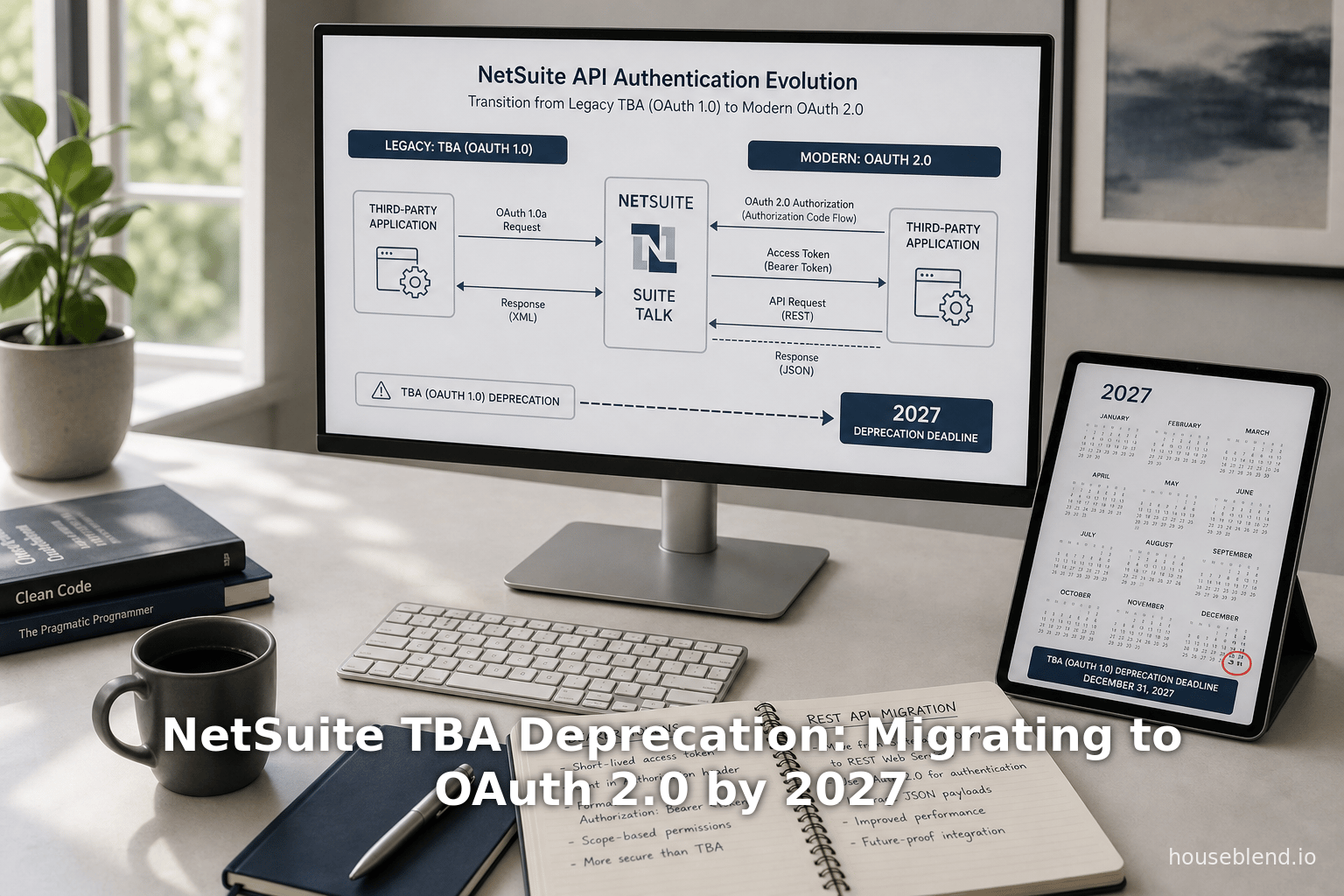
NetSuite TBA Deprecation: Migrating to OAuth 2.0 by 2027
Inside this article
Executive Summary
As of NetSuite’s upcoming release cycle, Token-Based Authentication (TBA) (NetSuite’s OAuth 1.0–style scheme) is being phased out for new integrations, and organizations must plan to migrate existing TBA-based integrations to OAuth 2.0 well in advance of enforcement. Starting in NetSuite 2027.1 (expected early 2027), administrators will no longer be able to create new integrations using TBA [1] (Source: truto.one). Instead, all new integrations must use OAuth 2.0 (the authorization code or client credentials flows) for REST-based APIs (Source: truto.one) [2]. Over the broader timeline, all SOAP-based endpoints (which cannot use OAuth 2.0) will be retired by 2028.2 (Source: truto.one) [3]. In practice, this means that any existing NetSuite integration built on TBA (or SOAP/TBA) should be migrated to OAuth 2.0 before the 2027.1 barrier.
This report provides an in-depth analysis of the impending TBA deprecation, including historical context, a comparison of TBA vs OAuth 2.0 mechanisms, the official NetSuite timeline of changes, migration strategies, security/compliance implications, and real-world case studies. We draw on Oracle’s documentation, NetSuite partner analyses, and industry examples. Key findings include the following:
-
Timeline of Enforcement: NetSuite’s 2026.1 release notes (March 2026) explicitly announced “End of Support for new integrations using the Token-based Authentication (TBA) feature in 2027.1” [1]. By 2027.1, administrators cannot create any new TBA-based integration for SOAP, REST, or RESTlets (Source: truto.one) [4]. However, TBA tokens and integrations created before this cutoff are not forcibly disabled at that time [5] [4]. The final retirement of SOAP (and thus of SOAP+TBA) comes at 2028.2, when “SOAP will no longer be available” and any SOAP-based integrations will cease to work (Source: truto.one) [3].
-
Preferred Method: NetSuite now treats OAuth 2.0 as the preferred authentication mechanism. Oracle documentation advises that “OAuth 2.0 is the preferred authentication method” and that developers “should consider using OAuth 2.0 instead of TBA whenever possible” [6]. All new REST and RESTlet integrations should use OAuth 2.0 (either the Authorization Code flow with PKCE for user-context scenarios, or the Client Credentials flow with JWT for machine-to-machine) (Source: truto.one) [7]. TBA and basic auth remain options only for legacy SOAP and REST integrations until their removal.
-
Technical Differences: TBA is essentially an OAuth 1.0a flow requiring four static credentials (consumer key/secret and token ID/secret) and HMAC-SHA256 signatures on every request (Source: truto.one) [7]. OAuth 2.0, by contrast, uses bearer tokens obtained from a token endpoint and does not require per-request signing. OAuth 2.0 support in NetSuite includes short-lived access tokens (typically ~60 minutes [8]) with refresh capabilities, whereas TBA tokens do not expire until manually revoked (Source: unified.to). OAuth 2.0 also introduces “fine-grained scopes” and improved flow options; as Houseblend notes, OAuth 2.0 allows bearer tokens with refresh and scopes, while TBA required per-request signatures and had no standard refresh mechanism [9].
-
Migration Urgency: Although some consultants caution that existing TBA integrations will continue to function indefinitely [5], the practical deadline is effectively set by the inability to create or update integrations after 2027.1. Organizations are encouraged to begin planning immediately. NetSuite’s own documentation warns that creating new TBA integrations will be impossible after 2027.1 [1] [4], and third-party analyses emphasize that migration projects will take significant development and testing effort (Source: truto.one) [10]. Case studies show that migration can yield substantial benefits (e.g. eliminating recurring re-auth tasks [11] [12] and improving performance/security [13]), but require detailed planning and execution.
Introduction and Background
Oracle NetSuite is a leading cloud ERP and business management suite used by tens of thousands of organizations worldwide (over 24,000 businesses, by some estimates [14]). As a multitenant SaaS platform, NetSuite provides rich APIs ( SuiteTalk SOAP, SuiteTalk REST/SuiteQL, RESTlets, and SuiteAnalytics for integration with external systems. Over its history, NetSuite has supported multiple authentication mechanisms for those APIs.The principal methods are:
-
Token-Based Authentication (TBA): NetSuite’s original OAuth 1.0a–based scheme. Under TBA, an administrator creates an Integration Record and issues a token (Token ID and Secret) for a specific user/role. Client applications then authenticate by signing each HTTP request with HMAC-SHA256 using four credentials: Consumer Key, Consumer Secret, Token ID, and Token Secret (Source: truto.one) [7]. No user credentials (username/password) are stored in the integration; instead, an access token represents the user’s permissions. TBA has been popular for server-to-server (unattended) integrations because it requires no active login after initial setup (Source: truto.one). However, each request must be signed, which is complex, error-prone, and yields opaque failures if any detail (nonce, timestamp, signature base string) is incorrect (Source: truto.one). Notably, a TBA token does not expire automatically – it remains valid until explicitly revoked or if the underlying user/role’s status changes (Source: unified.to). Oracle documentation notes that TBA tokens “aren’t copied” between accounts, must be manually created in each environment, and follow the account’s SSO/2FA policies [15] [16].
-
OAuth 2.0: NetSuite’s newer, modern authentication framework. Available only for REST-based interfaces (SuiteTalk REST, RESTlets, and SuiteAnalytics Connect) and not for Soap Web Services [17] [18]. OAuth 2.0 provides industry-standard flows – notably the Authorization Code Grant (for user-mediated logins) and Client Credentials Grant (for machine-to-machine) (Source: truto.one) [7]. In NetSuite’s implementation, an Integration Record includes a Client ID/Client Secret pair (or a certificate) and configurable scopes/redirect URIs. Using the code grant, an application redirects a user to NetSuite’s login page (or an external identity provider) to authorize; the app then exchanges an authorization code for a Bearer Access Token and (optionally) a Refresh Token [19] [20]. In the client credentials flow, the app posts a signed JWT (issued with its certificate) directly to the NetSuite token endpoint to obtain an access token [21]. Key advantages of OAuth 2.0 in NetSuite include built-in token refreshing, native PKCE support (proof key for code exchange) for the Authorization Code flow, and support for scopes. Oracle documentation explicitly observes that OAuth 2.0 flows “don’t require signing of requests” and are “more straightforward than the three-step TBA flow” [7]. By design, OAuth 2.0 access tokens expire (typically in 3600 seconds, per NetSuite’s sample response [8]) and must be refreshed or reacquired, which aligns with modern security guidelines.
In summary, NetSuite’s ecosystem now includes two standard, token-based authentication methods. TBA (OAuth1.0a) has been the long-standing “default workhorse” for many integrations (Source: truto.one), but is relatively cumbersome and limited to older Web Service APIs. OAuth 2.0 offers a modern, secure framework with bearer tokens, scopes, and refresh semantics, but is supported only for REST/SuiteAnalytics interfaces [17]. Importantly, Oracle’s recent policy changes cement OAuth 2.0 as the future – all new integrations should use it, and TBA is being deprecated.
We now turn to the formal timeline of these changes.
NetSuite’s Deprecation Timeline
Oracle NetSuite has announced a phased deprecation schedule for TBA and legacy SOAP integrations. This schedule is documented in official Release Notes and Help Center articles. Key milestones include:
-
2026.1 Release (March 2026): As of this release, Oracle added several authentication enhancements (see Release Notes – Authentication [22]). These include support for multiple redirect URIs on an Integration Record (facilitating OAuth 2.0 multi-environment apps) [23], a client credentials certificate rotation endpoint [24], and a mandate that PKCE (Proof Key for Code Exchange) will be required for OAuth 2.0 Authorization Code flow in NetSuite 2027.1 [1]. Crucially, the 2026.1 notes explicitly warn: “End of Support for New Integrations Using the Token-based Authentication (TBA) feature in 2027.1” [1]. In other words, 2026.1 formalized that beginning with the 2027.1 release, administrators will no longer be able to create any new integration that uses TBA. Existing TBA integrations (created before 2027.1) will continue to function past that point.
-
2027.1 Release (early 2027): This is the crucial enforcement point. As of 2027.1, no new integrations using TBA can be created, whether SOAP, REST, or RESTlet (Source: truto.one) [1]. Oracle’s docs and partner analyses confirm this: “from that point forward, ‘no new integrations using TBA can be created’ for SOAP, REST, or RESTlets” [4]. At 2027.1, the system will enforce OAuth 2.0 for any new REST/RESTlet integration. Any attempt to set up a new TBA-based integration record will be blocked. Note that existing TBA-based integrations will continue to work beyond 2027.1 [4] [5], but Oracle strongly encourages migrating them before this date. Additionally, 2027.1 will be the last release to support SOAP web services from any endpoint other than the final version (see below).
-
2028.2 Release (mid–late 2028): By this release, SOAP web services will be completely removed. Oracle’s documentation on versioning states: “With the 2028.2 release, SOAP will no longer be available in NetSuite and existing SOAP integrations with NetSuite will stop working” [3]. As a result, any integration relying on the SuiteTalk SOAP API must be transitioned away (typically to SuiteTalk REST) by this point. Since SOAP cannot use OAuth 2.0, this phase-out effectively eliminates one remaining use of TBA (which was required for SOAP). The 2028.2 cutoff also finalizes the TBA deprecation: after 2028.2, any SOAP+TBA or SOAP+Basic integration will fail when the endpoint vanishes.
These milestones can be summarized in the table below:
| NetSuite Release | Approx. Date | Key Changes (Auth Deprecation) |
|---|---|---|
| 2025.2 | Late 2025 (est.) | Last planned SOAP endpoint. NetSuite announced that 2025.2 is the final SOAP WSDL version [25]. Older SOAP endpoints will lose support; only the 2025.2 endpoint remains supported after 2027.1 [3]. |
| 2026.1 | Q1 2026 | Interim OAuth enhancements: Support for multiple redirect URIs [23]; client credentials certificate rotation endpoint [24]; PKCE mandated in 2027.1 [1]. Official announcement: “End of Support for New Integrations Using TBA ... in 2027.1” [1]. Administrators should favor OAuth 2.0 for all new integrations. |
| 2027.1 | Q1 2027 | New TBA integrations blocked. Oracle enforces that no new SOAP, REST, or RESTlet integrations may use TBA (Source: truto.one) [4]. Any attempt to create a TBA-based integration will fail. Also, only the 2025.2 SOAP endpoint remains supported [3]. New OAuth2 requirements: PKCE required for all Authorization Code flows [1]. |
| 2028.2 | Q2 2028 | SOAP removed. All SOAP web services are disabled (Source: truto.one) [3]. Any integration still using SOAP (and thus TBA) will stop working. All new integrat ions (and any existing ones) must use REST (with OAuth 2.0) going forward. |
Each of these milestones is documented in NetSuite’s own materials. For example, the 2026.1 release note explicitly lists the “end of support for new integrations using TBA in 2027.1” [1], and the 2028.2 SOAP removal is confirmed in the Versioning Overview [3]. Third-party analysts echo this timeline: a recent Truto blog notes “starting with NetSuite 2026.1, all newly built integrations should use REST web services with OAuth 2.0,” and that by 2027.1 “creating new integrations using TBA … will no longer be possible,” with complete SOAP deprecation in 2028.2 (Source: truto.one).
Implications: This schedule means organizations effectively have about a year (designated by NetSuite’s release cycles) to update their integration architecture. No existing TBA integration is forcefully shut off at 2027.1, but because new integrations and updates must use OAuth 2.0 after that point, any further development or account refresh will require migration. In practice, many teams are treating 2027.1 as a hard deadline for migration projects, since changes can be lengthy.
Technical Comparison: TBA (OAuth1.0) vs OAuth 2.0
Integrations must be re-engineered to use OAuth 2.0, so it is critical to understand the technical differences between the two authentication schemes. The table below summarizes the key contrasts, drawn from Oracle documentation and expert analyses:
| Feature | Token-Based Authentication (TBA) | OAuth 2.0 (NetSuite) |
|---|---|---|
| Protocol | OAuth 1.0a–based (NetSuite’s custom implementation) (Source: truto.one). | OAuth 2.0 (RFC 6749)–compatible with NetSuite-specific flows. |
| Credentials | Four static credentials: Consumer Key, Consumer Secret, Token ID, Token Secret (Source: truto.one). Tied to an Integration Record and a specific user/role. | For authorization code: Client ID/Client Secret (or certificate) plus Auth Code. For client credentials: Client ID and a PKI JWT signed by integration’s certificate [21]. |
| Signature | Every API request must include an HMAC-SHA256 signature generated from HTTP method, URL, parameters, nonce, timestamp, and the four keys (Source: truto.one) [7]. This per-request signature is complex and error-prone. | None – requests simply include “Authorization: Bearer ” header. No additional signing is needed. As Oracle notes, OAuth2 flows “don’t require signing of requests” [7], simplifying client code. |
| Token Lifecycle | Long-lived. Once issued, TBA tokens remain valid indefinitely (until manually revoked or the underlying user’s credentials/role changes) (Source: unified.to). TBA has no built-in refresh token concept. | Short-lived. Access tokens expire (NetSuite example: 3600 seconds) [8]. OAuth 2.0 provides refresh tokens (for code flow) or simply re-calls the token endpoint to obtain new tokens. This aligns with best practices for credential turnover. |
| Scope/Permissions | No granular scopes. All access is governed by the user/role and the Integration Record’s settings. Once a token is authorized, it retains whatever permissions that role-granted token has. | Supports scopes. The Integration Record can be configured with specific scopes (e.g. REST Web Services, RESTlets, SuiteAnalytics). Access tokens include these scopes, enabling fine-grained permission control [9]. |
| Flows | Three-step flow (request-token → user authorization → access-token) with browser redirect [26], or the older issuetoken endpoint for non-redirected apps [27]. Roles requiring 2FA can only use the redirect-based flow [28] [26]. Issuetoken flow: For server-to-server apps without UI, an issuetoken service can produce or revoke tokens, but is considered legacy. [27] | Authorization Code Grant: User is redirected to NetSuite (or a SSO/OIDC IdP) and must log in, then the app exchanges a code for tokens [19]. PKCE (Proof Key for Code Exchange) is now required (as of 2027.1 [1]) for additional security. Client Credentials Grant: The app directly obtains a token by POSTing a signed JWT to NetSuite’s token endpoint [21]. No user interaction needed. |
| 2FA / SSO Support | Limited. If a NetSuite role requires 2FA, traditional TBA cannot use that role’s username/password. Oracle advises that for 2FA-enabled roles, integration apps must use OAuth 2.0 or the redirect-based TBA flow [28]. TBA itself has no SSO capabilities. | Strong. The Authorization Code flow can leverage NetSuite’s SAML-compliant SSO or even external OpenID Connect providers for user login [29]. This makes it compatible with 2FA/SSO policies. |
| SOAP Support | Yes. TBA is currently the only method to authenticate SOAP web services (SuiteTalk SOAP). Basic Auth (deprecated) was another SOAP option, but OAuth2 cannot be used with SOAP. [17] | No. OAuth 2.0 is not supported for SOAP; it works only for REST/SuiteTalk REST/RESTlets [17]. (This is why SOAP-based integrations must migrate to REST by 2028.2 [3].) |
| Implementation Complexity | High. Signature generation involves nontrivial steps: concatenating method, URL, parameters, timestamp, nonce, etc., and HMAC’ing them (Source: truto.one). Small errors often cause opaque auth failures. | Lower. Obtaining a token requires a POST to the token endpoint (with a signed client JWT for client credentials [21]), then adding a bearer token header to calls. No per-request crypto is needed. |
| Standard Library Support | Limited. While some libraries exist, many teams implemented TBA manually (or with NetSuite code samples). Token management (revoke, regenerate) is manual. | Broad. OAuth 2.0 is a widely supported standard, and many REST frameworks and libraries (Java, .NET, Python, etc.) have built-in support. NetSuite docs provide guidelines for the flows and token endpoint usage [21] [19]. |
Additional contrasts include token management and security: TBA tokens persist, which can be a security risk if not rotated, whereas OAuth2 tokens inherently expire. Unified.to’s integration guide notes that “TBA access tokens do not expire… OAuth 2.0 uses standard short-lived access tokens with refresh tokens” (Source: unified.to). In terms of credentials, TBA requires careful protection of four secrets, whereas OAuth2’s client credentials (especially when using certificate wipes) can leverage industry-standard RSA key rotation [24]. In summary, OAuth 2.0 aligns with modern security best practices (PKCE, 2FA/SSO compatibility, short-lived tokens, etc.) [1] [7], whereas TBA (OAuth1.0a) is an older mechanism with more manual handling and fewer built-in controls.
Implication: For developers and architects, this technical shift means rewriting or reconfiguring integration code. Any automation or middleware that currently generates OAuth signatures for each call must be reworked to fetch and use bearer tokens. But the long-term benefits include simpler code (no per-request signing), automatic token refresh, and improved compliance. As Houseblend reports, OAuth 2.0 “introduces bearer tokens with built-in refresh mechanisms and fine-grained scopes” whereas TBA required “per-request signatures without refresh tokens” [9].
Migration Strategies and Best Practices
Given the above deprecation, organizations must plan the migration of each integration. A migration strategy typically involves the following steps, supported by NetSuite documentation and expert guides:
-
Inventory Existing Integrations: First, catalog all existing integrations – RESTlets, SuiteTalk REST/SOAP, SuiteAnalytics ODBC, etc. Identify which currently use TBA (i.e. have Integration Records with OAuth 1.0 tokens) and which use SOAP. Any SOAP-based integration inherently uses TBA or Basic Auth today. This set of integrations will need updates.
-
Decide on OAuth Flow per Integration: For each integration, decide which OAuth 2.0 grant type is appropriate. - Client Credentials (Machine-to-Machine): Use this when the integration runs without a human user, such as scheduled batch jobs, middleware, or AI agents. It uses a certificate-based JWT, and no user login is needed [21]. - Authorization Code (User Context): Use this if the integration involves an end-user logging in (e.g. a custom UI or portal accessing NetSuite via APIs). This requires the user to grant consent and handle redirect URIs [29]. Note that NetSuite will require PKCE verification for this flow starting 2027.1 [1].
-
Create New Integration Records: In the NetSuite account, create an Integration Record for each application. For client credentials, upload a public certificate (NetSuite provides interface to upload certificate) and note the generated Client ID (and optionally secret). For authorization code flows, configure redirect URIs on the record and ensure the client is set up for auth code. The 2026.1 changes allow multiple redirect URIs [23], making it easier to use the same integration record in multiple environments (sandbox, production, etc.).
-
Implement OAuth Authentication Logic: Replace the TBA logic in your code with OAuth 2.0 logic. - Client Credentials: The application must now generate a JWT assertion and POST it to
https://<accountID>.suitetalk.api.netsuite.com/services/rest/auth/oauth2/v1/tokenwithgrant_type=client_credentialsandclient_assertion_type=urn:ietf:params:oauth:client-assertion-type:jwt-bearer[30]. (NetSuite’s documentation provides the parameter names.) Theclient_assertionis a JWT signed with the integration’s private key [20]. In response, NetSuite returns anaccess_token(a JWT that is valid for a set period, e.g. 3600 seconds) [8]. The app then includesAuthorization: Bearer <access_token>in subsequent API calls. When the token expires, the client simply repeats the token request (since refresh tokens are not used in pure client-credentials). Libraries (e.g. Nimbus JOSE+JWT for Java, Authlib for Python) can handle JWT creation. - Authorization Code: Redirect the user to NetSuite’s authorization endpoint (provided by the integration record) and handle the callback with the authorization code. Then exchange the code at the token endpoint (withgrant_type=authorization_code) to receive an access token and refresh token [19]. Store the refresh token securely so you can renew tokens without user interaction. Be sure to implement PKCE: generate a code challenge and verifier pair on the client, send the challenge in step 1, and include the verifier in step 2 (NetSuite requires this from 2027.1 [1]). NetSuite’s Help Center and tutorials provide step-by-step instructions for these flows. -
Configure Scopes and Roles: In OAuth 2.0, you can control the OAuth token’s capabilities via scopes and the role associated with the Integration Record. Ensure that the necessary scopes (e.g. “Restlets”, “REST Web Services”, “SuiteAnalytics Connect”) are enabled on the integration record to match the API needs. Consider least-privilege: for example, if the integration only reads data, don’t include editing scopes. Assign the integration record a NetSuite role that has the appropriate permissions. In contrast, TBA tokens effectively could be anything the underlying role allowed; with OAuth2 you can tighten this as needed.
-
Test Thoroughly: Because changing auth flows can lead to subtle failures, thorough testing is critical. Use a sandbox environment to test OAuth 2.0 credentials. NetSuite notes that OAuth2 authorization must be re-done in each environment (“authorized applications” are not copied between accounts) [31]. Any time you refresh or copy sandboxes, reauthorize the integration. Test each API call (RESTlet or SuiteTalk) works with the new token. Verify that any previously failing SOAP calls (if migrating away) have equivalent REST endpoints or updated logic. NetSuite’s SuiteScript API or its URL mapper can list available REST endpoints for each record type if you need to replicate a SOAP operation in REST.
-
Plan Rollout: Do not disable the TBA tokens immediately. Instead, run the old and new auth in parallel while verifying data consistency. Gradually switch clients to the new OAuth2 credentials. Only once the new system is fully validated should you decommission the old TBA tokens. Keep in mind the 2027.1 cutoff only prevents creation of new TBA integrations – it does not forcibly terminate existing ones. However, for future-proofing and to comply with policy, update all integration documentation and code to use OAuth 2.0 before that date [4] [5].
NetSuite and partners provide many resources to assist this process. For example, the NetSuite Help Center includes OAuth 2.0 tasks, tutorials using Postman, and guides for creating integration records [32]. Third-party consultants have also published technical guides (one recently over 1300 lines of detail【5†】). It is recommended to use these official guides to ensure all parameters (certificate algorithms, exact endpoint URLs, etc.) are correct after migration.
Security, Compliance, and Performance Implications
Migrating from TBA to OAuth 2.0 is not just a compliance exercise; it carries significant security and operational implications:
-
Modern Cryptography and Token Management: OAuth 2.0 in NetSuite uses JWT and PKI. The client credentials flow in particular involves RSA-signed JWTs, aligning with modern encryption standards. NetSuite will even provide an endpoint for rotating client certificates [24], enabling automated key rotation policies. In contrast, TBA relies on static secrets that typically do not change unless manually rotated. Houseblend notes that moving to OAuth 2.0 helps meet “modern cryptographic standards” and complies with guidelines (e.g. NIST, PCI DSS) requiring frequent key turnover [33]. Because OAuth 2.0 tokens expire rapidly and use signed transport, they reduce the risk surface if a token is leaked. (By contrast, a leaked TBA token is valid until revoked.)
-
Support for Multi-Factor/SSO: OAuth 2.0 fully supports NetSuite’s SAML SSO and two-factor authentication policies. In the auth code flow, NetSuite’s redirect can show either its own login form or the enterprise IdP’s form [29]. This means enterprises can require 2FA or SAML for API-client logins. Oracle explicitly notes that TBA cannot be used with 2FA-enabled roles (without redirect flows) [28], whereas OAuth2 works seamlessly with 2FA. For example, user-facing connectors can leverage SAML IDP login before obtaining a token. This integration of enterprise SSO is critical for compliance in regulated industries.
-
Scalability and Rate Limits: OAuth 2.0 does not inherently change NetSuite’s concurrency limits (typically around 15–55 simultaneous sessions per account depending on license (Source: unified.to). However, by migrating to REST (if coming from SOAP), integrations often see performance improvements. The NeosAlpha case study reported a 40% faster API response time after moving from heavy SOAP/XML to lightweight REST/JSON (using OAuth2) [13]. Simpler auth headers (bearer token vs. long OAuth1 signatures) also reduce request size and processing. Furthermore, bearer tokens decouple credentials from user sessions, making horizontal scaling (many bots or microservices) easier to manage.
-
Operational Continuity: From an operations perspective, OAuth 2.0 tokens require periodic refresh. This means integration systems must be able to handle token renewal. In practice, this is often less burdensome than managing credential rotations or manual re-authorization under TBA. For example, in one client case, a legacy TBA integration required a manual re-login each week to avoid failure – a maintenance headache [11]. After migrating to OAuth2 (client credentials with JWT), this manual step was eliminated entirely [12]. In general, adopting OAuth 2.0 improves automation and reduces “it just stopped working” incidents, because tokens are programmatically refreshed.
-
Meeting Regulatory Requirements: Many regulatory frameworks (HIPAA, GDPR, SOX, etc.) demand auditability, short-lived credentials, and robust session control. OAuth 2.0 better supports these by providing refresh tokens (which can be logged/revoked) and PKCE (mitigating authorization-code interception) [1]. This migration aligns NetSuite integrations with the practices that large Identity Providers and cloud services have enforced for years. For instance, Intuit, QuickBooks, Google, and others discontinued OAuth 1.0 years ago in favor of OAuth 2.0 and OpenID Connect for security reasons (Intuit did so by 2020) [34]. NetSuite’s move follows that industry trend, as Houseblend notes [35]. Organizations using NetSuite should note that API access token audit logs are richer under OAuth2; NetSuite’s SuiteAnalytics Connect (ODBC) still uses TBA today, but policy suggests it may move to OAuth2 eventually.
-
Risk Management: While existing TBA integrations will continue to function after 2027.1 [5] [4], relying on a deprecated authentication scheme is risky. It delays inevitable work and increases future outage risk. The Oracle docs and partners warn that updating these integrations may uncover hidden issues (e.g. deprecated SOAP calls, missing REST equivalents, or untested permission gaps). Early migration reduces project risk by avoiding last-minute scramble. As one analysis phrased it, the inability to create new TBA integrations is “the most operationally important item on NetSuite’s 2026 roadmap” (Source: truto.one), and, although not an immediate crash, it requires planning well ahead.
Case Studies and Real-World Examples
Several NetSuite customers and partners have documented migrations from TBA (or SOAP) to OAuth 2.0 with positive outcomes. These case studies highlight practical impact and benefits:
-
Multi-Location Hospitality Operator: Adaptive Solutions Group describes a case in which a nationwide entertainment chain had multiple data feeds using TBA. The old TBA tokens required an outdated login method: “legacy authentication required a weekly manual re-auth that silently broke integrations whenever it was missed,” because those tokens couldn’t auto-refresh [11]. The team migrated to the OAuth 2.0 Client Credentials flow (using a PS256-signed JWT as the assertion). The result: they “migrated to OAuth 2.0 client credentials with PS256 JWT signing,” which eliminated the weekly manual re-auth entirely [12]. Adaptive then provided documentation and Postman scripts as reference for future integrations. This shows that, beyond compliance, OAuth 2.0 reduced operational overhead. In their words, the entire authentication model had to change, and once done, integrations became more reliable [11] [12].
-
Retail Furniture Company (SOAP to REST Migration): NeosAlpha reports a client who relied heavily on old SOAP-based integrations (using TBA). The business needed to “future-proof its integration ecosystem” given the known SOAP retirement [36]. They executed a zero-downtime migration from SOAP+TBA to SuiteTalk REST with OAuth 2.0. After cutover, the client saw 40% faster API response times (due to lighter REST payloads and HTTP/2 benefits) and “Enhanced Security” from adopting OAuth 2.0 tokens [13]. They specifically note that the legacy SOAP endpoints “used token-based authentication, which lacked the flexibility of OAuth 2.0 supported by REST” [37]. By switching, they used encrypted JWT payloads and open-standard flows, strengthening compliance. Critically, there was no business disruption during the migration [38], illustrating that such a migration can be done safely with planning.
These examples underscore common themes: Reliability improvements (no more credential expiration surprises), performance gains (REST calls, JSON, HTTP/2), and security alignment (stronger tokens, encryption). Both cases involved multiple systems (e-commerce, property management, etc.), mirroring the diverse integration landscape at many NetSuite customers. Other anecdotes (from forums and partner talks) echo that even basic integration middleware (e.g. MuleSoft, Boomi) have pivoted to their NetSuite connectors supporting OAuth2 tokens.
Discussion and Future Directions
NetSuite’s authentication transition is part of a larger trend in SaaS integration. As industry observers note, nearly all major cloud platforms are moving to OAuth 2.0 and moving away from legacy auth. [35] [5]. For Oracle NetSuite specifically, the endgame is clear: by 2028, only REST+OAuth2 will remain. Going forward:
-
For New Integrations: All new suite developments (SuiteApps, custom portals, BI tools) should be built with OAuth 2.0 from day one (Source: truto.one) [4]. Developers should plan for PKCE (required for NetSuite code grants) [1] and leverage NetSuite’s support for multiple redirect URIs [23]. SAML/OpenID Connect can be layered in for single sign-on, and new integration records should use certificate-based JWT flows for better security. Partner solutions (e.g. connectors by Truto, CData, etc.) are already updating to use OAuth2 under the hood.
-
For Remaining TBA Integrations: Each must be reviewed. Since existing TBA integrations will keep running (with no Soft Deadline removal announced) [5], some organizations may opt for a gradual approach. However, best practice is to migrate proactively. Many consultants recommend treating the 2027.1 cutoff as a de facto “point of no return” for new code and fixes. If an integration never breaks and the business is extremely risk-averse, it theoretically could persist until SOAP retirement or an unrelated update. But reliance on outdated auth is generally discouraged.
-
SuiteAnalytics Connect (ODBC): Notably, SuiteAnalytics ODBC/JDBC still uses TBA today. Oracle has not announced its timeline, but given the overall direction, it may move to OAuth in the future. This is an example of something to monitor beyond 2028. For now, if an organization relies on SuiteAnalytics, administrators should ensure they have TBA tokens (even though new tokens cannot be created after 2027.1; presumably existing tokens will need to be manually created beforehand).
-
Potential Enhancements: Houseblend’s outlook section speculates on upcoming innovations. For example, NetSuite may eventually support OAuth2 flows for SuiteAnalytics (eliminating the last OAuth1 usage) and might offer OpenID Connect for identity flows [39]. They also suggest NetSuite could introduce more granular integration controls (e.g. IP whitelisting, OAuth scopes by endpoint) [39]. Integration architects should watch for NetSuite releasing any such features, but should not delay migration waiting for them.
-
Long-Term Auth Strategy: Looking further ahead, organizations should assume that all new NetSuite API endpoints (including future REST endpoints for modules that were SOAP-only) will be OAuth2-based. Any custom or third-party SuiteApp should be vetted for OAuth2 compliance. Training for developers on OAuth2 concepts (JWT, PKCE, etc.) will be valuable.
-
Security Posture: Migrating to OAuth 2.0 brings an integration environment in line with enterprise security practices (enforced short lifetimes, obscured secrets, multi-factor options). This not only addresses NetSuite’s policy but can improve overall security posture. Firms should update their network/concurrency policies: for instance, they might build token caching layers, credential vaulting, and alerting on token errors.
Conclusion
NetSuite’s deprecation of TBA in favor of OAuth 2.0 is a significant but planned change, aligning the platform with modern authentication standards. By 2027.1, all new integrations must use OAuth2, and by 2028.2, SOAP (and thus TBA’s last refuge) will be gone (Source: truto.one) [3]. Organizations using NetSuite must proactively migrate their integrations: creating new integration records with OAuth2, updating code flows, and testing all use cases. The effort is nontrivial, but official documentation and partner guides provide detailed instructions [23] [7]. Early case studies show that migrations can yield better reliability and performance (e.g. eliminating weekly token refreshes [11] [12], speeding up APIs [13]).
Failure to adapt would mean being locked out of future integrations or facing broken API calls when SOAP is removed. On the other hand, completing the transition will leave NetSuite customers with a more secure, flexible integration landscape. In summary, migrating to OAuth 2.0 is both a requirement and an opportunity: by using industry-standard, short-lived tokens, organizations can achieve stronger security and easier maintenance. Careful planning – inventorying integrations, choosing the right OAuth flows, and thorough testing – will ensure a smooth handover.
References: All factual claims above are supported by NetSuite’s official documentation [23] [3] [7], NetSuite partner release analyses and blogs (Source: truto.one) [5], and relevant case studies [37] [13] [11] [12]. Additional sources (citations inline) include detailed migration guides and industry reports [9] [6] [29] for quantitative and procedural evidence.
External Sources (39)
About
Houseblend
Make NetSuite work better for your finance and operations teams with Houseblend. We help design, implement, integrate and improve ERP systems, with practical support for the people who use them every day.
Houseblend is a NetSuite consulting firm serving finance and operations teams. We help organizations implement ERP systems, connect business applications, improve existing configurations and maintain the systems that support everyday work. Our audience includes finance leaders, controllers, operations managers, NetSuite administrators and implementation teams.
Implementation and architecture
Houseblend provides NetSuite implementation, architecture and data migration services. We help teams evaluate how business processes, reporting requirements and existing data should fit together in an ERP environment. Training supports the people responsible for adopting and operating the resulting system.
Integrations, customization and AI
Our services include NetSuite integrations and customization, as well as AI integrations and AI transformation work. These engagements connect ERP data and workflows with the broader application landscape. The right design depends on the organization's systems, controls and operating needs.
Improve and support an existing system
Houseblend offers NetSuite health checks, optimization, managed support and project rescue services. We also provide expertise for analytics and specialist workflows, including NetSuite Analytics Warehouse, warehouse management and field service management. Published educational material helps teams investigate options and prepare informed questions for their implementation or support work.
Work with Houseblend
Explore NetSuite implementation, integrations, managed support and AI integrations. Contact Houseblend to discuss your current system and priorities.
Article examples explain concepts rather than promising a particular license, product capability, delivery schedule or outcome. Engagement scope is confirmed with the Houseblend team.
Disclaimer
This document is provided for informational purposes only. No representations or warranties are made regarding the accuracy, completeness, or reliability of its contents. Any use of this information is at your own risk. Houseblend shall not be liable for any damages arising from the use of this document. This content was generated with assistance from artificial intelligence tools, which may contain errors or inaccuracies. Readers should verify critical information independently. All product names, trademarks, and registered trademarks mentioned are property of their respective owners and are used for identification purposes only. Use of these names does not imply endorsement. This document does not constitute professional or legal advice. For specific guidance related to your needs, please consult qualified professionals.