Houseblend Article
NetSuite XRechnung and ZUGFeRD Setup: Germany 2027 Guide
Summary
- 01Structured e-invoice issuance becomes mandatory in Germany from 1 January 2027 for businesses with prior-year turnover above €800,000, extending to nearly all businesses from 1 January 2028.
- 02Only ZUGFeRD's EN 16931 and EXTENDED profiles meet Germany's structured e-invoice mandate; MINIMUM, BASIC, and BASIC WL profiles do not qualify.
- 03NetSuite natively supports inbound XRechnung receiving via its EU Electronic Invoicing SuiteApp, but outbound XRechnung generation typically requires a partner-built template extension or third-party platform.
- 04Peppol Access Point integration alone commonly takes 1 to 6 weeks, so organizations above the €800,000 threshold should treat 2027 as an active near-term deadline rather than a distant one.
- 05Adoption is accelerating but incomplete: only 45 percent of German companies could receive structured e-invoices in December 2024, rising to 59 percent using standardized formats in a later survey.
Inside this article
- 01Executive Summary
- 02Introduction and Background
- 03The Legal Mandate: Timeline, Thresholds, and Statutory Basis
- 04XRechnung and ZUGFeRD: Format Definitions, Profiles, and Technical Differences
- 05Peppol, the Four-Corner Model, and the Leitweg-ID
- 06Configuring NetSuite for XRechnung and ZUGFeRD Compliance
- 07Step-by-Step Implementation Guidance and Common Pitfalls
- 08Data Analysis and Evidence
- 09Case Studies and Real-World Examples
- 10Implications and Future Directions
- 11Frequently Asked Questions (FAQs)
- 12Conclusion
NetSuite XRechnung and ZUGFeRD Setup: Germany 2027 Guide
Executive Summary
Germany is moving from optional to mandatory structured business-to-business (B2B) electronic invoicing on a fixed legal timetable. The Wachstumschancengesetz (Growth Opportunities Act), promulgated 27 March 2024 [1], amended Section 14 of the Umsatzsteuergesetz (UStG, Germany's Value Added Tax Act) to require that a compliant e-invoice be issued, transmitted, and received in a structured electronic format enabling automated processing; a conventional PDF no longer qualifies [2]. All German businesses have had to be able to receive structured e-invoices since 1 January 2025 [3]. Issuance becomes mandatory from 1 January 2027 for businesses whose prior-year turnover exceeded €800,000, and extends to nearly all remaining businesses from 1 January 2028 [4] [5]. Industry lobbying to delay the 2027 date to 2028 has not, as of July 2026, produced any confirmed change to the statutory timetable [6].
XRechnung and ZUGFeRD are two common formats that can satisfy the requirement when used in a compliant form; they are not an exhaustive legal list. XRechnung is a pure XML format standardized by KoSIT (Koordinierungsstelle für IT-Standards) and implemented in UBL 2.1 or UN/CEFACT CII syntax [7]. ZUGFeRD is a hybrid PDF/A-3-plus-XML format maintained by FeRD (Forum elektronische Rechnung Deutschland), whose current version is 2.5.2, effective 1 September 2026 [8]. Only ZUGFeRD's EN 16931 and EXTENDED profiles, not MINIMUM, BASIC, or BASIC WL, meet the legal definition [9]. Both formats converge operationally with the Peppol (Pan-European Public Procurement Online) network, run by OpenPeppol AISBL [10]; since XRechnung 3.0 and Peppol BIS Billing 3.0.18, the two are content-equivalent for domestic German transactions [11].
For Oracle NetSuite customers, native tooling covers inbound XRechnung receipt through the EU Electronic Invoicing SuiteApp [12] and Peppol network connectivity through an Avalara partnership [13], but Oracle's own PEPPOL template documentation notes that sample outbound templates and data source plug-ins may not generate a valid e-document without further customization [14], which has created a market of consulting extensions and third-party accounts payable (AP) automation platforms. Bitkom survey data shows adoption accelerating but incomplete: only 45 percent of German companies could receive structured e-invoices in December 2024 [15], rising to 59 percent of companies using standardized formats for invoice creation in a subsequent survey [16]. Given typical NetSuite e-invoicing integration timelines of weeks to a few months [17], organizations above the €800,000 turnover threshold should treat NetSuite configuration work as an immediate priority rather than a 2027 problem to defer.
Introduction and Background
Germany is completing a multi-year transition from paper and unstructured PDF invoicing to mandatory structured electronic invoicing for domestic B2B transactions. The legal foundation is the Wachstumschancengesetz, promulgated in the Federal Law Gazette on 27 March 2024 [1], which amended Section 14 UStG to redefine what counts as an invoice for VAT purposes. Under the amended law, an "elektronische Rechnung" (electronic invoice) must be issued, transmitted, and received in a structured electronic format that enables automated processing [2]; anything else, including a conventional PDF sent by email, is legally classified as a "sonstige Rechnung" (other invoice) and no longer satisfies the mandate [18] [19].
The rollout is staged. All German businesses have been required to be able to receive structured e-invoices since 1 January 2025 [3]. Issuance becomes mandatory on 1 January 2027 for businesses whose turnover in the prior year exceeded €800,000, and extends to essentially all businesses from 1 January 2028 [4] [5]. For organizations running Oracle NetSuite as their enterprise resource planning (ERP) system in Germany, meeting this deadline means configuring the platform, or a partner add-on, to generate and receive invoices in a common compliant structured format, such as XRechnung, a pure XML format, or ZUGFeRD, a hybrid PDF-plus-XML format [20].
This report explains the regulatory timeline, the technical differences between XRechnung and ZUGFeRD, how the Peppol delivery network fits in, what NetSuite natively supports versus what requires a partner SuiteApp, and the practical steps and pitfalls involved in getting compliant before the 2027 deadline. As of August 2026, roughly five months remain before the threshold deadline takes effect, making near-term implementation planning material to whether an affected organization meets the date.
The Legal Mandate: Timeline, Thresholds, and Statutory Basis
Germany's e-invoicing obligation did not begin with the 2027 deadline. Business-to-government (B2G) suppliers to federal public authorities have been required to submit electronic invoices since 27 November 2020, under the federal E-Rechnungsverordnung (ERechV, Electronic Invoicing Ordinance) [21] [22]. The Wachstumschancengesetz extended structured invoicing into the B2B space. According to the Bundesministerium der Finanzen's (BMF, Federal Ministry of Finance) own April 2024 monthly report, the Bundesrat approved the mediation committee's compromise on 22 March 2024 and the law was promulgated five days later, introducing mandatory structured e-invoicing for transactions between domestic businesses from 1 January 2025 [3].
The BMF has issued at least two application-guidance circulars to clarify implementation: an initial "Einführungsschreiben" dated 15 October 2024 [23], and an amending circular dated 15 October 2025 addressed to state finance authorities [24]. The 2025 circular clarifies a practically important distinction: if a submitted file fails to meet the structured-format requirements because of a technical format error, it is simply reclassified as a "sonstige Rechnung" rather than voiding the transaction outright [25]. An industry federation has further explained the VAT consequence of this distinction: format errors merely downgrade the document, but errors in the invoice's mandatory content fields mean no proper invoice exists at all, which can result in denial of input VAT deduction (Source: bdi.eu).
The compliance timeline that matters most for planning purposes centers on the €800,000 turnover threshold. Businesses whose total turnover exceeded this amount in the preceding year must issue structured e-invoices for domestic B2B transactions from 1 January 2027 [4] [5]; all other businesses, apart from small businesses exempted under Section 19 UStG, must comply from 1 January 2028. Small-value invoices up to €250 gross and transport tickets remain exempt and can continue to be issued as ordinary invoices indefinitely [26]. During 2025 and 2026, businesses may still send paper or non-compliant electronic invoices under transitional rules [27].
As of mid-2026, some industry associations, including the Zentralverband des Deutschen Handwerks (ZDH, the German Confederation of Skilled Crafts), have publicly lobbied to push the €800,000 threshold date from 2027 to 2028 [28], citing implementation burden on mid-market firms. Independent verification found no confirmation that the BMF or federal government has announced any change to the statutory timetable as of July 2026 [6] [29]; organizations should plan on the 2027 date holding.
Two further statutory details affect implementation. First, the mandatory invoice retention period was shortened from ten to eight years under the Fourth Bureaucracy Relief Act (Viertes Bürokratieentlastungsgesetz), effective for the 2025 tax year, with the BMF issuing implementation guidance on 8 July 2025 [30] [31]. Second, Section 26a UStG treats failure to retain a required invoice duplicate for the mandated period, among other e-invoicing-related violations, as a regulatory offense (Ordnungswidrigkeit) [32], with fines for most Section 14/14b-related violations capped at €5,000 [33]. Separately, under current EU law, German tax authorities cannot make input VAT deduction contingent on possession of a structured e-invoice until the EU-wide digital reporting system under the VAT in the Digital Age (ViDA) initiative takes effect on 1 July 2030 (Source: bdi.eu), meaning the 2027 and 2028 deadlines are domestic issuance obligations rather than immediate EU-wide VAT-deduction gating events.
Federal public-sector suppliers required to submit electronic invoices under the ERechV.
All German businesses must be able to receive structured e-invoices.
Structured e-invoice issuance becomes mandatory for businesses above the turnover threshold.
Issuance mandate extends to essentially all remaining businesses.
EU-wide digital reporting may condition VAT deduction on e-invoice possession.
XRechnung and ZUGFeRD: Format Definitions, Profiles, and Technical Differences
XRechnung and ZUGFeRD are common German formats that implement EN 16931, the European semantic data model for electronic invoicing published by the European Committee for Standardization (CEN), which defines the core elements and business rules an invoice must contain regardless of its underlying syntax [34]. CEN approved a revised reference, EN 16931-1:2026, in a vote unanimously supported by the national standardization bodies of 17 EU member states, with the definitive text released 18 March 2026 to reflect ViDA-driven requirements (Source: ec.europa.eu).
XRechnung is a pure XML implementation, or Core Invoice Usage Specification (CIUS), of EN 16931 [35], standardized by KoSIT and expressed in one of two mandatory syntaxes: OASIS Universal Business Language (UBL) 2.1 or UN/CEFACT Cross Industry Invoice (CII) D16B [36]. Version 3.0 took effect on 1 February 2024, replacing version 2.3 [37], and the specification has since received periodic bugfix releases without normative changes, most recently a winter 2025/26 release dated 2026-01-31 [38]. Because XRechnung contains no visual layer, it is not directly human-readable without dedicated viewer software; it is designed for straight-through automated processing.
ZUGFeRD takes the opposite architectural approach: it embeds the structured XML invoice data inside a PDF/A-3 file, and that PDF forms the visible, human-readable component of the invoice [39]. ZUGFeRD is maintained by FeRD, founded on 31 March 2010 in Berlin [40] and operating as a working group of the AWV (Arbeitsgemeinschaft für wirtschaftliche Verwaltung) [41]. ZUGFeRD is technically and functionally identical to the French Factur-X format; the two have shared the Factur-X identifier since March 2020 [42]. The current version as of August 2026 is ZUGFeRD 2.5.2, aligned with Factur-X 1.09.2 and formally effective 1 September 2026 [8], built on UN/CEFACT CII syntax D22B while remaining fully backward compatible with D16B [43]. ZUGFeRD 2.5 was already the first release to incorporate functionality anticipating the EN 16931-1:2026 revision [44].
ZUGFeRD is not a single format but a family of five profiles: MINIMUM, BASIC WL, BASIC, EN 16931 (also called COMFORT), and EXTENDED. This distinction matters directly for German B2B compliance:
- MINIMUM: invoice number, date, seller, buyer, and total amount only, with no line items, VAT breakdown, or payment terms [45]; does not satisfy the mandate.
- BASIC WL: excluded from the VAT requirements for a German e-invoice. BASIC: not an EN 16931 profile, but not categorically excluded; it can meet the VAT requirements if its structured data contains all required VAT invoice information [46].
- EN 16931 (COMFORT): implements all EN 16931 mandatory fields, including complete line items and VAT breakdown [9]; satisfies the mandate.
- EXTENDED: a superset of EN 16931 with additional fields for complex invoicing, cross-border transactions, and public procurement [47]; satisfies the mandate.
The two formats are converging operationally rather than competing. Since XRechnung 3.0 and Peppol BIS Billing 3.0.18 (effective February 2025), the two are content-equivalent whenever both invoicing parties are based in Germany [11], though Peppol BIS Billing is expressed only in UBL 2.1 syntax while XRechnung permanently supports UN/CEFACT CII as well [48]. ZUGFeRD's native CII syntax, by contrast, is not natively carried over the Peppol network, so German Peppol invoices are transmitted as XRechnung UBL documents instead (Source: invoicenavigator.eu).
- Pure XML format standardized by KoSIT, implemented in UBL 2.1 or UN/CEFACT CII syntax.
- Not directly human-readable without dedicated viewer software; built for automated processing.
- Content-equivalent to Peppol BIS Billing 3.0 for domestic German transactions since version 3.0.
- Hybrid format embedding structured XML inside a human-readable PDF/A-3 file.
- Only the EN 16931 and EXTENDED profiles satisfy the mandate; MINIMUM, BASIC, and BASIC WL do not.
- Not natively carried over Peppol; German Peppol invoices are sent as XRechnung UBL instead.
Both formats implement the EN 16931 semantic data model but diverge on human readability and native Peppol transport.
XRechnung and ZUGFeRD are two common formats that can satisfy the requirement when used in a compliant form; they are not an exhaustive legal list.
Peppol, the Four-Corner Model, and the Leitweg-ID
Peppol (Pan-European Public Procurement Online) is a pan-European document exchange network and specification set, run by OpenPeppol AISBL, a Brussels-based non-profit organization established under Belgian law [10]. Germany's federal invoice submission portal, OZG-RE, itself uses the Peppol network so suppliers can automatically submit e-invoices to federal agencies [49].
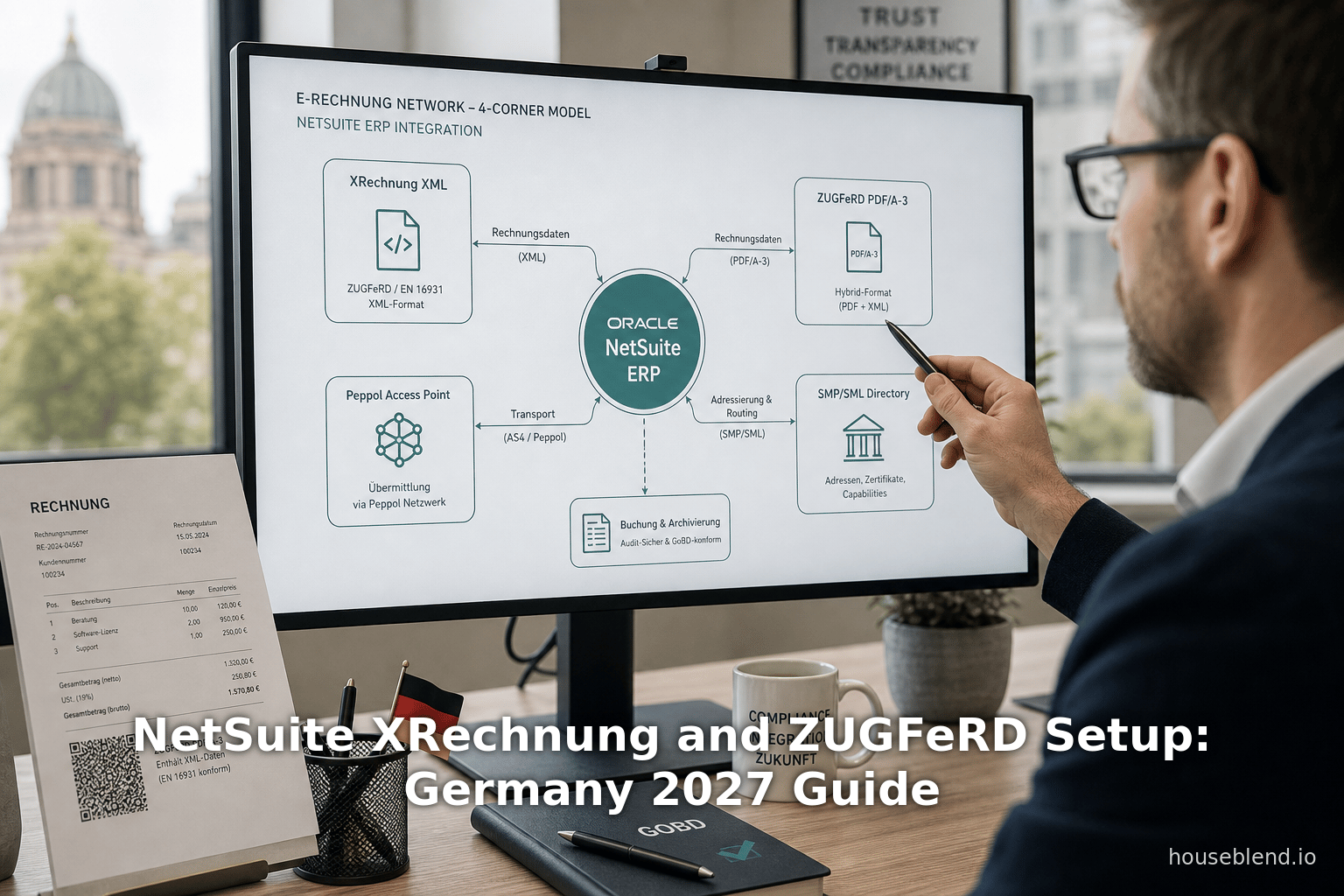
Peppol routes documents through what is commonly called the four-corner model. Invoice recipients (corner 4) must be registered with a Service Metadata Publisher (SMP) server; when a participant registers, the SMP contacts the network's single, centrally operated Service Metadata Locator (SML), which is the only server of its kind in the entire network [50]. When a sender's Access Point (corner 2) wants to deliver an invoice, it looks up the recipient's participant identifier against the SMP layer to determine which receiving Access Point (corner 3) should get the document, and whether that Access Point will accept it. Because Peppol BIS Billing 3.0 is compatible with XRechnung invoices, no changes to the underlying invoice content are required to route it over Peppol [51].
Routing within Germany relies on a specific identifier: the Leitweg-ID, a German public-sector routing code that appears in the XRechnung field BT-10 (Buyer Reference) and is registered in the Peppol participant identifier scheme under International Code Designator (ICD) value 0204 [52] [53]. The Leitweg-ID is variable in length, between 5 and 46 characters, made up of mandatory coarse addressing plus a check digit and optional fine addressing, with the check digit computed using the ISO/IEC 7064:2003 Modulo 97-10 algorithm, the same checksum method used for International Bank Account Numbers (IBAN) [54]. When an invoice travels over Peppol to a German public-sector recipient, the outer transport envelope carries the full Peppol participant identifier, while the invoice's own BT-10 field carries only the Leitweg-ID itself [55]. Missing or malformed Leitweg-IDs are documented as the most common rejection reason on Germany's federal ZRE invoice submission portal, underscoring why this single field is a frequent source of onboarding friction for issuers new to structured invoicing (Source: invoicenavigator.eu).
OpenPeppol has also launched a "Peppol ViDA Pilot" intended to demonstrate that the Peppol network and its EN 16931-based specifications can satisfy the EU's forthcoming ViDA digital reporting requirements [56], a signal that Peppol connectivity configured today for XRechnung delivery is likely to remain relevant as EU-wide digital reporting rules phase in toward 2030.
Configuring NetSuite for XRechnung and ZUGFeRD Compliance
Oracle NetSuite addresses German e-invoicing through a combination of native SuiteApps and partner-built extensions, and organizations planning for the 2027 deadline need to understand which parts of the stack Oracle ships natively and which require a third-party add-on.
On the receiving side, NetSuite's European Union Electronic Invoicing SuiteApp allows receiving and processing vendor bill and vendor credit transactions in XRechnung format for NetSuite users in Germany [12]. Configuring it involves navigating to Setup, E-Documents, E-Document Templates, and selecting the Xrechnung Inbound E-Document template for editing [57], then assigning a Germany E-Document Package to relevant vendor records so inbound XRechnung files route correctly. This satisfies the receiving obligation that has applied to all German businesses since 1 January 2025.
On the issuing side, Oracle's broader Electronic Invoicing product enables the creation and transmission of electronic invoices and tax data via tax authorities' platforms and exchange networks directly from NetSuite [58]. It natively generates invoices in UBL 2.1, which are then converted into the outgoing format required by individual country regulations [59]. Connectivity to the Peppol network itself is delivered through a separate SuiteApp, NetSuite Electronic Business (NSEB), which links participating NetSuite users to the Peppol network by partnering with Avalara, removing the need to register separately with an Access Point in each country [13]. The NSEB SuiteApp installs for free from the SuiteApp marketplace, though Avalara's provisioning and mandate activation require separately purchased licensing [60]. Once configured, NetSuite's PEPPOL Mandate Activation feature can bulk-activate every Avalara-supported Peppol mandate for a subsidiary in a single action [61]. For countries or use cases that Avalara supports but NetSuite has not yet localized, Oracle also offers an Electronic Invoicing Builder Kit for building custom compliance logic [62]. Avalara publicly expanded its NetSuite partnership around this capability in October 2023 [63], and Avalara's own documentation for the integration explains that ZUGFeRD is a hybrid format combining a human-readable PDF with embedded structured XML data [64].
A structural gap is worth flagging directly. NetSuite's free Electronic Invoicing app is described by an implementation partner as shipping without a native XRechnung template, meaning outbound structured invoice generation for the German market is not turnkey out of the box [65]. Oracle's own PEPPOL template documentation similarly notes that its sample outbound templates and data source plug-ins are provided for reference and may not generate a valid PEPPOL e-document without further customization [14]. A NetSuite-focused advisory practice similarly confirms that Oracle has enhanced its e-invoicing SuiteApp specifically to facilitate receipt of German XRechnung invoices ahead of the mandate [66], reinforcing that receiving is the more mature native capability while outbound generation is where the market of add-ons has formed.
Separately from e-invoicing generation itself, Oracle also publishes a Germany Localization SuiteApp that provides features addressing German accounting and financial reporting requirements, including national tax reports and country-specific charts of accounts [67]. This SuiteApp complements, but does not replace, the e-invoicing configuration: it addresses statutory bookkeeping and VAT return requirements, not e-invoice format generation.
Step-by-Step Implementation Guidance and Common Pitfalls
Regardless of which NetSuite e-invoicing path an organization chooses, the practical implementation sequence follows a consistent pattern documented across ERP vendors and Peppol service providers:
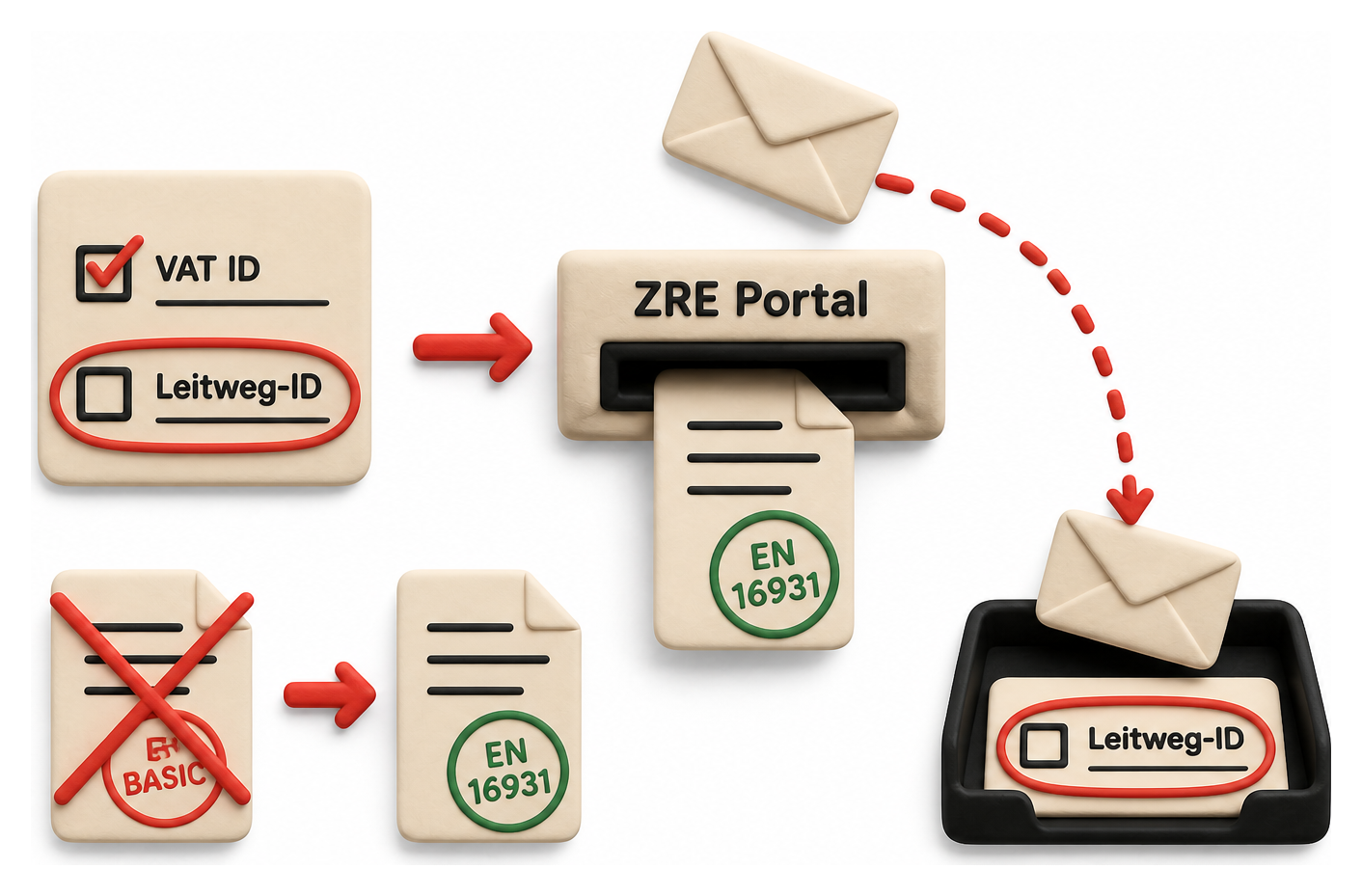
- Master data cleanup: Ensure every customer and vendor record carries a valid VAT identification number and, for transactions touching German public-sector recipients, a correctly formatted Leitweg-ID in the buyer reference field, since malformed or missing Leitweg-IDs are the leading documented cause of invoice rejection on Germany's federal submission portal (Source: invoicenavigator.eu).
- Format and profile selection: Confirm which format the counterparty requires. If issuing ZUGFeRD, use only the EN 16931 or EXTENDED profile; a documented and recurring implementation mistake is assuming the ZUGFeRD BASIC profile is EN 16931 compliant, when it is not (Source: invoicenavigator.eu). The embedded PDF container must also be genuinely PDF/A-3 compliant, not merely a regular PDF or the PDF/A-1 or PDF/A-2 variants that many PDF-generation libraries default to (Source: invoicenavigator.eu).
- Access Point or service-provider connection: Register with a Peppol Access Point, either through NetSuite's Avalara-powered NSEB SuiteApp or an independent Peppol service provider. One Peppol Access Point provider documents the technical integration sequence as creating a legal-entity record, generating a Peppol participant identifier, and posting invoices to a submission endpoint [68], with production access activated once contracting is complete.
- Template mapping and validation testing: Map NetSuite's native invoice data to the target E-Document Template, then validate output XML before go-live. KoSIT publishes an open-source XML validation engine capable of checking both XML Schema and Schematron business rules [69], with configuration modules updated alongside each XRechnung release, for example a March 2025 release compatible with XRechnung 3.0.x [70]. Validation for XRechnung checks against XML Schema, EN 16931 core Schematron rules, and Germany's national business rules layer, expressed in the format's documentation as validating against "XSD + EN 16931 core + BR-DE rules" (Source: invoicenavigator.eu); ZUGFeRD's EN 16931 profile is checked against XML Schema and EN 16931 core rules alone, without the additional national layer.
- Timeline planning: Budget realistic lead time. One Peppol Access Point provider's documented ERP integration timeline runs approximately 1 to 6 weeks depending on scope [17], and that estimate covers only the network connectivity piece, not NetSuite-side template and workflow configuration.
- Archiving alignment: Coordinate the e-invoicing rollout with recordkeeping practice. Germany's BMF amended the GoBD (Grundsätze zur ordnungsmäßigen Führung und Aufbewahrung von Büchern, the German bookkeeping and record-retention principles), effective 14 July 2025, specifically because of the domestic e-invoicing mandate that took effect on 1 January 2025 [71], clarifying that a separate PDF or image copy of an outgoing invoice need not be stored from creation onward if an identical duplicate can always be regenerated on demand [72].
A further pitfall specific to Peppol-connected environments is version drift: KoSIT has flagged that numerous older XRechnung document-type versions are marked deprecated within the Peppol network's own code lists and scheduled for eventual shutdown [73], so organizations that hard-code an older schema version risk future delivery failures even if their initial go-live succeeds.
Table 1 below summarizes the statutory timeline discussed above.
| Date | Requirement | Applies To |
|---|---|---|
| 27 November 2020 | B2G e-invoice issuance mandatory [21] | Suppliers to federal public authorities |
| 1 January 2025 | All businesses must be able to receive structured e-invoices [3] | All domestic B2B recipients |
| Through 31 December 2026 | Transitional issuance of paper or non-compliant e-invoices still allowed [27] | All businesses |
| 1 January 2027 | Structured e-invoice issuance mandatory [5] | Businesses with prior-year turnover above €800,000 |
| 1 January 2028 | Structured e-invoice issuance mandatory for essentially all remaining businesses [4] | All businesses except small businesses under Section 19 UStG |
| 1 July 2030 | EU-wide digital reporting requirements may condition VAT deduction on e-invoice possession (Source: bdi.eu) | All EU member states (ViDA) |
As the table shows, the 2027 date is not the finish line for most German businesses by count, since a majority fall below the €800,000 threshold and gain an additional year, but it is the operative deadline for the businesses that generate the largest share of domestic B2B invoice volume.
- 01Master data cleanup
Ensure customer and vendor records carry valid VAT IDs and correctly formatted Leitweg-IDs.
- 02Format/profile selection
Confirm the counterparty's required format and use only compliant ZUGFeRD profiles.
- 03Access Point connection
Register with a Peppol Access Point via NetSuite's NSEB SuiteApp or an independent provider.
- 04Template mapping/validation
Map NetSuite invoice data to the E-Document Template and validate output XML before go-live.
- 05Timeline planning
Budget realistic lead time; network integration alone commonly runs 1 to 6 weeks.
- 06Archiving alignment
Coordinate the rollout with GoBD recordkeeping practice.
Following the full sequence positions an organization to meet the 2027 issuance deadline without last-minute rework.
Skipping master data cleanup or profile selection is a documented cause of invoice rejection and non-compliant output.
Data Analysis and Evidence
Adoption data shows Germany's e-invoicing transition accelerating but incomplete going into the 2027 deadline. A Bitkom (the German digital industry association) survey found that as of December 2024, fewer than half of German companies, only 45 percent, were able to receive invoices in structured e-invoice format [15], just weeks before the 1 January 2025 receiving mandate took effect. Among companies that had adopted digital invoice-receiving formats at that point, EDI (Electronic Data Interchange) formats dominated at 71 percent, while ZUGFeRD or Factur-X accounted for about a quarter at 27 percent [74], and pure XRechnung XML represented only 5 percent, indicating that ZUGFeRD's human-readable hybrid design was, at that stage, more broadly adopted for receiving than pure-XML XRechnung outside public-sector contexts.
A subsequent Bitkom survey shows meaningful progress: for the first time, more than half of invoicing companies, 59 percent, used standardized e-invoice formats (EDI, ZUGFeRD, or XRechnung) to create digital invoices, up from 45 percent a year earlier, 30 percent in 2020, and just 19 percent in 2018 [16]. The share of companies still creating invoices exclusively on paper fell to 8 percent, down from 14 percent five years earlier [75].
Threshold analysis from the ZDH, based on a survey of German businesses, found 44.0 percent of respondents reported prior-year turnover above the €800,000 issuance-mandate threshold, versus 56.0 percent below it [76], illustrating that the 2027 deadline captures a substantial minority of firms by count even though, by transaction volume, larger firms above the threshold typically account for a disproportionate share of total invoicing activity.
On the network side, Peppol had 6,086,809 active participants across 116 countries at the time of the most recent snapshot examined for this report (Source: peppol-id.eu), with Germany accounting for 11,590 active participants (Source: peppol-id.eu), a comparatively small fraction of the global network reflecting Germany's continued reliance on direct XRechnung and ZUGFeRD exchange alongside, rather than exclusively through, the Peppol network. This pattern is consistent with the retention and format-error mechanics discussed earlier: because format errors merely reclassify a document as an "other invoice" rather than invalidating VAT treatment outright, and because Section 26a UStG caps most e-invoicing-related administrative fines at €5,000 [33], the compliance risk profile for German e-invoicing sits closer to a documentation and process-control problem than an existential penalty regime, consistent with survey data showing steady but gradual adoption curves rather than a compliance cliff.
Table 2 below compares two common formats across the dimensions most relevant to a NetSuite implementation decision.
| Attribute | XRechnung | ZUGFeRD (Factur-X) |
|---|---|---|
| Format type | Pure structured XML, no visual layer | Hybrid: PDF/A-3 with embedded XML [39] |
| Syntax | UBL 2.1 or UN/CEFACT CII D16B [36] | UN/CEFACT CII D22B, backward compatible with D16B [43] |
| Current version (Aug 2026) | 3.0.2, bugfix release 2026-01-31 [38] | 2.5.2, effective 1 September 2026 [8] |
| Maintainer | KoSIT | FeRD / AWV [41] |
| Human readability | Requires viewer software | PDF component directly human-readable |
| Compliant profiles | Single specification, always mandate-compliant | EN 16931 and EXTENDED only [9]; MINIMUM, BASIC, BASIC WL excluded |
| Peppol network transport | Native, content-equivalent to Peppol BIS Billing 3.0 for German-to-German invoices | Not natively carried; delivered as XRechnung UBL on Peppol instead (see Peppol section above) |
The table underscores a practical implication for ERP configuration: an organization that only needs Peppol-routed, machine-processed invoicing can standardize on XRechnung, while one that needs a human-readable document as the primary artifact, for example to satisfy accounts payable staff who review invoices visually, will lean toward ZUGFeRD's EN 16931 or EXTENDED profile even though it demands stricter PDF/A-3 generation discipline.
Missing or malformed Leitweg-IDs are documented as the most common rejection reason on Germany's federal ZRE invoice submission portal, underscoring why this single field is a frequent source of onboarding friction for issuers new to structured invoicing
Case Studies and Real-World Examples
Because Oracle's native NetSuite e-invoicing tooling for Germany is described by implementation partners as shipping without a ready-made XRechnung output template [65], several distinct vendor approaches have emerged to close that gap. Reviewing them illustrates the range of integration patterns available to a NetSuite customer preparing for the 2027 deadline.
Native SuiteApp Plus Third-Party Tax Engine
Oracle's own path pairs the free NSEB SuiteApp with Avalara's compliance engine, a partnership through which Avalara links participating NetSuite users to the Peppol network without requiring separate Access Point registration in each country [13]. This model keeps invoice generation logic inside NetSuite's native UBL 2.1 output and outsources country-specific format conversion and network delivery to Avalara.
Consulting-Built Template Extension
Alta Via Consulting, a NetSuite implementation partner, built a packaged extension marketed as "Localization Germany for NetSuite," specifically to add outbound XRechnung XML generation on top of Oracle's free Electronic Invoicing app. The firm's own description of the gap it addresses states plainly that the standard Oracle app supplies no template for the XRechnung [65]; its extension uses custom customer master-data fields, a script, and a workflow to generate the required XRechnung XML directly from a standard NetSuite invoice [77].
AP Automation Platform with Bundled E-Invoicing
Zone & Co, an AP automation vendor, offers an e-invoicing module within its ZoneCapture product that the company describes as a native NetSuite application for e-invoicing compliance [78]. Its documentation is explicit that only Peppol-network communications are guaranteed supported, with any other network dependent on its underlying e-invoicing provider's own support [79]; the relevant plugin shipped in ZoneCapture version 2.14.0, released 29 November 2024 [80]. Zone & Co's own marketing states the platform has processed over 586,000 e-invoices to date [81], a vendor-reported adoption figure rather than an independently audited statistic.
Dedicated E-Invoicing Middleware
Invoice-Portal offers a purpose-built NetSuite integration that converts NetSuite invoices and credit notes into Peppol BIS, XRechnung, and Factur-X formats [82]; the vendor markets itself as Peppol Certified with e-invoicing coverage across more than 35 European countries [83]. This category of vendor typically positions itself as middleware sitting alongside NetSuite rather than as a SuiteApp bundle, trading deeper NetSuite-native integration for broader multi-country network reach.
Table 3 below summarizes these four approaches side by side.
| Solution | Provider | What It Covers | Peppol Connectivity |
|---|---|---|---|
| Electronic Invoicing + NSEB SuiteApp | Oracle / Avalara | Outbound generation via UBL 2.1 conversion; free install, licensed Avalara activation [60] | Yes, via Avalara partnership |
| EU Electronic Invoicing SuiteApp | Oracle | Inbound XRechnung vendor bill and credit processing [12] | N/A (inbound receiving) |
| Localization Germany for NetSuite | Alta Via Consulting | Outbound XRechnung XML generation via custom fields, script, workflow [77] | Depends on chosen Access Point |
| ZoneCapture e-invoicing module | Zone & Co | AP automation plus outbound e-invoicing [78] | Peppol network only guaranteed [79] |
| NetSuite integration | Invoice-Portal | Converts invoices to Peppol BIS, XRechnung, Factur-X; syncs delivery status [82] | Peppol Certified [83] |
Across all four patterns, the common thread is that NetSuite customers preparing for the 2027 mandate are choosing between deepening a single vendor relationship, commissioning a bespoke consulting build, or adopting a specialized third-party AP or e-invoicing platform, and the right choice depends heavily on transaction volume, the proportion of German counterparties, and whether Peppol-exclusive delivery is sufficient or broader network reach is required.
Implications and Future Directions
Three forward-looking dynamics should inform how organizations configure NetSuite today rather than treating the 2027 deadline as an isolated compliance event. First, the format standards themselves continue to evolve. ZUGFeRD 2.5 already incorporates functionality anticipating the EN 16931-1:2026 revision [44], meaning organizations that hard-code today's profile structures without planning for periodic format updates will face recurring, not one-time, integration work. XRechnung shows the same pattern: KoSIT has already begun deprecating older document-type versions within the Peppol network's own code lists [73], so a configuration validated once at go-live is not guaranteed to remain valid indefinitely.
Second, the German deadline sits inside a larger EU trajectory. The EU's ViDA initiative is expected to introduce EU-wide digital reporting requirements with a target effective date around 1 July 2030 (Source: bdi.eu), and OpenPeppol has already established a dedicated Peppol ViDA Pilot to demonstrate that Peppol's EN 16931-based specifications and network can meet those future requirements [56]. Organizations that configure NetSuite for Peppol-based XRechnung delivery now are, in effect, building toward infrastructure the EU is likely to require more broadly later in the decade, whereas organizations that adopt a Peppol-adjacent but non-Peppol delivery mechanism purely to satisfy the 2027 German mandate may face a second integration project when EU-wide digital reporting arrives.
Third, political pressure to delay remains live but currently unsuccessful. Industry associations, including the ZDH, continue to lobby for pushing the €800,000 threshold date from 2027 to 2028 [28], and as of July 2026 the German government had not announced any change to the statutory timetable [6]. Given that Peppol Access Point integration alone commonly runs 1 to 6 weeks once network connectivity work begins [17], before accounting for NetSuite-side master data cleanup and template validation, organizations above the €800,000 threshold that have not yet started configuration work face a narrowing runway regardless of whether the deadline eventually slips.
Frequently Asked Questions (FAQs)
What is the difference between XRechnung and ZUGFeRD? XRechnung is a pure structured XML format with no visual layer, built for straight-through automated processing and standardized by KoSIT [7]. ZUGFeRD is a hybrid format that embeds structured XML inside a human-readable PDF/A-3 file, maintained by FeRD [39]. Both implement the EN 16931 European semantic data model, but only ZUGFeRD's EN 16931 and EXTENDED profiles, not MINIMUM, BASIC, or BASIC WL, satisfy Germany's structured e-invoice mandate [9].
Do I need Peppol to use NetSuite for German e-invoicing? Not strictly for direct point-to-point exchange, but Peppol is the primary network NetSuite's own Avalara-powered SuiteApp uses to reach counterparties without country-by-country Access Point registration [13], and since XRechnung 3.0 and Peppol BIS Billing 3.0.18, the two formats are content-equivalent for German-to-German transactions [11], making Peppol connectivity the practical default for most NetSuite deployments.
Does NetSuite generate XRechnung invoices out of the box? NetSuite natively receives and processes inbound XRechnung vendor bills through its EU Electronic Invoicing SuiteApp [12]. For outbound generation, Oracle's own sample templates and data source plug-ins are documented as needing further customization before they generate a valid e-document [14], which is why partner-built extensions or third-party AP automation platforms are commonly used to close the gap.
What happens if my invoice has a formatting error? German tax guidance treats a structurally invalid e-invoice as reclassified into the "other invoice" category rather than an automatic legal nullity [25], though errors in the invoice's substantive VAT content, as opposed to pure formatting, can mean no proper invoice exists at all and can jeopardize input VAT deduction (Source: bdi.eu).
When exactly do I need to comply if my company's turnover is below €800,000? Your business must already be able to receive structured e-invoices, a requirement in force since 1 January 2025 [3]. Issuance becomes mandatory for your business from 1 January 2028 [4], one year after the deadline that applies to larger businesses.
Conclusion
Germany's shift to mandatory structured B2B e-invoicing is now a matter of statutory record, not proposal: the Wachstumschancengesetz set the legal framework in March 2024, the receiving obligation has applied since January 2025, and issuance becomes mandatory from 1 January 2027 for businesses above the €800,000 turnover threshold, extending to nearly all businesses from 1 January 2028. Despite continued industry lobbying for a delay, no postponement had been confirmed as of mid-2026. For NetSuite customers, compliance is achievable but not automatic: the platform provides strong native support for receiving XRechnung invoices and for connecting to the Peppol network through its Avalara partnership, but outbound XRechnung generation commonly requires a partner-built template extension or a dedicated third-party e-invoicing or AP automation platform. The technical distinction between XRechnung's pure-XML, automation-first design and ZUGFeRD's hybrid, human-readable PDF approach should guide which format an organization prioritizes, informed by its counterparties' preferences and its own back-office processing capabilities. Organizations above the €800,000 threshold that have not yet begun master-data cleanup, transmission-method and provider decisions, and template validation should treat 2027 as an active deadline requiring near-term action, not a distant milestone.
External Sources (83)
About
Houseblend
Make NetSuite work better for your finance and operations teams with Houseblend. We help design, implement, integrate and improve ERP systems, with practical support for the people who use them every day.
Houseblend is a NetSuite consulting firm serving finance and operations teams. We help organizations implement ERP systems, connect business applications, improve existing configurations and maintain the systems that support everyday work. Our audience includes finance leaders, controllers, operations managers, NetSuite administrators and implementation teams.
Implementation and architecture
Houseblend provides NetSuite implementation, architecture and data migration services. We help teams evaluate how business processes, reporting requirements and existing data should fit together in an ERP environment. Training supports the people responsible for adopting and operating the resulting system.
Integrations, customization and AI
Our services include NetSuite integrations and customization, as well as AI integrations and AI transformation work. These engagements connect ERP data and workflows with the broader application landscape. The right design depends on the organization's systems, controls and operating needs.
Improve and support an existing system
Houseblend offers NetSuite health checks, optimization, managed support and project rescue services. We also provide expertise for analytics and specialist workflows, including NetSuite Analytics Warehouse, warehouse management and field service management. Published educational material helps teams investigate options and prepare informed questions for their implementation or support work.
Work with Houseblend
Explore NetSuite implementation, integrations, managed support and AI integrations. Contact Houseblend to discuss your current system and priorities.
Article examples explain concepts rather than promising a particular license, product capability, delivery schedule or outcome. Engagement scope is confirmed with the Houseblend team.
Disclaimer
This document is provided for informational purposes only. No representations or warranties are made regarding the accuracy, completeness, or reliability of its contents. Any use of this information is at your own risk. Houseblend shall not be liable for any damages arising from the use of this document. This content may include material generated with assistance from artificial intelligence tools, which may contain errors or inaccuracies. Readers should verify critical information independently. All product names, trademarks, and registered trademarks mentioned are property of their respective owners and are used for identification purposes only. Use of these names does not imply endorsement. This document does not constitute professional or legal advice. For specific guidance related to your needs, please consult qualified professionals.