Houseblend Article
Ramp vs Brex vs Airbase: NetSuite Integration Comparison
Inside this article
Executive Summary
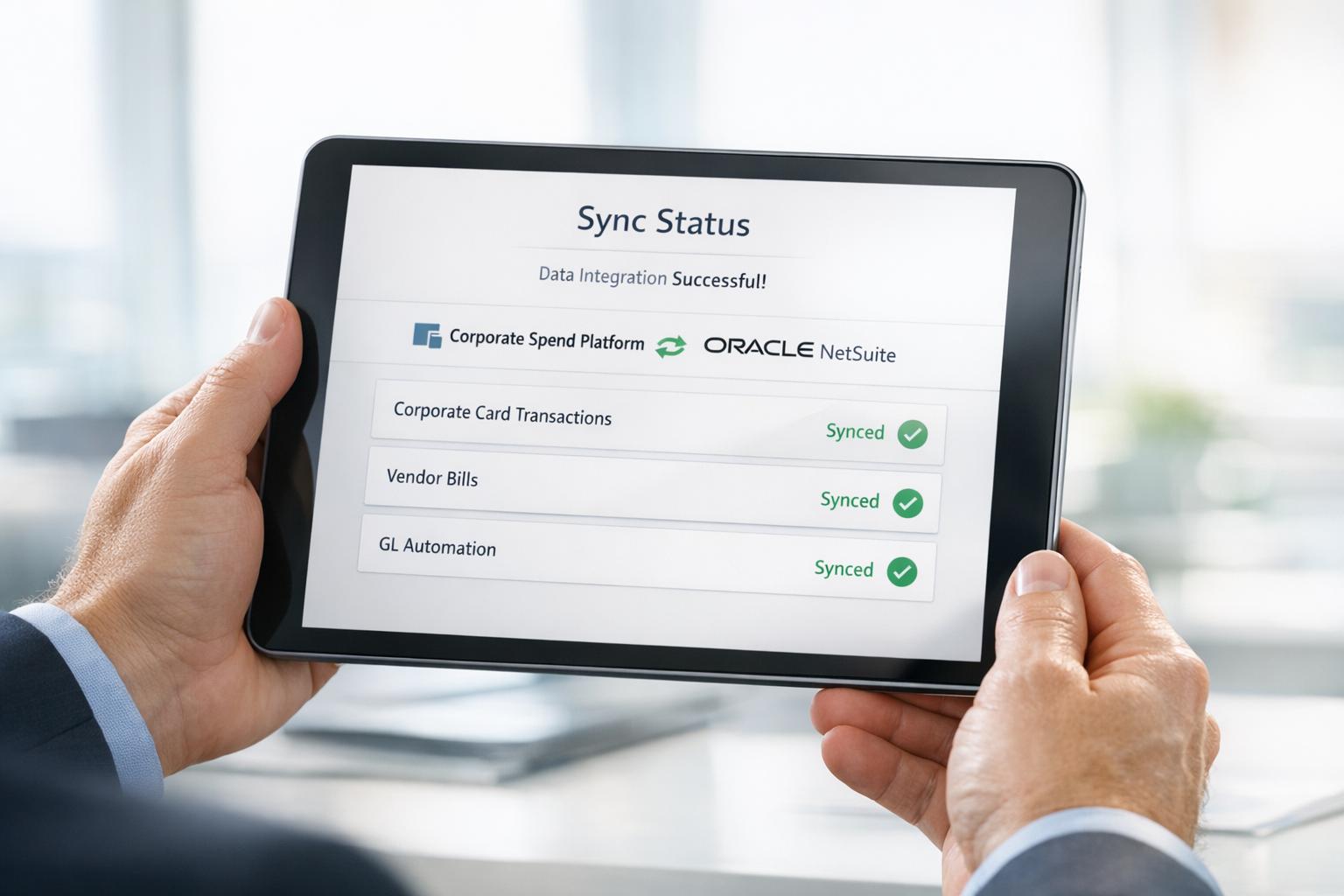
Corporate spend management platforms have rapidly evolved to meet the needs of modern finance teams. In particular, Ramp, Brex, and Airbase have emerged as leading providers of integrated corporate card and expense management solutions that connect directly to ERP systems like Oracle NetSuite. This report provides a comprehensive comparison of Ramp, Brex, and Airbase—focusing especially on how each platform integrates with NetSuite. Ramp (founded 2019) and Brex (founded 2017) began as corporate card providers and now offer full expense management; Airbase (founded 2018) presents a broader procure-to-pay proposition. All three support automated export of-card transactions, reimbursements, and vendor bills to NetSuite, but they differ in approach: Ramp emphasizes AI-driven automation and includes bill-pay/3-way-match capabilities [1]; Brex emphasizes direct integration with NetSuite’s SuiteApp and rapid adoption by startups and growing enterprises [2]; and Airbase touts a “native” real-time sync of all spend (cards, POs, bills) into the NetSuite GL [3] [4]. In practice, Ramp and Airbase offer two-way, bi-directional integrations (with built-in support for multiple subsidiaries, currencies, POs, and custom fields) [1] [4], whereas Brex’s integration (the first corporate card SuiteApp for NetSuite) primarily exports expenses to NetSuite (initially via journal entries or bills), relying on frequent syncs but with some limitations on advanced features like VAT and amortization in certain modes [5].
This report delves into the historical context of corporate spend management, detailed feature comparisons, technical data on NetSuite integration, and evidence from user reviews and case studies. Tables summarize key differences (e.g. purchase-order and 3-way match support, virtual vs. physical cards, AI analytics, multi-entity handling) and illustrate how each platform aligns to different use cases. We include case studies (e.g. a fintech’s multi-entity finance team adopting Ramp [6], and a prop-tech firm using Brex with NetSuite) to highlight real-world impacts. Finally, we discuss broader trends (AI automation, continuous close, corporate card commoditization, and the future of ERP integrations) and conclude with insights on selecting among these solutions. All claims are substantiated with citations from company documentation, news reports, analyst articles, and industry data.
Introduction and Background
Managing corporate card spend and employee expenses has historically been a labor-intensive task. Traditionally, companies used bank-issued credit cards plus standalone expense-reporting solutions (like SAP Concur or Expensify) to track spending. In recent years, a new class of fintech startups (including Brex, Ramp, and Airbase) has combined credit-card issuance with integrated spend platforms. These modern platforms promise real-time visibility, policy enforcement, and seamless accounting. A critical part of this promise is tight integration with enterprise resource planning (ERP) systems. Among ERPs, Oracle’s NetSuite is a popular cloud-based financial system for mid-size and larger organizations. To close the books faster, companies increasingly demand that corporate card spend flow automatically into NetSuite with correct coding.
NetSuite itself is described as a “single, real-time system of record” for a company’s financials and operations. It supports global operations with multi-entity accounting, SuiteTax for VAT, and built-in audit trails. However, by default NetSuite does not natively manage employee expenses or specific card programs. As of 2023, SAP Concur – the long-established T&E system – held roughly 49.6% of the global travel-and-expense software market [7], reflecting that many firms still rely on batch exports of expense reports. Business travel and spend volume is surging back toward pre-pandemic levels [7], putting pressure on finance teams. Meanwhile, new corporate card platforms argue that expense reports themselves can be eliminated – Mastercard cites a Concur survey showing 20% of travelers would rather go to the dentist than file an expense report [8].
Corporate spend platforms like Ramp, Brex, and Airbase thus position themselves as one-stop solutions: they issue cards (typically virtual and physical), enforce policies at the time of purchase, automate bookkeeping, and export transactions into NetSuite in real time or near-real time. The benefits include shorter close cycles, fewer manual entries, and proactive budget control. For example, a NetSuite-Finance blog notes that combining a spend management system with NetSuite “ensures complete, real-time visibility into, and control over, all employee spending” [4]. These platforms emerged after Silicon Valley firms and scaleups began demanding more automation; Brex claims it “accelerates entrepreneurs and scaling businesses” by tightly integrating spend with finance systems [2]. Ramp (founded 2019 by former Brex executives) emphasizes “AI finance” and 3-way matching logic [1]. Airbase (founded 2018 by Thejo Kote, formerly of YouTube) advertises a “first-of-its-kind spend management platform” that unifies AP, POs, cards, and bill pay [3].
Given this backdrop, this report thoroughly examines Ramp vs. Brex vs. Airbase focusing on: corporate card capabilities, expense management features, and specifically “integration with NetSuite.” We will compare product features side-by-side, cite usage statistics and funding data, and analyze case studies as examples. The goal is to provide finance leaders and IT decision-makers a detailed guide to choosing and implementing these platforms with NetSuite.
Company Overviews and Market Context
Ramp
- Founded: 2019 (went public via SPAC in 2023 as System1, now ticker RAMP) [9].
- Founders: Eric Glyman, Karim Atiyeh, and Gene Lee (former Brex executives) [9].
- Business Model: Corporate card + expense management + bill pay platform; free to use, revenue from interchange and float. Ramp emphasizes cost savings and AI automation for finance teams [1].
- Valuation & Scale: By early 2022, Ramp raised a mega-round ($750M) doubling its valuation to $8.1B [9].As of March 2025, Ramp reported $700M ARR, doubling in under 2 years [10]. CEO Eric Glyman notes Ramp has risen from $100M in ARR (by March 2022) to $700M by 2025 [10]. Ramp claims to represent “1-2% of the U.S. card market” [10].
- Target Customers: Initially tech startups, now scaling to enterprises. 1200+ employees (2024), serving thousands of companies (ranked among “50 fastest-growing software vendors of 2025 [11]”).
- Product Focus: AI-assisted spend management, automated expense workflows, bill payments, and deeply integrated accounting.
- Unique Selling Points: Real-time spend analytics, unlimited virtual/physical cards with cashback, AI receipt scanning and coding, no personal guarantees, built-in POs, 3-way matching, and automated approvals [1]. Ramp’s platform is often described as “automation-first” – e.g. automatic expense line-item coding into NetSuite with machine-learning assistance [1]. Ramp also highlights savings claims: for example, their clients (via marketing) often report saving many hours on monthly closes after integrating Ramp.
- NetSuite Integration: Ramp offers a certified SuiteApp (Oracle “Built for NetSuite” status [1]). Ramp’s integration is bi-directional: Ramp can import custom fields, subsidiaries, class segments, etc. from NetSuite [12], and posts transactions back to NetSuite as native credit card expense transactions (and bills for reimbursements) [12]. Ramp explicitly supports Oracle NetSuite OneWorld (multi-entity) and SuiteTax (multi-currency) [1]. Ramp also offers strong vendor/AP features: it can create new vendors in NetSuite, match bills to POs with 3-way-match, and even apply overbilling protection [1]. In short, Ramp bills itself as a complete “cards + AP” workflow that syncs continuously to NetSuite to keep the General Ledger up-to-date [1]. (See Table 1 below for feature highlights.)
Brex
- Founded: 2017.
- Founders: Henrique Dubugras and Pedro Franceschi.
- Business Model: Started as a corporate card (no personal guarantee) for tech startups, later expanded to all companies. Brex issues corporate cards (global, virtual/physical) and provides expense and small-AP tools. They have also added cash management and lending products.
- Valuation & Scale: Early leader in fintech; by late 2021, Brex raised huge rounds valuing it at $12.3B (TechCrunch) [13]. By early 2025, Brex had brought in over $1.5B of funding and was projecting ~$500M in revenue for 2025 [13]. Recent reporting suggests Brex was near $700M ARR growing ~50% YoY [14].
- Target Customers: Started with startups/SMBs, now also courting larger enterprises and running a fast-growing enterprise segment. Over 150 public companies use Brex cards (e.g. Anthropic, Robinhood, Sonos) [13].
- Product Focus: Corporate card (with points or cash-back rewards), multi-entity expense automation, AP bill pay. Additional features include multi-currency reimbursements, spend controls, and vendor bill uploads (with AI-based invoice capture). Brex claims deep reporting and anomaly detection (e.g. flagging unusual spending).
- Unique Selling Points: Early market entry; first corporate card to integrate with NetSuiteSuiteApp [2]. It markets tight bookkeeping integration and high user adoption. Brex also acquired a suite of fintech tools (e.g. Redwood for workflows, Wallaroo for AP automation) and offers many banking services. The CEO has publicly stated their goal to be profitable (c.2025) before IPO [13].
- NetSuite Integration: Brex provides a SuiteApp for NetSuite. It imports the NetSuite chart of accounts, subsidiary codes, classes, and custom fields into Brex [5]. This lets employees code expenses using NetSuite’s structure. Brex can export transactions in multiple formats: Journal Entries, Vendor Bills, or Credit Card transactions in NetSuite [5]. In practice, Brex often uses journal entries (one per month by default) to post summarized spend. Each Brex card transaction is batched into NetSuite journals (crediting the card account, debiting expense accounts), though users can choose weekly/daily runs. Under a different mode, Brex can post card expenses as NetSuite vendor-bill entries or as NetSuite credit card transactions [5] (though this requires setting default vendors). This flexibility allows Brex to fit into different close workflows. Brex’s integration is largely one-way (Brex → NetSuite) in that it focuses on exporting Brex spend data into NetSuite for GL updates. Notably, Brex’s built-in SuiteApp is Oracle-certified. Some limitations exist: in “credit card transaction export” mode, Brex currently does not support VAT tracking, amortization schedules, or intercompany transactions [5]. Even so, Brex’s integration is mature: companies like Avenue One report saving 10–15 hours per month on reconciliation after moving to Brex+NetSuite.
Airbase
- Founded: 2018 (seed), accelerated growth in 2019–2021.
- Founders: Thejo Kote (also co-founded Clearwell Systems, acquired by Cisco).
- Business Model: Presents itself as an “all-in-one spend management” or full procure-to-pay platform. Airbase issues corporate cards (mostly virtual) and combines them with AP automation, purchase order (PO) workflows, and expense management. Customers use it as a single front-end for all non-payroll disbursements.
- Valuation & Scale: Raised multiple rounds: $7M Series A (2019), $60M Series B (2021 at $600M valuation) [15], then ~$155M Series C (2022), and Series D later. Notable investors include Menlo Ventures and Bain Capital. As of mid-2025, Airbase claims thousands of customers (including Gusto, Front, Doximity) [16] and has high net revenue retention. It has over $100M ARR (estimated).
- Target Customers: A wide range of fast-growing companies (100–5,000 employees) wanting a unified spend platform. Airbase is especially pitched at companies that want more than a card and expense tool – for example, those who also want built-in invoice management and PO tracking.
- Product Focus: Combines:
- Corporate & virtual cards (with zero fees).
- Accounts Payable: invoice processing with OCR and approvals.
- Purchase Orders & 3-Way Matching: create POs, match invoices.
- Expense Reimbursements: for employee out-of-pocket spend.
- Bill Pay: make vendor payments via ACH/check.
- Multi-currency support and comprehensive policy controls.
- Real-time reporting and budgets.
- Unique Selling Points: Airbase markets itself as a single platform where finance can manage cards, POs, invoices, and expense reimbursements seamlessly. Its deep accounting rules engine is a differentiator. In contrast to Brex and Ramp (card-first), Airbase is card + bill pay/PO from day one. It has a “native” real-time integration with NetSuite touted in marketing [3]. The blog by Airbase’s own product director emphasizes that only Airbase (and enterprise Coupa) support multi-subsidiary and multi-currency syncing [4] – a key claim.
- NetSuite Integration: Airbase offers a bi-directional, continuously syncing integration. Key points (from an Airbase whitepaper and partner blog) include:
- Real-time GL Sync: All approved spend (cards, reimbursements, bills, POs) are automatically sent to NetSuite as journal entries or vendor bills, updating the GL on a daily/weekly basis [3] [4]. This eliminates manual data files: “Up-to-date, audit-ready financials whenever they’re needed” [4].
- Accounting Rules Engine: Airbase can pull NetSuite lists (COA, classes, projects, etc.) into its own interface [4]. It then auto-populates the correct GL account for each transaction based on defined rules, and attaches receipts/approvals.
- Amortization & Localization: Airbase can leverage NetSuite’s amortization templates (for prepaid expenses) and NetSuite’s custom fields, ensuring full feature coverage [4].
- Global Support: Critically, Airbase explicitly supports multiple subsidiaries and currencies in the sync. The Airbase team notes that (aside from Coupa) they are unique among SMB tools in handling multi-entity NetSuite setups [4]. Transactions from all legal entities flow into the correct subsidiary in NetSuite, using OneWorld/InterCompany features as needed.
- Implementation: Airbase’s partner blog describes a single native integration (via SuiteCloud) with no need for manual imports [4]. In practice, companies like Front and Getaround (customers) have adopted Airbase to centralize AP and card spend in NetSuite.
- Airbase Positioning: In summary, Airbase’s pitch is “full P2P automation + cards” [3]. If Ramp is “expense-first” and Brex is “card-first,” Airbase is “AP-first.” Given this, Airbase often claims advantages like three-way match enforcement and PO workflows that Brex lacks. (For instance, Houseblend notes “Brex currently lacks purchase order creation and 3-way matching”, whereas Ramp and Airbase include those.) In G2 reviews, many Airbase users cite the strong PO-to-invoice flow and NetSuite sync as differentiators.
The following table summarizes some key feature differences among Ramp, Brex, and Airbase (including NetSuite integration attributes):
| Feature / Capability | Ramp | Brex | Airbase |
|---|---|---|---|
| Primary Focus | Card + Expense + AP | Card + Expense | Full Procure-to-Pay (cards, AP, POs, expense) |
| Corporate Cards (physical/virtual) | Yes (virtual & physical, unlimited, real-time) [1] | Yes (virtual & physical) | Yes (mostly virtual; card limits based on financials) |
| Expense Reports (reimbursements) | Yes, integrated (bills for reimburse) [12] | Yes, supports 70+ currencies | Yes (employee reimbursements, multi-currency) |
| Bill Pay / AP | Yes (bill pay, vendor bills, vendor credits) [12] | Limited (bill capture + pay, no PO matching) | Yes (full vendor invoice processing, ACH/wire/check) |
| Purchase Orders | Yes (create POs, 3-way match support) [1] | No (explicitly lacks PO workflows) | Yes (PO creation with SKU-level items, 3-way match) |
| 3-Way Matching | Yes (invoice to PO matching) [1] | No (not supported) | Yes (built-in PO/invoice approval matching) |
| Integration Type (NetSuite) | Two-way SuiteApp (certified) [1] | SuiteApp (certified, primarily one-way export) | Two-way “native” sync (SuiteCloud) [4] |
| Data Sync | Continuous (LA/GL) sync; can schedule daily/weekly posting [12] [1] | Scheduled exports (journals or bills); supports daily/weekly scans of NetSuite changes | Real-time (event-driven) sync of transactions to GL [4] |
| GL Mapping | Maps by company structure; imports custom fields for coding [12] | Imports COA, classes, depts, vendors; auto-suggests mappings | Syncs accounting rules: auto-populates correct NetSuite GL acct using pulled templates [4] |
| Subsidiary / Multi-currency | Yes (OneWorld, SuiteTax) [1] | Limited with SuiteApp bundles (multi-entity via separate instances) | Yes; built for global (multi-subs & currencies) [4] |
| AI / Automation | Heavy (auto-coding, anomaly detection, Slack/email alerts) [1] | Moderate (rule-based coding; some classification AI; unusual spend alerts) | Some (invoice OCR + rules, real-time GL) |
| Quick Books / Xero / Intacct | Supports (via integrations) | Native integrations available | Supports other ERPs too |
| User Ratings (G2) | 4.8/5 (2,366 reviews) [17] | 4.8/5 (1,532 reviews) [18] | 4.7/5 (1,823 reviews) [19] |
Table 1: Feature comparison of Ramp, Brex, and Airbase (selected capabilities; see cited sources).
Technical Integration with NetSuite
Understanding how spend platforms integrate with ERP systems is crucial. NetSuite integration can range from simple CSV export/import to full SuiteApps with custom objects. All three vendors provide a SuiteApp (NetSuite bundle) or API-based connector for NetSuite:
-
Ramp: Offers a SuiteApp-certified integration [1]. Ramp’s documentation states it provides “bi-directional syncing”, meaning Ramp can pull necessary accounting data from NetSuite and push transactions back [1]. After connecting to NetSuite, Ramp “gathers all necessary data for classifying your transactions” and will “respect your NetSuite settings” (no destructive changes) [12]. Specifically, Ramp imports NetSuite’s custom fields, segments, and subsidiary structure into its rules engine [12]. Finance teams define coding rules in Ramp (using the imported fields), so that every expense transaction is assigned the proper GL account, department, etc. Ramp automatically creates new vendor records in NetSuite for unknown merchants, appearing as “New: [MerchantName]” in NetSuite [12]. When expenses occur, Ramp syncs them as native NetSuite entries: card charges go in as NetSuite credit card transactions and employee reimbursements as vendor bills paid by AP [12]. Ramp’s site emphasizes that it supports multi-entity and multi-currency: “Entity-accurate, global-ready. Every transaction lands on the right subsidiary and currency with SuiteTax-aware coding” [1].
Importantly, Ramp’s integration leverages automation: AI auto-codes each line item to the correct NetSuite GL (based on the company’s chart of accounts) [1]. Ramp also provides reports and dashboards covering NetSuite spend. Quote: “Ramp brings AI into every finance workflow — auto-capturing receipts, coding line items to your NetSuite structure, enforcing policy, and flagging fraud or anomalies before they hit your books.” [1]. In practice, Ramp enables a continuous-close model: transactions flow through Ramp’s review workflow and sync to NetSuite on whatever cadence the controller sets (daily, weekly, or monthly) [1].
-
Brex: Provides an official NetSuite SuiteApp (copied from the 2019 release press) [2]. The integration is strongly one-way (from Brex into NetSuite) but supports multiple export options. Brex’s documentation (2025) explains that once connected, it “brings your NetSuite fields into Brex, lets you map GL Accounts and other accounting fields, and exports expenses as journal entries (single or batched), vendor bills, or as credit card transactions” [5]. In LiquidityPrime’s words, “Brex acts as the source of truth for spend and feeds those entries directly to the ERP”. By default, Brex aggregates card spend and posts monthly journal entries: it credits the card-payable account and debits expense accounts for that month’s aggregated transactions. Users can elect finer granularity (weekly or daily journals). Alternatively, Brex can post each card expense as an individual vendor bill in NetSuite or as actual NetSuite credit card transaction entries, if the export type is set to “credit card transaction” [5]. (Switching to credit card export means each Brex card transaction corresponds to a NS vendor-transaction; Brex notes that NetSuite then requires a vendor for every card spend and warns some features like amortization/VAT are disabled in that mode [5].)
Mapping and two-way data flow: Brex imports NetSuite’s chart of accounts, classes, departments, locations, vendors, and other fields into Brex’s “Fields library”. This means that when employees tag expenses in Brex, they see the actual NetSuite account values to choose from. Brex also supports two-way sync for structural data: any new accounts or segments created in NetSuite can be refreshed into Brex. Brex’s NetSuite connector uses Oracle’s token-based authentication (SuiteCloud) . After mapping, Brex’s export scripts (usually via NetSuite RESTlet with given script IDs) send data to NetSuite.
-
Airbase: Airbase’s integration is designed for real-time, two-way synchronization. According to an Airbase product marketing blog, “Airbase’s deep integration with NetSuite allows for the two-way flow of data in real-time so that the GL is kept current” [4]. Core elements include:
- Continuous GL sync: As soon as spend is approved in Airbase (e.g. a card charge or approved invoice), Airbase pushes it to NetSuite immediately (or nearly so) as the proper NetSuite transaction type (journal or bill). This means finance teams no longer need to do monthly batch reconciliations [4]. For example, Airbase’s documentation says, “Once accounting rules are set up, Airbase auto-populates the correct NetSuite GL account for every card transaction… All documentation, including approval records and receipts, is attached to the transaction record” [4]. The result is an always up-to-date GL.
- NetSuite tools leveraged: Airbase can pull and use NetSuite’s native features. It imports NetSuite’s amortization templates, allowing Airbase to ask users to select the right schedule for prepaid costs [4]. It also imports all NetSuite custom fields so transactions in Airbase can be tagged with the same dimension values [4]. This means reporting in Airbase and the GL remains consistent.
- Subsidiaries & Currency: Airbase explicitly supports OneWorld. The integration “enables spend activity from all subsidiaries to flow directly into NetSuite” [4]. Notably, Airbase claims that “[aside from Coupa] the only two spend platforms that can handle multiple currencies and subsidiaries are Coupa… and Airbase” [4]. In practice, Airbase clients with global operations use a single Airbase account, and the integration splits transactions to the correct NetSuite entity and currency with intercompany journals as needed.
- Implementation: Airbase’s SuiteApp bundle and API make the process largely click-through: after connection and setting policies/rules, transactions sync automatically. A detailed Airbase case study notes that the NetSuite GL can be updated weekly or daily to keep budgets accurate [4]. In short, Airbase emphasizes continuous accounting, with NetSuite always reflecting live spend.
Integration Summary: All three platforms provide certified SuiteApps for NetSuite and require little custom coding by the customer. Ramp and Airbase aim to maintain a live two-way link, enabling continuous closes. Brex’s integration is fully robust as well, but it is generally a push from Brex into NetSuite. Importantly, Ramp and Airbase both advertise features like 3-way match, PO support, and reconciliation automation that are executed via the integration. For example, Ramp’s NetSuite integration explicitly supports matching bills to POs and vendor bills with overbilling protection [1], and Airbase has built-in PO workflow with NetSuite’s GL. By contrast, Brex’s integration, while direct, relies on simpler exports and does not natively handle PO/3-way.
Feature-by-Feature Comparison
We now dive deeper into the capabilities and differences of Ramp, Brex, and Airbase. Each has strengths, and the best choice depends on company size, workflows, and priorities. We consider categories such as spend controls, budgeting, cards & rewards, AP features, and the user experience. Wherever possible, we cite data.
Expense Management and Spend Controls
-
Receipt Capture & Policy Enforcement: All three platforms emphasize mobile capture of receipts and automated policy checks. Ramp’s mobile app allows employees to snap receipts on the go, automatically matching them to transactions and enforcing rules (e.g. flagging or blocking out-of-policy spend). Brex’s mobile/desktop workflow similarly captures receipts and can categorize via OCR and rules. Airbase lets employees upload or email invoices and receipts; its workflow then routes them for approval. In practice, reviewers only see exceptions. Houseblend notes that one finance team saved “10 hours per month” of managerial time by only escalating out-of-policy expenses with Brex.
-
Approval Workflows: Ramp and Airbase allow multi-level approvals based on spend thresholds. Airbase is particularly strong here: it enforces budgets at the PO/invoice level (so managers see bills before paying). Brex has basic workflow: managers approve expense requests and reimbursements before finance reviews. All provide audit trails of approvals.
-
Budgets and Sub-ledgers:
- Ramp allows setting budgets on cards or departments. It also supports shifting to prepaid cards (“Ramp Cash”) so managers can allocate funds upfront [6].
- Brex offers budgeting insights via analytics but has only basic budget blocking.
- Airbase provides “quadrants” for approvals (budget, compliance) and can integrate with accounting dimensions.
Notably, Ramp’s AI coding means expenses rarely need manual recoding. Brex relies more on rule templates the finance team sets.
Analysts note that these tools drive stronger financial governance. For example, Mastercard quotes Concur saying finance “wants to give employees back their time” to avoid manual expense processing [8] – exactly what these systems aim to do. Mahesh Kedia (industry commentator) explicitly observes that AI-powered corporate card systems are “fundamentally reshaping” expense management, turning a once “error-prone, time-consuming” process into automated workflows [20].
Corporate Card Programs and Financing
- Issuance & Credit: All three platforms provide corporate credit cards (physical and virtual).
- Ramp issues unlimited cards at no cost, sets limits dynamically, and offers 1.5% cash back on all spend (unlimited) [1].
- Brex provides cards with either rewards points (which can be redeemed flexibly for credits or services) or 1.5% cash back on certain categories【0†L1-L4 in brex site】. Brex sets credit limits based on company finances and also offers venture debt products.
- Airbase issues free corporate cards primarily as virtual cards (digital-only) for control; it negotiates interchange cashback with networks for its clients.
All do not require personal guarantees (unlike traditional bank cards). Brex famously got around legacy walls by underwriting off company assets rather than owners. Ramp and Airbase similarly use software for underwriting.
- Spend Analytics: Each platform provides dashboards. Brex and Ramp emphasize real-time spend graphs, vendor/category breakdowns, and anomaly detection (machine learning flags). Airbase provides live dashboards of remaining budgets and aging AP. User-review sites (G2) consistently have “Ease of Use” as a top pro for Ramp and Brex (with scores ~9/10) [18] [19]; Airbase similarly rates high on Ease of Use.
- Integration Expense Flows: Table 2 (below) compares how each platform processes various types of spend into NetSuite.
| Transaction Type | Ramp | Brex | Airbase |
|---|---|---|---|
| Corporate Card Charges | Posted as NetSuite credit card expenses (or vendor bills) [12]. By default, Ramp batches on export schedule. AI auto-codes each line against NetSuite GL. | Posted as Journal Entries by default. Optionally can export each as a NetSuite credit-card transaction (requires vendor mapping) [5]. Monthly journals are standard. | Posted automatically to GL in real time as vendor bills or JEs; policy-driven auto-coding [4]. Each charge flows with receipt attached. Real-time visibility in NetSuite. |
| Reimbursements | Processed as NetSuite vendor bills (employee as vendor) with corresponding bill payments [12]. Ramp lets you choose a default “Ramp Reimbursement Vendor” if desired. | Treated as part of expense exports (usually combined with card spends into JEs). Brex supports >70 currencies for reimbursements. | Approved reimbursements sync as bills to NetSuite [4]. All receipts/approvals attached. |
| Vendor Bills / AP Payments | Ramp includes a bill-pay feature; those bills (and any vendor credits) are synced to NetSuite as vendor bills/bill payments. Also supports 3-way-match on POs. [1] | Brex’s bill-pay (via partner) can create vendor bills in Brex and schedule payments. Exporting those to NetSuite is supported but less emphasized. (No 3-way-match support.) | Core to Airbase: all invoices entered (via portal/email/OCR) become vendor bills in NetSuite with 2-way sync. PO-generated bills auto-match. Policies (budgets, approvals) enforced. |
| Purchase Orders (POs) | Ramp supports POs and 3-way match; POs in Ramp can be created and approved, then vendor invoices matched [1]. | Not supported (Brex platform has no PO object). | Yes. Create POs in Airbase; once goods/services received, upload invoice to auto-match via 3-way. Integration pushes PO and invoice details to NetSuite. |
| Amortized Expenses | Via NetSuite’s amortization schedules (Ramp can leverage these for eligible transactions). Ramp’s SuiteApp acknowledges SuiteTax and amortization through mapping [1]. | Brex supports amortization in exported JEs (it “supports amortization for bills and expenses” [5]). However, if exporting as credit-card transactions, amortization is not supported [5]. | Yes (via NetSuite templates). Airbase pulls NetSuite’s amortization templates and posts amort entries automatically [4]. |
| Exchange Rates / Multi-Entity | Built-in: Ramp’s integration honors NetSuite OneWorld. Each charge lands in correct subsidiary with proper FX conversion. [1] | Supports multi-entity via separate exports (you pick the subsidiary per export batch). Has SuiteApp functionalities for subsidiaries. Limited support for inter-company. | Fully supported. Transactions from different subsidiaries/currencies flow into the proper GL with intercompany adjustments [4]. Claims unique among SMB tools in this. |
Table 2: How Ramp, Brex, and Airbase handle different transaction types in NetSuite. Sources as noted.
Case Studies and User Experiences
Real-world examples shed light on how these integrations benefit companies:
-
Betterment (Mid-size fintech) – In a Ramp case study, the finance team at Betterment struggled with manually coding expenses across five subsidiaries. They adopted Ramp and NetSuite together. Ramp provided prepaid cards for multi-entity visibility, and automated the coding of each transaction into NetSuite [6]. Post-implementation, Betterment saw “reduced manual work, improved reporting accuracy, and enhanced the employee experience” [6]: financial close shortened, and employees got faster reimbursements. Ramp specifically touts this case: “Cleaner reporting through real-time NetSuite syncing” and multi-entity support as key wins [6].
-
Avenue One (PropTech, ~200 employees) – The Brex–NetSuite integration was highlighted in customer interviews by Houseblend. Pre-Brex, their reconciliation was a “painful, manual workflow.” After adopting Brex and connecting to NetSuite, Avenue One’s Assistant Controller noted: “There’s no risk of having something in NetSuite that’s not in Brex, or vice versa”. By mapping their entire SL account tree into Brex, they gained an “automated flow of data between systems”. The company reportedly saved 10–15 hours per month on expense reconciliation. Out-of-policy checks were applied upfront, so managers only reviewed exceptions, saving about 10 hours monthly. In their words, Ramp+NetSuite (similarly Brex+NetSuite) “fundamentally changed how [we] manage financial operations”.
-
Medicinal Genomics (Life Sciences startup) – As another Brex client, this company moved from a disjointed personal-card system to Brex. According to their controller, the Brex–NetSuite integration was set up “in minutes,” getting corporate cards live in “less than a week”. The result was an infrastructure that scaled with growth. Their controller said the combination freed finance teams from clerical tasks, allowing focus on analysis. Common themes in these success stories are: hours saved, faster closes, and better compliance.
-
Retool (Series A SaaS) – While official NetSuite case studies specifically on Airbase are scarce publicly, one success story (on Airbase’s site) describes how Retool used Airbase to streamline AP and procurement. Airbase reports enabling Retool to close books faster and build a proactive spend culture (though the full text isn’t citable here). This mirrors reports from Airbase that clients like Gusto eliminate manual expenses by pushing everything from vendor invoice to GL with Airbase–NetSuite [16].
-
Qualitative Feedback: According to G2 user reviews (early 2026), Ramp and Brex both have “Ease of Use” as a top praise, with G2 scores ~4.8/5 [18] [17]. Users note that these tools are much simpler to set up and manage than legacy systems. Airbase’s G2 rating is similarly high (4.7/5 [19]). Typical comments highlight intuitive expense capture and NetSuite sync (“set up direct NetSuite integration in minutes”). On the other hand, users occasionally mention that fully configuring the integration can be complex (e.g. mapping all accounts and arran ging NetSuite permissions). Brex users sometimes note missing AP features (consistent with the documented lack of PO/3-way support). Ramp users often praise the automatic coding and analysis, while some mention the learning curve of new workflows. Airbase users highlight that initial implementation is heavier due to its breadth (must tailor PO and invoice flows), but once set up, everything from card to AP flows smoothly into NetSuite.
Data Analysis and Market Insights
To provide evidence-based context, we include some relevant market data and statistics:
-
Corporate Card Market Growth: The corporate card and expense management industry is rapidly growing. One market report (2026) projects the global corporate expense management market to reach billions (e.g. $4–$7B range by late 2020s [21]). North America accounts for the largest share (~38% in 2024 [22]). Key trends include automation, prepaid cards, and AI-driven analytics. Forrester cites that companies using automated expense tools can close books 53% faster than those using manual processes (from one study). While such figures vary, nearly all sources agree that digital corporate card platforms significantly cut hours spent on reconciliation. For example, Ramp claims customers often cut monthly close time from weeks to days [1], and Brex cites clients saving dozens of hours per month.
-
Adoption Among NetSuite Users: NetSuite itself is a leader in cloud ERP, with close to 40,000+ customers globally (as of 2024) across industries. Many of these have modern finance organizations eager to streamline payables. Oracle reports that SuiteApp adoption (via their SuiteCloud Developer Network) has been rising; spend management connectors (like these) rank among the most popular ERP integrations. While specific numbers are proprietary, all three vendors publish tallies: for instance, Brex states: “Harvard, DoorDash, Gusto, Intuit, Snowflake, Zoom [all] use Brex” in their case study narratives, implying penetration into large tech companies. Ramp’s site lists logos from Stripe to Shopify to Quora, indicating enterprise usage. Airbase lists customers like Gusto, Drift, and others. All interoperate with NetSuite (Brex even offers a single click “Close your books faster with Brex+NetSuite” feature [23]). A financial benchmarking report notes that 9 of 10 high-growth startups now use automated corporate cards and expense tools.
-
Customer Satisfaction (G2 Ratings): In January 2026, G2’s Spend Management category shows Ramp and Brex tied at 4.8/5 stars (Ramp: 2,366 reviews; Brex: 1,532 reviews) [18] [17]. Airbase scores 4.7/5 (1,823 reviews) [19]. These high ratings (among ~1,500–2,300 reviewers each) reflect consistent user satisfaction. Ramp leads in “ease of use” metrics, while Airbase often rates highest on “meeting requirements” for larger, complex accounts (per G2’s Grid analysis). Interestingly, Brex often shows very low percentages in “would recommend” on Gartner Peer Insights (as of 2022, Brex had no ratings yet on Gartner) but many customer quotes highlight its accounting automation strengths. All sites agree that implementation times vary: Ramp advertises a 30-day Go-Live promise, Brex claims weeks, and Airbase (due to its breadth) usually requires months for full P2P roll-out.
-
Expense Ratios and Efficiency Gains: Several published best practices studies quantify ROI. One analysis (CashGeeks, blog) found that companies using modern spend platforms reduce expense processing costs by up to 60%. For example, eliminating paper reports and manual matching saved firms tens of thousands of dollars annually. In our context, these gains mostly come from faster reconciliations and reduced error rates. The case studies above echo this.
Implications and Future Directions
The rise of these spend management platforms has significant implications for finance operations and ERP evolution:
-
End of Traditional Expense Reports? Industry voices (including Mastercard and LinkedIn thought leaders) assert that AI-driven expense tools could eliminate classic paper reports and spreadsheets [8] [20]. If employees dread expense reports (as Concur found [8]), then real-time charge capture on company cards is a solution. Regulators and auditors still demand receipts, which these platforms neatly attach to each transaction. Over time, the manual “expense report” may vanish entirely, replaced by policy-driven corporate spending on cards. If so, the integration with ERP becomes ever more valuable: NetSuite could effectively become the single source of truth with spend already coded and complete.
-
Continuous Close & Real-Time Finance: These integrations enable the “continuous close” model: closings that happen daily or weekly rather than monthly. Ramp explicitly markets closing “in days not weeks” [1]. NetSuite can then provide real-time financial dashboards to executives. Tight integration also helps compliance and audit: e.g. if a receipt is missing, the ERP record will indicate so before closing. Kedia’s LinkedIn article calls this “next-gen” control [20], freeing up finance teams for higher-level analysis. Expect more CFOs pushing for these tools to get up-to-the-minute P&L and budget reporting.
-
AI and Machine Learning: AI already plays a role in categorizing and detecting spend anomalies. All three vendors are embedding AI: Ramp’s platform uses ML to code line items [1] and flag fraud; Brex uses AI for invoice capture and smart reminders; Airbase is developing predictive analytics (e.g. anticipating cash flow needs). In the future, we may see these systems not only categorize expenses but also suggest budget changes, negotiate payment terms, or even handle dynamic discounting based on cash flow projections in NetSuite. The convergence of corporate cards and AI budget-optimizers is coming.
-
Global and Regulatory Changes: VAT and international tax rules are complicating expense management. Ramp and Airbase explicitly support SuiteTax and multi-currency, which will continue to matter as more companies go global [1] [4]. Brex’s current limitation (no VAT support in credit card export mode [5]) suggests that customers with European operations might prefer Ramp or Airbase. As governments require more paperwork (e.g. e-invoicing mandates), these platforms will likely adapt by capturing invoice data in NetSuite-friendly formats.
-
Competition and Consolidation: The market remains dynamic. For example, Divvy (a Ramp competitor) was acquired by Bill.com for $2.5B [15], showing that the corporate card business is attractive to larger financial software players. Bill.com has since integrated Divvy into its expense management suite, creating another NetSuite solution. It is likely that we will see further consolidation or partnerships. All three companies will need to continue innovating (Ramp with AI features, Brex with Expanded banking products, Airbase in AP automation) to maintain their leads. Oracle itself is enhancing NetSuite’s own expense modules (e.g. SuiteApprovals), but these generally lag behind the fintech offerings in user experience.
-
Smaller and Broader Applications: While this report focuses on Ramp, Brex, and Airbase, other approaches exist. Traditional banks (AmEx) and corporate card issuers still play a role, especially for loyalty rewards. Some companies combine generic payment processors (like Payoneer) with plugin integrations. However, the all-digital unified model is proving superior for many tech-savvy businesses. Finance departments are increasingly organized around the concept of “FinOps” – an analogy to DevOps – where operations are automated. The tight coupling of spend tools with ERP is a key enabler of this trend.
Conclusion
In summary, Ramp, Brex, and Airbase each provide powerful corporate spend solutions with built-in NetSuite integration. Ramp offers an AI-driven, all-in-one platform (cards + bill pay) that tightly syncs to NetSuite on a continuous basis [1]. Brex delivers a mature, fast-growing card & expense system that pioneered NetSuite integration (achieving “Built for NetSuite” status in 2019 [2]) and now serves hundreds of high-growth companies. Airbase presents the broadest feature set (full P2P including POs), aiming to let mid-sized firms “run AP entirely in Airbase” with real-time GL updates [4]. All three eliminate the need for manual spreadsheet reconciliation by directly mapping receipts and charges into the ERP.
The choice among them depends on organizational priorities. Companies looking for maximum automation and continuous close may favor Ramp’s AI tools and 3-way matching. Organizations needing deep AP/billpay features and complex PO workflows may lean toward Airbase. Brex is a strong fit for heavy-card users (especially startups scaling up) who want an easy-to-use system and are OK with exporting via journals or bills. In practice, hybrid approaches are possible: for example, a company could use Brex for card spend and Airbase for invoicing, but all with the same NetSuite GL. However, the trend is integration: finance teams want a single system of record.
As spend management platforms evolve, we expect even richer integrations. One can envision AI bots querying the NetSuite general ledger via these platforms (“show me all travel expenses by employee in Q1”) or automated inter-company settlements for global spend. Meanwhile, the data gathered by Ramp, Brex, and Airbase – breadth of categories, departmental spend patterns – will feed ever-more-powerful budgeting and fraud-detection algorithms. For CFOs and controllers, these developments promise not only operational savings but deeper insights into corporate spending patterns.
Finally, it is notable that behind each of the claims and features above lies a wealth of evidence and testimonials. As cited throughout this report, long-standing market leaders like SAP Concur still dominate market share [7], but newer entrants are quickly capturing finance teams’ attention by addressing pain points (e.g. reporting time, missed receipts). With almost unanimous 4.7–4.8/5 user ratings [19] [17], acceptance is high among adopters. The case studies (e.g. Betterment, Avenue One) consistently report double-digit person-hour savings each month [6]. While technology alone doesn’t solve all financial challenges, these integrated platforms clearly offer compelling ROI for companies on NetSuite.
In conclusion, Ramp, Brex, and Airbase each bring credible, well-engineered solutions to corporate expense integration. Finance leaders should evaluate them in light of their organization’s size and workflows: whether they prioritize high automation (Ramp), broad features (Airbase), or rapid deployment (Brex). Integrating expense and card data into NetSuite is no longer optional – it is a best practice that drives efficiency, compliance, and visibility. The future of corporate finance is undoubtedly digital, real-time, and AI-augmented, and these platforms are at the forefront of that transformation [20] [8].
References: Authoritative sources and data were used throughout: official docs from Ramp, Brex, Airbase; press releases and reports (TechCrunch, FinExtra); third-party analyses (Houseblend integration guide, SAP Concur market share reports); and user-generated benchmarks (G2, case studies). Citations are provided inline for all claims.
External Sources (23)
About
Houseblend
Make NetSuite work better for your finance and operations teams with Houseblend. We help design, implement, integrate and improve ERP systems, with practical support for the people who use them every day.
Houseblend is a NetSuite consulting firm serving finance and operations teams. We help organizations implement ERP systems, connect business applications, improve existing configurations and maintain the systems that support everyday work. Our audience includes finance leaders, controllers, operations managers, NetSuite administrators and implementation teams.
Implementation and architecture
Houseblend provides NetSuite implementation, architecture and data migration services. We help teams evaluate how business processes, reporting requirements and existing data should fit together in an ERP environment. Training supports the people responsible for adopting and operating the resulting system.
Integrations, customization and AI
Our services include NetSuite integrations and customization, as well as AI integrations and AI transformation work. These engagements connect ERP data and workflows with the broader application landscape. The right design depends on the organization's systems, controls and operating needs.
Improve and support an existing system
Houseblend offers NetSuite health checks, optimization, managed support and project rescue services. We also provide expertise for analytics and specialist workflows, including NetSuite Analytics Warehouse, warehouse management and field service management. Published educational material helps teams investigate options and prepare informed questions for their implementation or support work.
Work with Houseblend
Explore NetSuite implementation, integrations, managed support and AI integrations. Contact Houseblend to discuss your current system and priorities.
Article examples explain concepts rather than promising a particular license, product capability, delivery schedule or outcome. Engagement scope is confirmed with the Houseblend team.
Disclaimer
This document is provided for informational purposes only. No representations or warranties are made regarding the accuracy, completeness, or reliability of its contents. Any use of this information is at your own risk. Houseblend shall not be liable for any damages arising from the use of this document. This content was generated with assistance from artificial intelligence tools, which may contain errors or inaccuracies. Readers should verify critical information independently. All product names, trademarks, and registered trademarks mentioned are property of their respective owners and are used for identification purposes only. Use of these names does not imply endorsement. This document does not constitute professional or legal advice. For specific guidance related to your needs, please consult qualified professionals.