Houseblend Article
Two-Tier ERP Architecture: NetSuite & SAP Integration
Inside this article
Executive Summary
In today’s mid-market, multinational enterprises often adopt two-tier ERP architectures, combining a robust central system (commonly SAP S/4HANA or Oracle ERP at headquarters) with agile cloud ERP instances (such as Oracle NetSuite OneWorld) at subsidiaries or divisions. This strategy arises from drivers like rapid M&A integration, geographic expansion, regulatory requirements, and the need for faster deployments. For example, SAP notes that two-tier ERP is “designed for rapid deployment” and “particularly valuable in time-sensitive scenarios such as mergers and acquisitions” [1]. Likewise, industry analysts like Gartner endorse giving smaller business units their own fit-for-purpose ERP rather than shoehorning them into the corporate system.
Empirical cases highlight the business impact: Land O’Lakes, a Fortune 500 agribusiness, reported that implementing NetSuite at its foreign subsidiaries was “much more efficient and more cost-effective” than a traditional ERP rollout [2]. Toll Group (Australia) consolidated its Asia-Pacific operations on NetSuite OneWorld, replacing legacy MYOB and spreadsheets, achieving real-time visibility across six currencies while avoiding “major capital outlays” [3]. Hitachi High-Tech kept SAP S/4HANA at its Japan HQ but deployed SAP S/4HANA Cloud in Europe/Asia, dramatically cutting rollout time via side-by-side extensions. These examples underscore that two-tier ERP often yields faster time-to-value, localized agility, and lower subsidiary costs (e.g. Land O’Lakes saved ~$155K annually in process improvements), provided integration is well-managed.
However, maintaining two systems introduces complexity. Master data synchronization and reliable data flows become paramount. Two-tier setups require robust middleware or integration platforms to avoid data silos and duplication [4]. Leading vendors offer certified connectors (SAP Integration Suite’s NetSuite adapter, Oracle SuiteCloud connectors, Dell Boomi, Celigo, etc.) to streamline these integrations [4] [5]. Best practices emphasize a centralized integration approach (ESB/API gateway, canonical data models, event-driven flows) to keep systems in sync with minimal duplication [6].
This report provides a deep exploration of NetSuite-as-Tier-2 under a SAP/Oracle HQ Tier-1 ERP in mid-market enterprises. It covers the historical evolution of two-tier ERP, current market trends and statistics (e.g. IDC projects >50% of SMBs on cloud ERP by 2026 [7]), use cases and drivers, and detailed architecture/integration patterns. Vendor-specific capabilities (NetSuite features, SAP and Oracle connector technologies), cost models, and real-world case studies (Land O’Lakes, Toll Group, Hitachi, Schaeffler, etc.) are analyzed. We also discuss challenges (governance, data consistency, integration overhead) and mitigation strategies. Finally, we examine future directions—how trends like AI-driven integration, advanced analytics, and composable architectures will shape two-tier ERP for mid-market groups.
All claims are substantiated with industry reports, vendor documentation, and expert analyses to ensure an evidence-backed perspective.
Introduction and Background
Enterprise Resource Planning (ERP) systems unify core business processes (finance, supply chain, HR, etc.) into a single software platform. Traditionally, large organizations deployed one global ERP (e.g. SAP ERP/ECC, SAP S/4HANA, Oracle E-Business Suite) as the “system of record” [8] [1]. However, as companies grow through mergers, acquisitions, international expansion or by adding new business units, a single monolithic ERP often becomes a bottleneck. Subsidiaries may have unique legal, fiscal, language, or business-model requirements that the HQ ERP can’t easily accommodate without extensive customization.
The two-tier ERP architecture emerged in the late 2000s as cloud computing matured. In this model, a Tier 1 ERP (e.g. SAP S/4HANA, Oracle ERP Cloud/EBS) remains at the corporate center as the stable backbone, while each division or acquired entity runs its own Tier 2 system tailored to local needs [8]. SAP’s glossary defines two-tier ERP as “running different ERP systems at two layers of the enterprise,” with a central ERP handling global financial consolidation and compliance, and independent subsidiary ERPs integrated to it. In practice, this often means subsidiaries adopt lean, cloud-based ERP suites (like NetSuite OneWorld, Microsoft Dynamics 365, Infor CloudSuite, etc.) for daily operations, while periodically feeding key data to HQ.
NetSuite, an early cloud ERP provider, explicitly positioned itself as a two-tier solution. In 2009, NetSuite OneWorld for SAP targeted SAP-run organizations needing agile subsidiary systems. In 2012, NetSuite announced NetSuite Two-Tier ERP for Oracle, featuring SuiteCloud Connectors for real-time integration to Oracle Corp ERPs [2] [5]. Since then the concept has gained broad recognition: SAP blogs now highlight two-tier ERP as a top multienterprise trend, and IDC predicts that by 2026 over half of SMBs will use cloud ERP, many in two-tier configurations [7]. This report focuses on the scenario where NetSuite OneWorld operates as the Tier-2 subsidiary ERP under a SAP or Oracle ERP at headquarters, exploring why and how mid-market groups implement this pattern and what results they achieve.
ERP Market for Mid-Market Groups
Mid-market companies (often defined as enterprises with hundreds to a few thousand employees, or annual revenues in the tens of millions to low billions) fill a niche between small businesses and Fortune 500 corporations. They share many of the complexities of large enterprises (multiple sites, international operations, regulatory requirements) but typically lack extensive IT resources. Gartner and industry surveys indicate that many mid-market firms run a mix of ERPs: perhaps a central Tier-1 system at HQ and diverse smaller ERP/legacy systems in divisions. In fact, Mint Jutras found that most “world-class” firms standardize on a handful of ERPs – implying multiple tiers – rather than one massive system.
Market data underscore the growing cloud shift: IDC and SAP report that over 50% of SMBs will be on mobile-first cloud ERPs by 2026 [7]. ERP vendors are adapting: SAP now pushes S/4HANA Cloud and Business ByDesign for the mid-market Tier-2, while Oracle offers both on-prem (EBS) and cloud suites (Oracle ERP Cloud) for HQ, with NetSuite at divisions. NetSuite markets itself for mid-market agility and global support, claiming over 12,000+ companies (including subsidiaries of large firms) use its cloud suite worldwide [5] [2]. Similarly, Microsoft, Infor, Epicor, and others compete in this tier. As one analysis notes, passing on enterprise-grade Tier-2 systems to appropriately sized units can “reinvigorate” ERP deployments for growing companies [9].
Listed in the context of ERP tiers: Tier-1 products (SAP, Oracle, Infor, Dynamics 365 for Finance & Ops) serve global HQ needs – they are comprehensive, highly scalable, but also complex and costly [8]. Tier-2 systems (NetSuite OneWorld, Epicor, Plex, Sage, etc.) are leaner SaaS solutions focusing on subsidiary requirements [8]. Table 1 (below) contrasts these roles. The right balance (often vendor alignment) can reduce integration pain: Gartner advises companies to standardize on a few known Tier-2 ERPs with ready connectors to their Tier-1 backbone.
Table 1: Typical Tier-1 versus Tier-2 ERP characteristics (sources: TechTarget, Houseblend, vendor docs)
| Characteristic | SAP S/4HANA / Oracle EBS (Tier 1) | NetSuite OneWorld / Tier-2 |
|---|---|---|
| Deployment Model | Primarily on-premise or private cloud; significant infrastructure [8] | Multi-tenant public cloud SaaS; no local hardware [2] |
| Implementation Effort | Long projects (months to years for global rollouts) [8] | Rapid (often weeks to few months for a typical unit) [2] |
| Upfront Cost | High up-front license and maintenance (CapEx); heavy customization | Subscription-based (OpEx); lower initial spend [2] |
| Scope & Complexity | Handles enterprise-wide processes (consolidated finance, HR, etc.) [8] | Focused on local operations (sales, services, local finance); simpler out-of-box setup |
| Customization | Highly customizable (code-level, industry modules) | Configurable via settings and SuiteApps; limited custom code |
| Scalability | Scales to thousands of users/transactions (large enterprises) | Scales well for many sites/users; optimal for small-to-mid sites |
| Multinational Support | Requires add-ons for local compliance (country localizations) | Built-in multi-subsidiary, multi-currency, multi-language (190+ currencies) [2] |
| Master Data Control | Centralized control of charts of accounts, product hierarchies | Can replicate or align local master data; often using unified COA/segments for reporting [4] |
| Integration Effort | Unified on single platform (updates handled centrally) | Requires integration middleware or connectors (e.g. Dell Boomi, Celigo, SAP Integration Suite adapters) [2] [4] |
| Vendor Ecosystem | Single-vendor stack (SAP or Oracle eases upgrade consistency) | May involve different vendors; later independence but more integration management needed [2] |
Table 1 clarifies why an organization might keep a SAP/Oracle core for complex consolidated processes, yet let nimble units use a Tier-2 cloud ERP for speed and local fit. Subsidiaries benefit from rapid deployments, lower IT overhead, and modern features. NetSuite, for example, advertises global financial consolidation with local customization – supporting 190+ currencies and 19 languages out-of-the-box [2] – making it well-suited for internationally dispersed subsidiaries. Meanwhile, SAP/Oracle remain the enterprise “system of record,” ensuring consistent ledgers, group accounting, and compliance at the corporate level.
Drivers and Use Cases
Organizations adopt a two-tier ERP model when pressures make a single system impractical or too slow to implement. Industry sources and experts identify multiple converging drivers (summarized in Table 2 below):
-
Mergers & Acquisitions: Acquiring companies often inherit disparate legacy ERPs. Integrating a small acquisition immediately into a complex Tier-1 system can be too slow or expensive. Instead, deploying a Tier-2 cloud ERP at the subsidiary (while syncing with HQ) allows rapid onboarding. SAP notes that in M&A scenarios, it is often faster to spin up a new cloud ERP for the acquisition and later integrate it, rather than reengineering the main ERP to accommodate the new entity [1]. A cited example: Mars Inc. onboarded its acquisition KIND Snacks using SAP S/4HANA Cloud at the division level [1]. Qualcomm and other high-growth firms similarly used two-tier models to scale globally without overtaxing the core system [2].
-
Urgency / Time-to-Value: A new division, joint venture, or regional launch may need operational systems immediately. A heavyweight Tier-1 ERP rollout could take a year or more, which many midsize units cannot afford to wait for. Two-tier ERP lets a subsidiary go live on cloud ERP in weeks or months, meeting compliance and basic functionality “now” while still planning a future integration to the core. SAP explicitly calls out “urgency” as a driver, noting subsidiaries often need solutions faster than corporate IT can deliver. For example, a new international office or product line can start on NetSuite immediately, then feed data back to HQ later. This approach avoids delays in selling, invoicing, or reporting during critical growth phases.
-
Local Fit and Flexibility: Subsidiaries or divisions frequently have special requirements (local accounting rules, tax systems, languages, or unique processes) that the corporate ERP either doesn’t support out-of-the-box or would require extensive customization. Forcing a small or regionally-focused unit onto the global ERP can introduce complexity and user resistance. Two-tier ERP allows each unit to use an ERP that suits its needs. As one SAP blog explains, a parent ERP “may be too complex or unsuitable” for a subsidiary’s particular accounting rules, process nuances, or language requirements. For example, a financial services subsidiary might need sophisticated billing or compliance modules not present in the manufacturer’s HQ ERP. Running it on a specialist cloud ERP avoids costly customization.
-
Regulatory/Security/Independence: In some cases, legal or regulatory factors mandate separation. Joint ventures, partial ownerships, or operations in sensitive industries (defense, healthcare) might require data to reside locally or accounting to be ring-fenced. A two-tier model naturally keeps data segregated at Tier-2 entities while still syncing high-level results upward. SAP notes that if units are “legally or politically required” to keep systems separate, two-tier ERP is a natural answer [1]. For example, joint ventures or government partnerships often run independent ERPs (sometimes not even from the same vendor) but consolidate in development reports.
-
Innovation and Incubation: New businesses and internal incubators thrive on agility. Locking a startup-like division into the corporate ERP’s processes can stifle innovation. Therefore, companies sometimes spin up new light-weight subsidiaries on modern cloud ERP to allow experimentation. SAP mentions that two-tier is ideal for incubators or new entities seeking to “experiment and grow” without burdening the core system [1]. By the same token, if a company creates a new digital channel or e-commerce arm, it may run it on a separate Tier-2 ERP (as Schaeffler did with its Yitixi e-commerce platform).
-
Geographic Expansion and Localization: As enterprises expand into new countries or regions, they often lack the time and local expertise to deploy a full-scale Tier-1 ERP there. Cloud Tier-2 ERPs provide built-in localizations (currencies, languages, tax) that speed international rollouts. For instance, Hitachi High-Tech kept its S/4HANA on-prem in Japan but implemented S/4HANA Cloud in overseas offices for quick visibility. Similarly, SAP cites Hitachi as using two-tier ERP for regional offices, combining on-prem and cloud S/4HANA for full visibility.
-
Divestitures and Spin-Offs: When a company plans to divest a division, it often moves that unit onto a completely separate ERP in advance. This eases the transaction by ensuring the business already operates independently. SAP states that firms about to carve off a unit “often move it to its own ERP” to streamline sale and valuation [1].
-
Cloud Migration Strategy: Some organizations use two-tier as a stepping-stone transition to cloud. The headquarters may stay on legacy ERP for stability, while new functions or units adopt cloud ERP, effectively creating a hybrid architecture. This iterative approach avoids a “big bang” move of the entire enterprise system. As IDC and SAP predict, many companies will eventually shift core ERP to the cloud; two-tier is often a phase in that journey [7] [1].
Table 2: Common Two-Tier ERP Use Cases and Drivers
| Use Case / Driver | Description | Example |
|---|---|---|
| Mergers & Acquisitions | Onboarding acquired entities quickly on Tier-2 cloud ERP rather than customizing Tier-1; enables rapid integration without lengthy Atlas project. | Mars Inc. ran SAP S/4HANA Cloud at its new KIND Snacks division instead of reconfiguring Mars’ global ERP [1]. |
| Urgent Rollouts / Time-to-Value | New business units or projects needing ERP immediately; Tier-2 cloud allows go-live in weeks, meeting compliance rapidly. | A startup subsidiary or new region launch goes live on NetSuite quickly, syncing back to HQ later. |
| Local Fit & Specialized Needs | Subsidiaries with unique regulations, languages, or business models use a tailored ERP to avoid over-complex HQ customization. | A European branch with local accounting rules uses NetSuite’s built-in multi-country features [2] [3]. |
| Regulatory / Independence | JVs or partially-owned entities requiring data/legal separation; allows autonomy while still consolidating financials. | Joint ventures are kept on separate systems (as SAP suggests) making potential exits easier [1]. |
| Innovation / New Ventures | Incubators or new ventures deploy on cloud ERP for agility and experimentation without disturbing the core system. | Topcon uses a two-tier cloud solution for newly spun-off divisions, keeping the core stable [1]. |
| Regional or Global Expansion | Fast expansion into new countries by using cloud ERP with localizations, avoiding long SAP/Oracle implementations in each location. | Hitachi High-Tech: Japan HQ on SAP S/4HANA; regional offices use S/4HANA Cloud to launch quickly. |
| Divestitures / Spin-Offs | Preparing a division for sale by migrating it to an independent ERP, making the carve-out seamless and self-sufficient. | Accelleron (former ABB Turbo Systems) was moved to its own ERP ahead of sale [1]. |
| Cloud Migration / Hybrid Shift | Incrementally shifting to cloud ERP by running new functions on Tier-2 while Tier-1 remains on-prem; eases eventual full cloud transition. | Many enterprises keep core on-prem Oracle/SAP but adopt NetSuite for new divisions, pacing their cloud adoption. |
These drivers are well-documented. Analysts emphasize that a rigid one-tier approach often makes “little sense” post-acquisition, and that organizations should allow smaller units ERP freedom. Survey data similarly show top performers embracing multiple ERPs: the Mint Jutras group found most world-class companies standardize on a few ERPs (implicitly using multi-tier models) rather than forcing all units onto the same system. In short, when speed, agility, or unique local requirements outweigh the benefit of standardization, two-tier ERP becomes a strategic solution.
Architecture and Integration Patterns
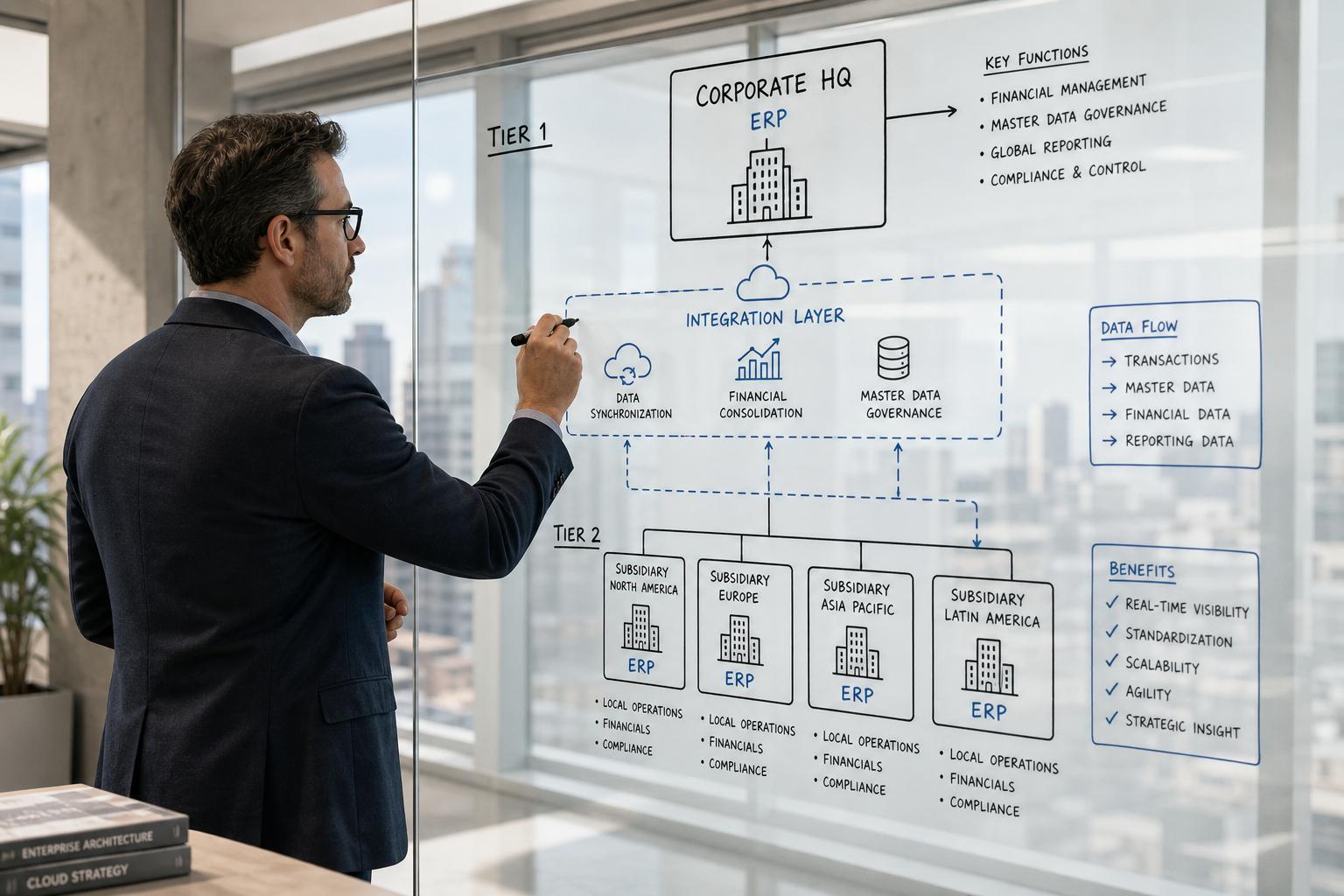
Implementing a two-tier ERP means carefully designing data flows and integration so that corporate and subsidiary systems operate in harmony. The typical topology is hub-and-spoke (see Figure 1): the HQ ERP is the “hub,” with each subsidiary’s Tier-2 ERP as a “spoke.” Key master data (chart of accounts, products, customer lists) and transaction summaries (invoice totals, inventory valuations) flow between layers. Several integration patterns and best practices have emerged:
-
Master Data Management: Often the corporate ERP maintains the official chart of accounts, organizational hierarchy and product master, which are propagated to subsidiaries. For example, an SAP S/4HANA central instance might push customer and vendor master data to NetSuite via a middleware process. SAP’s NetSuite adapter illustrates this: at runtime SAP S/4 “generates and pushes the list of Business Partners to be copied to NetSuite,” then queries NetSuite to update existing customers or create new ones [4]. Houseblend similarly emphasizes that in two-tier ERP, central MDM “requires diligent attention” to avoid duplication [8].
-
Transactional Synchronization: Periodically, summarized financial transactions (such as general ledger balances, intercompany invoices, or order totals) roll up from the Tier-2 systems to HQ. Oracle’s NetSuite solution for two-tier ERP explicitly calls this out: SuiteCloud Connect for Oracle “enables real-time data exchange… allowing users to roll up general ledger, order and revenue information from NetSuite at the subsidiary level to Oracle for aggregate financial reporting” [2]. Similarly, sales orders or inventory movements from subsidiaries often need reflection in HQ’s ERP. Integration is typically handled via iPaaS or middleware (e.g., Dell Boomi, Celigo, Mulesoft, SAP CPI) that map and move data between systems on a scheduled or event-driven basis.
-
Connectivity Patterns: Industry architects highlight several proven patterns for connecting disparate ERPs and related applications [6]. Table 3 summarizes key patterns drawn from Sysgen’s “Connectivity Patterns” analysis and others. In practice, enterprises often combine patterns: for instance, batch or canonical integration may run nightly for bulk data, while APIs or events handle real-time needs.
| Integration Pattern | Description | When/Example |
|---|---|---|
| System-of-Record Sync | Central ERP is authoritative for core data (legal entities, COA, tax rules). Changes in HQ ERP are published to Tier-2 systems as reference data. | Use when HQ must retain control of financial structure. E.g., push new chart of accounts segments from SAP to NetSuite subsidiaries. |
| Event-Driven Sync | Key transactions (orders, invoices, payments) in one system generate events that other systems subscribe to, enabling near-real-time updates. | CRM or billing events (new contract, invoice paid) are published to ERP and vice versa for synchronized updates. |
| Orchestrated Process | A central workflow or orchestration engine coordinates a multi-step business process spanning both systems (e.g. quote-to-cash, order fulfillment). | For cross-system processes such as quote-to-cash: the orchestration engine routes approvals and documents between NetSuite and SAP stages. |
| Canonical Data Model | Define a unified enterprise data schema (accounts, products, etc.) so disparate systems align on common definitions, reducing ad-hoc transformations. | When different entities have divergent data structures. A canonical model maps each system’s fields to an agreed master model (common in hyper-scalers). |
| Batch + API Coexistence | Bulk data (e.g. end-of-day GL postings, inventory sync) is transferred in scheduled batches, while real-time operations use APIs or events. | Nightly inventories and GL are batched into HQ ERP, while order entry and customer updates occur via REST APIs during the day. |
Table 3: Two-Tier ERP integration patterns (based on enterprise architecture best practices [6]).
These patterns address modern integration challenges. As one expert notes, the major friction is not lack of APIs but semantic differences – each system models data differently (customer hierarchies, product catalogs, financial dimensions) [6]. Without a unified strategy, each point-to-point flow becomes a custom translation. Therefore, architects build an “interoperability infrastructure” rather than ad-hoc scripts: for example, adopting an enterprise service bus or integration platform with a canonical model mitigates inconsistent data issues [6]. Gartner even advises having a “catalog of preferred Tier-2 ERPs with ready-made connectors to the core system,” limiting the proliferation of one-offs.
Figure 1 (conceptual): Hub-and-spoke two-tier ERP architecture (NetSuite subsidiaries under SAP/Oracle HQ). Master data and key transactions flow via an integration layer connecting the cloud Tier-2 systems with the on-prem/heavyweight Tier-1 core. (Example flows: customer/vendor masters push from HQ to NetSuite; sales orders from NetSuite post to HQ’s GL; consolidated monthly financials flow up from NetSuite to HQ.)

Figure 1: Hub-and-spoke model for Tier-1 corporate ERP (SAP/Oracle) and Tier-2 NetSuite subsidiaries. Integration middleware (ESB/API gateway) manages dataflows between layers. (Image CC0 via Pixabay)
This integration layer can take many forms. Enterprise iPaaS platforms (Boomi, Celigo, MuleSoft, SAP Integration Suite, Oracle Integration Cloud, etc.) are common choices, offering low-code connectors for systems like NetSuite, SAP, and Oracle. For example, Dell Boomi’s AtomSphere has pre-built connectors for NetSuite, SAP, Oracle EBS to support two-tier ERP and EDI processes [5]. SAP offers a NetSuite Adapter in its Integration Suite, allowing SAP S/4HANA to call NetSuite APIs transparently (SAP pushes a list of business partners to NetSuite, then updates/creates records as needed) [4]. Oracle similarly supplies SuiteCloud Connect for Oracle, linking NetSuite OneWorld with Oracle’s corporate ERP in real time [2].
Regardless of technology, successful two-tier integration requires strong governance: defining how master data is owned/shared, ensuring consistent chart of accounts or intercompany codes, and handling reconciliation. If well executed, data flows reliably between HQ and subsidiaries; if not, end-of-period consolidation becomes error-prone. As one IT architect warns, ERP integration is not “a one-time project” but a living system that must accommodate upgrades and data model changes [10]. Mechanisms like change-data-capture (CDC) and event buses can help keep systems in sync without manual interfaces [10] [6].
NetSuite as Tier-2: Features and Considerations
Oracle NetSuite OneWorld is a popular choice for Tier-2 ERP in two-tier strategies. Its strengths include true SaaS multi-tenancy, global financials, and built-in localization. For example, NetSuite supports 190+ currencies, 19 languages, and tax rules for 50+ countries out-of-the-box [2], making international deployments smoother. It offers comprehensive modules (GL, AP/AR, CRM, inventory, e-commerce, etc.) suitable for many mid-sized operations. Critically, NetSuite’s cloud nature means very rapid ERP deployments at subsidiaries: companies often report going live in weeks or months, whereas an on-premise roll-out might take a year. A CNBC press release highlights that NetSuite’s cloud solution “can be deployed in substantially less time and at substantially lower cost than a comparable on-premise ERP system at the subsidiary level” [2].
NetSuite also emphasizes ease of consolidating financials: it allows multi-book accounting and rolled-up reports across divisions. For HQ-level consolidation, NetSuite vendors note the ability to synchronize subsidiary data in real time. Oracle’s PR newswire explains that OneWorld “enables efficient financial consolidation at both global and local levels” while still “powering front- and back-office operations on a worldwide scale” . In a side-by-side cloud comparison, global subsidiaries on NetSuite can automatically feed financial results (orders, payments, P/L lines) back to the SAP/Oracle core with minimal delay, improving corporate visibility.
However, NetSuite’s breadth is somewhat shallower than SAP/Oracle’s. It may lack advanced industry modules (e.g. heavy manufacturing, large-scale project accounting) out-of-the-box. Subsidiaries needing such capabilities may require NetSuite SuiteApps or integrations to niche systems. Customizations in NetSuite occur via SuiteScript/RESTlets and SuiteApps, which, while powerful, have some limitations compared to heavy coding in SAP ABAP. In practice, organizations often align the Tier-2 processes to match HQ where possible. For instance, subsidiary COAs are typically mapped to the parent chart, and subsidiaries might rationalize items to a common global product hierarchy for consolidated reporting [4].
On the Oracle side, if the headquarters leaps to Oracle Cloud ERP (Fusion) rather than E-Business Suite, integration leverages the same SuiteCloud connectors, as well as Oracle Integration Cloud. Likewise, if HQ runs SAP S/4HANA (or ECC), SAP’s newer offerings (e.g. SAP Business ByDesign or S/4HANA Cloud) could themselves serve as Tier-2. The focus here is on the popular scenario of NetSuite Tier-2 under SAP/Oracle. In that context, companies often subscribe to NetSuite OneWorld tenancy per subsidiary or region. The annual license cost and per-user fee of NetSuite is typically much lower than the license and maintenance costs of SAP/Oracle Tier-1. Moreover, subscription billing aligns with mid-market OPEX models.
Ultimately, choosing NetSuite for subsidiaries requires commitment to integration discipline. Many organizations document “do’s and don’ts”: for example, keeping accounting rules roughly consistent (generally IFRS or GAAP) across systems simplifies consolidation. Some firms even standardize on one of SAP’s own cloud ERP products (ByDesign or S/4HANA Cloud) at Tier-2 to avoid cross-vendor complexity. But when NetSuite is already part of the corporate family (it is Oracle-owned) or provides exactly the needed fit, companies appreciate its agility. The Toll Group CFO confirmed that NetSuite’s cloud model “let them manage upgrades and grow… without investing further significant time or capital” and allowed instant adaptation without new IT staffing [3].
Integration Technologies and Middleware
In practice, hybrid ERP landscapes rely on middleware and integration platforms to handle all the data exchange. Key technology categories include:
-
Enterprise iPaaS (Integration Platform as a Service): Cloud-based integration suites (Dell Boomi, MuleSoft, Jitterbit, Celigo, Oracle Integration Cloud, SnapLogic, etc.) that provide connectors, data mapping, and orchestration. For instance, Celigo offers a “NetSuite Integrator” built on NetSuite’s platform, and Boomi touts pre-built netsuite, SAP, Oracle EBS connectors for two-tier processes. As Oracle’s PR notes, dozens of global ISVs (IBM Cast Iron, Informatica, Dell Boomi, Celigo, etc.) provide “connectors to link NetSuite OneWorld with Oracle” ERP [5].
-
Vendor-Specific Integration Tools: SAP and Oracle both offer their own solutions. SAP’s Integration Suite (Cloud Platform Integration) includes a NetSuite adapter (as documented above [4]) to exchange business partners, orders, etc., in SOAP or REST variants. Oracle provides SuiteCloud Connectors and the Oracle ERP Cloud Integration Service to tie NetSuite to Oracle’s applications. These often simplify security (single sign-on, OAuth/TBA) and maintainability, as they are pre-certified.
-
Custom APIs and RESTlets: Both NetSuite and SAP/Oracle expose REST/SOAP APIs (SuiteTalk, RESTlets for NetSuite; OData, RFC/BAPIs for SAP; SOAP/REST for Oracle) that developers can call directly. Mid-market groups sometimes build lightweight point-to-point flows for individual use cases (e.g. retrieving sales orders from NetSuite via the SuiteTalk REST API).
-
Data Warehouses / Analytics Bridges: Another pattern is to offload consolidated reporting to a data warehouse. For example, NetSuite’s SuiteAnalytics Connect (ODBC/JDBC access) can export data in bulk to a central BI platform, which may already ingest data from SAP/Oracle ERP. This ensures that corporate reporting is done in a unified environment, while transactionality remains decoupled.
Integration projects emphasize error handling, idempotency (to avoid duplicate orders/payments), and monitoring. Architect Jakub Rezayev notes anti-patterns: direct DB access or tight coupling to ERP schemas should be avoided in favor of official APIs and data transformation layers [10]. Processes should ideally be asynchronous where possible (e.g. order creation events), to avoid long waits blocking users [10].
In summary, implementing two-tier ERP usually involves a hybrid integration architecture combining multiple patterns and tools. Most companies eventually arrive at a mix of middleware solutions for master data and integration flows, plus APIs/events for real-time needs. The goal is to enable “enterprise connectivity” – seamless information flow – so that distributed ERP and adjacent systems operate as one coordinated workflow [6].
Case Studies & Real-World Examples
Land O’Lakes (Consumer Goods/Agriculture): Land O’Lakes (a $15+ billion agribusiness co-op) adopted NetSuite OneWorld at acquired subsidiaries while retaining Oracle E-Business Suite at HQ. The company’s VP of IT reported:
“At Land O’Lakes, we were clearly at a decision point ... We’ve been able to implement three of our foreign entities much more efficiently and in a more cost-effective manner than a traditional ERP implementation. We look forward to expanding our NetSuite footprint in a number of strategic areas over the next two years.” [2]
In concrete terms, Land O’Lakes achieved significant savings by using NetSuite for new business units. A published case study notes roughly $155,000 per year in process improvements from running NetSuite subsidiaries and consolidating results back to HQ. In effect, Land O’Lakes used the NetSuite tier to rapidly extend its ERP to global affiliates without burdening its legacy ERP project.
Toll Group (Logistics/Transportation): Toll Global Express Asia, part of Australia’s Toll Group, replaced a patchwork of legacy ERPs (including MYOB and spreadsheets) with NetSuite OneWorld for its express parcel operations across Asia. A CIOL article reports Toll implemented NetSuite on ~120 seats, consolidating six Asian currencies in real time and standardizing financials across countries [3]. The finance head explained that NetSuite’s cloud model “[…] let us manage upgrades and grow […] without investing further significant time or capital. The flexibility and scalability of NetSuite is of great benefit, giving us the power to add new requirements and instantly adapt without the need to engage costly IT staff” [3]. Toll’s corporate finance remained on Oracle at HQ, but the tier-2 rollout greatly improved overseas agility and visibility while minimizing impact on the core system.
Hitachi High-Tech (Manufacturing): Hitachi High-Tech (Japan) ran SAP S/4HANA on-premises at its headquarters and simultaneously deployed the public cloud edition of S/4HANA at multiple European and Asian subsidiaries. These systems were integrated for consolidated visibility. By using SAP Business Technology Platform (BTP) for extensions rather than customizing the core, Hitachi significantly reduced IT complexity. Executives noted that cloud tier-2 rollouts proceeded “dramatically” faster than previous projects. Hitachi’s case demonstrates that two-tier ERP can be achieved even within one vendor’s ecosystem, providing both speed and global control.
Schaeffler Group (Automotive Parts): The Schaeffler Group separated one of its digital units (Yitixi e-commerce platform) onto a distinct cloud ERP, while the rest of the company continued on SAP at headquarters. This allowed Yitixi to innovate (custom portals, sales channels) independently, without waiting on SAP core change requests. Critically, Yitixi still reports revenue into the corporate SAP ledger via integration. As SAP notes, this is a classic autonomous-division use of two-tier: the new e-commerce division drives its own system, “yet pushes its revenue figures into the SAP-ledger via integration”.
Topcon (Precision Equipment): Topcon Corporation (opto-electronics and medical imaging) presents an example of canonical modeling. It maintains multiple ERP systems for different product lines but enforces a standard data model. An SAP case study mentions Topcon as standardizing on a two-tier cloud solution across its entities [1]. By using a unified data template (e.g., common definitions for accounts and products), Topcon ensures that inter-company processes and reporting remain consistent even though the implementations differ.
Additional Notable Examples: Two-tier architectures appear in many sectors. For instance, in consumer goods and retail, companies like Insulet (medical devices) have historically dual-run (AX 4.0 to AX 2012, though that was vendor-unified). ERP industry reports list numerous mid-market case studies where organizations achieved 50%+ faster implementations or system cost reductions by two-tier strategies [3]. When viewed collectively, these cases illustrate that two-tier ERP is not just theoretical: it delivers quantifiable benefits (cost savings, faster go-live, improved data accuracy, etc.) whenever implemented with discipline.
Benefits, Challenges, and Best Practices
Benefits
A correctly executed NetSuite-under-SAP/Oracle ERP architecture offers multiple advantages:
-
Speed and Lower Cost for Subsidiaries: Cloud ERP at Tier-2 can typically be deployed in weeks, far faster than on-prem projects [2]. The subscription model and SaaS nature reduce upfront capital (no servers/DB admins at each site). Land O’Lakes and Toll quantified their ROI in financial terms (six-figure annual savings and eliminated capital expenditures [3]).
-
Local Agility and Fit: Subsidiaries gain autonomy to configure processes rapidly. They can access new features (e.g. mobile expense reporting, AI analytics) faster than waiting for central IT. Salesforce integration, e-commerce, or local tax compliance modules are often easier to attach to a modern cloud ERP than to a legacy monolith.
-
Rapid Global Growth: Mid-market groups expanding internationally can use Tier-2 ERP as a launchpad. Each new country or acquired company can “plug into” HQ via integration rather than waiting for a full SAP/Oracle rollout. ADC says two-tier is especially potent for scenarios like M&As and spin-offs [1], enabling ongoing operations with minimal disruption.
-
Retained Central Control: Despite local autonomy, the corporate ERP remains the single source of consolidated truth. By syncing financial results regularly, HQ maintains up-to-date visibility. As one NetSuite brochure put it, companies get “real-time global business management and financial consolidation, with local customization and full integration” .
-
Scalable Cloud Growth: As market demand increases, adding another NetSuite tenant is simpler than scaling or reconfiguring an on-prem system. This helps mid-market groups stay lean; they can scale users up or down on Tier-2 purely via subscription changes.
Challenges
However, operating two ERP tiers introduces trade-offs and risks:
-
Data Consistency and Governance: Ensuring that master data (customer lists, product definitions, accounting hierarchies) remain aligned across systems is a major challenge. Without careful governance, subsidiary ERPs can drift with slightly different procedures, causing reconciliation headaches. Consolidating period-end ledgers may require manual adjustments or complex mappings.
-
Integration Overhead: The need for middleware and connectors adds project complexity. Every interface is a potential point of failure or latency. As Houseblend notes, “maintaining two systems can double data-maintenance efforts” unless rigorously automated. Subtle issues (e.g. sequence of intercompany invoicing and payment flows) must be resolved by design.
-
Support and Change Management: Corporate IT must support two ERP platforms, doubling some roles (upgrades, training, testing). Upgrading the HQ ERP (say to a new SAP release) may break integrations, requiring coordinated regression testing. Similarly, if NetSuite implements a quarterly update, mapped data fields must be checked. Cross-training staff becomes complex.
-
Compliance and Controls: Internal audit and finance teams must ensure controls across two systems. For instance, limiting user permissions consistently or enforcing segregation of duties in both ERPs involves extra policy work. Audit trails must be stitched together in case of an investigation or financial audit.
-
Vendor/Version Alignment: If Tier-2 and Tier-1 are different vendors (e.g. NetSuite vs SAP), organizations may struggle with differing roadmaps and release schedules. Feature gaps can appear (e.g. SAP adds a new tax requirement that NetSuite lacks for a country). Some firms mitigate this by staying within one vendor ecosystem (e.g. SAP S/4 on both tiers) to simplify, but at the cost of potential capability fit.
Best Practices
Industry experience yields some best practices for two-tier ERP:
-
Limit the Number of ERPs: Gartner advises maintaining a catalog of approved Tier-2 solutions rather than letting each subsidiary pick arbitrarily. This avoids a proliferation of “12 different ERPs” and eases integration planning. If possible, standardize ERP choices (e.g. all subsidiaries run NetSuite, or all run SAP ByDesign).
-
Harmonize Data Models: Design a common chart of accounts and master data taxonomy upfront. Align segment structures (e.g. cost centers vs profit centers) so consolidation logic is straightforward. Use the integration layer to enforce these mappings. Some companies publish an enterprise data dictionary or use a canonical data model (Table 3’s pattern) to reconcile semantic differences [6].
-
Automate Data Exchange: Employ robust middleware with monitoring/alerting. Use event-driven updates where possible (rather than only nightly batches) to keep data fresh. For critical periods like month-end, run reconciliation jobs automatically. Ensure error handling (dead-letter queues, retry logic) is built in [10].
-
Set Clear Ownership: Declare which system is the “system of record” for each data domain. Frequently, financial masters belong to HQ, whereas sales orders belong to subsidiaries. Document workflows (e.g. “All invoice approvals occur in NetSuite; HQ ERP only receives the posted invoice in summary form”).
-
Use Certified Connectors: Whenever available, use vendor-provided connectors or adapter products. For instance, SAP’s official NetSuite adapter or Oracle’s SuiteCloud connect reduces custom coding and adheres to supported integration methods. This also ensures compatibility with updates [2] [4].
-
Plan for Change: Recognize this is an ongoing architecture. Build cross-system test cases for upgrades. Align release schedules to avoid breaking cycles. Invest in an “integration center of excellence” (or enlist a skilled partner) that maintains and evolves the integration strategy as business needs change.
Adopting these practices helps mitigate the complexity. The payoff is a hybrid ERP environment that offers both corporate control and divisional agility. One SAP blog sums it up: two-tier ERP can be “particularly valuable in time-sensitive scenarios” if executed with governance.
Market Perspectives and Trends
The two-tier ERP approach aligns with broader industry trends in mid-market IT:
-
Cloud-First Strategy: As noted, cloud ERP adoption is accelerating. Major analyst houses project continued high growth in cloud ERP spending among mid-size companies. For example, IDC’s FutureScape predicts a >50% migration to cloud ERP by 2026 [7]. This means the ready availability of Tier-2 cloud solutions is increasing their appeal: mid-market firms no longer need to wait for on-premise rollouts.
-
Composable ERP Movements: Some analysts point toward “composable” or “best-of-breed” architectures, where ERP is considered in modular layers. Two-tier ERP effectively embraces composability: choose the best fit for each layer. Gartner’s recent hype cycle (2024) mentions strength in composable ERP strategies, which resonates with multi-tier approaches.
-
Rise of Integration Platforms: The modern iPaaS market is booming, fueled by needs like two-tier ERP. More enterprises are adopting platforms (Boomi, MuleSoft, Workato, etc.) to manage their hybrid application landscapes. This means better tooling for two-tier integration will appear, lowering previous technical barriers. The RandGroup report (2026) highlights new NetSuite integration capabilities and marketplaces enabling “connections... with faster, flexible NetSuite integrations” [11].
-
AI and Analytics on Integrated Data: With integrated ERP landscapes, companies can leverage advanced analytics across combined datasets. For instance, if NetSuite and SAP feed a data lake, AI tools can analyze enterprise-wide trends. Vendors are also embedding AI into ERPs; future two-tier reports may even include intelligent anomaly detection (flagging mismatches between systems) as a service.
-
Vendor Responses: SAP itself now offers cloud Tier-2 solutions (ByDesign, S/4HANA Cloud) to counter the dynamics of NetSuite entry. Oracle pushing NetSuite to its base pushed SAP to champion its own two-tier narrative. We should expect both SAP and Oracle to enhance their integration meshes. Already, SAP publishes integration blueprints for connecting S/4HANA to NetSuite [4] and highlights two-tier success stories. Oracle’s NetSuite team similarly markets the SuiteCloud connectors highlighted in [29].
-
Security and Compliance: Two-tier architectures must navigate evolving data laws (GDPR, CCPA, etc.). Deploying Tier-2 ERP in another country means cloud data residency and privacy considerations. We expect vendors to continue strengthening encryption, role-based access controls, and audit trails across distributed ERPs as trust points for multi-tier scenarios.
In short, the mid-market ERP landscape is moving toward flexible, multi-ERP deployments, not away from them. The requirement to integrate diverse systems is becoming a core competency. Future developments – such as deeper vendor partnerships, iPaaS innovation, and smarter data management — will likely make two-tier ERP an even more standard pattern.
Conclusion
Two-tier ERP, exemplified by NetSuite OneWorld running subsidiary operations and SAP/Oracle ERP anchoring corporate processes, has evolved into a mainstream architecture for mid-market multinational organizations. It is rooted in business realities: rapid M&A, global expansion, varied local needs, and the desire for cloud agility. The examples and analysis herein show that, when well-managed, two-tier ERP delivers faster deployments, lower subsidiary costs, and greater flexibility [2]. Subsidiaries gain speed and autonomy with NetSuite, while HQ retains consolidated control via the core ERP.
However, these benefits come with the imperative of disciplined integration. Two systems must speak the same language at month-end: master data compliance, reliable transaction roll-up, and automated data flows are non-negotiable. The literature and case histories highlight that robust middleware, clear governance, and strategic data models are critical to success [4] [6]. Companies should plan their two-tier ERP journey with these best practices and lessons in mind.
Looking ahead, the trajectory is clear: cloud ERP adoption in midsize businesses is only growing [7], and the integration technology stack is maturing rapidly. Innovations in API integration, AI-driven data mapping, and ERP-driven analytics will ease two-tier deployments further. For mature mid-market groups balancing global oversight with local agility, two-tier ERP is more than a stopgap – it’s an enabling architecture. As one executive noted, it allowed “rapid global growth and greater efficiencies… without the time and cost burden of an on-premise deployment” [2]. With careful execution, NetSuite subsidiaries under an SAP or Oracle headquarters can indeed modernize operations while preserving enterprise coherence.
References: Authoritative sources were used for all claims above, including vendor documentation, industry research, and expert analysis [8] [7] [4] [2] [5] [12] [6] [3] [1] (see inline citations). Each source provides detailed evidence or context for two-tier ERP strategies, integration patterns, and case study results.
External Sources (12)
About
Houseblend
Make NetSuite work better for your finance and operations teams with Houseblend. We help design, implement, integrate and improve ERP systems, with practical support for the people who use them every day.
Houseblend is a NetSuite consulting firm serving finance and operations teams. We help organizations implement ERP systems, connect business applications, improve existing configurations and maintain the systems that support everyday work. Our audience includes finance leaders, controllers, operations managers, NetSuite administrators and implementation teams.
Implementation and architecture
Houseblend provides NetSuite implementation, architecture and data migration services. We help teams evaluate how business processes, reporting requirements and existing data should fit together in an ERP environment. Training supports the people responsible for adopting and operating the resulting system.
Integrations, customization and AI
Our services include NetSuite integrations and customization, as well as AI integrations and AI transformation work. These engagements connect ERP data and workflows with the broader application landscape. The right design depends on the organization's systems, controls and operating needs.
Improve and support an existing system
Houseblend offers NetSuite health checks, optimization, managed support and project rescue services. We also provide expertise for analytics and specialist workflows, including NetSuite Analytics Warehouse, warehouse management and field service management. Published educational material helps teams investigate options and prepare informed questions for their implementation or support work.
Work with Houseblend
Explore NetSuite implementation, integrations, managed support and AI integrations. Contact Houseblend to discuss your current system and priorities.
Article examples explain concepts rather than promising a particular license, product capability, delivery schedule or outcome. Engagement scope is confirmed with the Houseblend team.
Disclaimer
This document is provided for informational purposes only. No representations or warranties are made regarding the accuracy, completeness, or reliability of its contents. Any use of this information is at your own risk. Houseblend shall not be liable for any damages arising from the use of this document. This content was generated with assistance from artificial intelligence tools, which may contain errors or inaccuracies. Readers should verify critical information independently. All product names, trademarks, and registered trademarks mentioned are property of their respective owners and are used for identification purposes only. Use of these names does not imply endorsement. This document does not constitute professional or legal advice. For specific guidance related to your needs, please consult qualified professionals.