Houseblend Article
NetSuite Autonomous Close: Capabilities and Limitations
Inside this article
- 01Executive Summary
- 02Introduction: The Month-End Close Challenge
- 03Evolution to Continuous and AI-Enabled Close
- 04NetSuite’s Autonomous Close: Core Capabilities
- 05What NetSuite’s Autonomous Close Automates
- 06What NetSuite’s Autonomous Close Does Not Automate
- 07Data and Evidence: Benefits of Automation
- 08Case Studies and Real-World Examples
- 09Implications and Future Directions
- 10Conclusion
NetSuite Autonomous Close: What It Actually Automates (and What It Doesn't)
Executive Summary
Month-end and period-end financial closes have long been a major bottleneck for businesses. In the survey of corporate finance teams, roughly 50% of finance organizations report a close cycle of six business days or more, with nearly 25% taking a full week or longer [1] [2]. Manual review, fractured systems, and spreadsheet workflows are cited as primary obstacles: 50–60% of practitioners say reliance on Excel and cross-team dependencies slow their closes [3] [4]. In this challenging context, Oracle NetSuite has introduced Autonomous Close, a suite of AI-driven capabilities (announced SuiteWorld 2025) aimed at automating routine close tasks end-to-end. According to initial demos and reports, the system continuously monitors transactions, auto-assigns and posts adjustments (journal entries, recurring items, accruals, etc.), performs reconciliations, and highlights exceptions throughout the period [5] [6] [7]. Oracle’s internal testing even suggests up to 98% of routine transactions can be handled automatically [8] [9].
Despite this, Autonomous Close is not a fully “hands-off” solution. Certain tasks must remain manual or judgment-driven. Experts emphasize that accounting estimates, materiality judgments, and complex exceptions still require human review [10] [11]. For example, while the system can flag anomalies (e.g. a sudden revenue spike), a human must interpret whether it is a valid business driver or a mispost [10]. Likewise, uncovering and fixing underlying data or integration errors remains a human-driven task [12]. In short, Autonomous Close automates predictable, rules-based work (posting, matching, accruals, simple error-checks), but does not replace human judgment or the need for approvals and final sign-off [10] [13].
This report provides an in-depth analysis of NetSuite’s Autonomous Close: its origins, underlying technology, specific capabilities and limits, real-world impacts, and future directions. We draw on Oracle documentation, industry surveys, expert analyses, and illustrative case examples. Section highlights include:
-
Background: The traditional close process is laborious and error-prone [14] [2]. Finance teams often spend tens of hours reconciling accounts and wrangling spreadsheets every month [15] [16]. Over 85% of finance executives consider their close processes “fairly mature,” yet a majority still seek faster, more automated closings [17] [18].
-
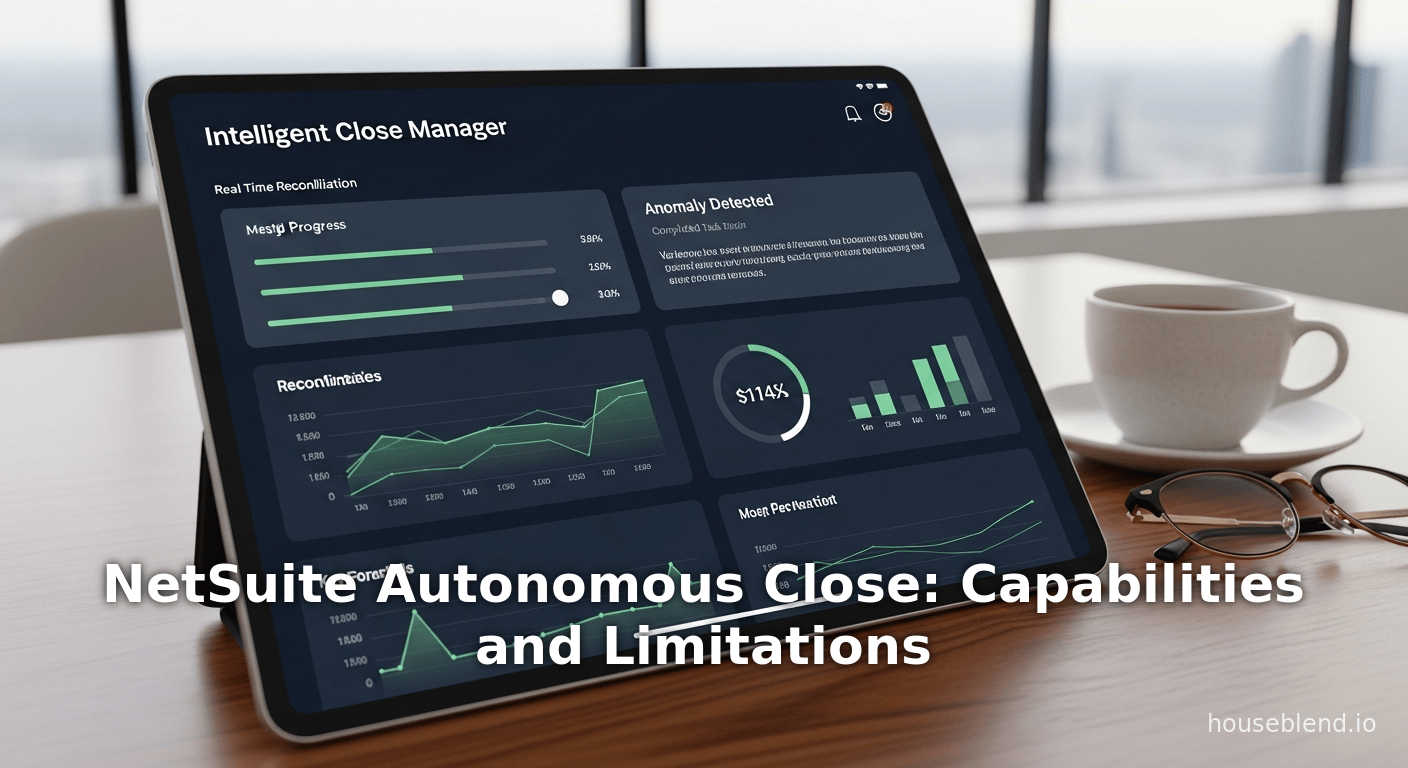
Technical Overview: Built on the new “NetSuite Next” AI platform, Autonomous Close continuously evaluates live transactional data. It automates tasks such as recording recurring journals, matching bank and credit card feeds, executing predefined accruals/allocations, and maintaining task-checklists [5] [7]. It flags anomalies via machine learning, generates alerts, and in some cases even drafts variance explanations [6] [19]. A centralized Intelligent Close Manager dashboard consolidates tasks, KPIs, and exceptions across subsidiary ledgers [20] [19].
-
Automated Tasks: In practice, Autonomous Close shifts routine closing work to the system. It can auto-post transactions when predefined ( vendor bills, recurring revenue, etc.) and lock periods once validations pass [21]. It performs auto-reconciliation for bank, AR/AP, and GL accounts using rules and AI-matching, drastically reducing manual matchwork [7] [6]. Accruals and allocations (e.g. payroll accruals, prepaids) run on schedule without intervention [22]. A built-in checklist engine monitors close activities, ensuring completeness and catching missing entries early [5] [23].Together, these capabilities promise major reductions in close time – for example, one tech sector client reportedly cut its close from 10–15 days down to 3–5 days using NetSuite’s system [24].
-
Unautomated Tasks: We also delineate what isn’t automated. Accounting judgment calls remain in human hands. AI can flag an unexpected balance shifted or a threshold breach, but management must interpret what to do [10]. Complex reconciliations or exceptions (e.g. currency mismatches, integration failures) still need manual resolution [12]. Tasks that cross systems (e.g. payroll, third-party billing) can only be monitored, not magically fixed by NetSuite [25]. And all approvals, financial signoffs and final audit reviews remain human responsibilities.
-
Case Examples: We include real-world scenarios. For instance, TechlyCodes reports a multi-entity finance team that used NetSuite’s period-locking rules to reduce post-close adjustments by over 60% [21]. Another company saw bank reconciliation time drop from two days to mere hours by leveraging automated feed matching [7]. These examples illustrate both the promise and the pragmatic rollout of Autonomous Close.
-
Implications & Future: We discuss how finance roles will shift toward exception management [26] [10], and the strategic implications of near-real-time closes. Surveys (Grant Thornton CFO signals, CFO.com, etc.) suggest strong interest in AI-driven close: e.g. 68% of CFOs want more automation in closing [27]. We also address challenges – data readiness, governance, and adoption strategies (drawing on NSGPT’s guidance [28] [29]) – and consider how Autonomous Close may evolve, including competition (e.g. embedded BlackLine-like features [30]).
Overall, NetSuite’s Autonomous Close represents a major advancement toward “lights-out” accounting, automating a large fraction of routine close work [5] [6]. However, it is not a magic wand: finance leaders must still manage exceptions and retain oversight. This report compiles extensive data, expert commentary, and case studies to clarify exactly which processes can or cannot be handed over to the system.
Introduction: The Month-End Close Challenge
Closing the books has always been a labor-intensive, error-prone endeavor. Even with modern ERP systems, the traditional month-end close relies heavily on spreadsheets, manual reconciliations, and last-minute adjustments. A recent Houseblend analysis notes that “50% of finance teams still take six or more business days to close” [31]. In fact, only about 18% of organizations achieve a truly rapid 1–3 day close cycle [31]. The consequence is often stale financial data: managers must make decisions weeks after transactions occur.
Several factors contribute to this lag. Data fragmentation across ERP modules, CRM, banking, and spreadsheets is common. Finance teams report that over 90% still rely heavily on Excel spreadsheets during closing [3]. Such manual processes introduce errors: as one industry guide puts it, spreadsheet-driven closing “creates risk, not control” [3]. Not surprisingly, CFO.com research finds that data quality issues, legacy systems, and Excel-dependency are top bottlenecks [32] [4]. Even routine tasks like cash reconciliations can consume 20–50 hours per month in mid-market companies [33]. Survey data underscores the frustration: more than half of finance leaders cite cross-team dependencies as slowing their close, and roughly half point to Excel-driven processes as a major barrier [4] [16].
These persistent challenges have led finance leaders to seek automation. Indeed, 85% of finance executives characterize their current close process as “fairly mature or sufficient,” yet a majority still want more improvement, especially via technology [17] [18]. In Grant Thornton’s Q1 2024 survey, 68% of CFOs said they want automation enhancements in their close processes, and 53% demanded more timely actionable data from closing [17] [18]. Furthermore, over half of CFOs are actively adopting AI: one survey reports that 54% of finance leaders already use generative AI for financial operations [34]. In short, the demand is clear: finance teams seek tools that reduce manual toil and accelerate closes.
The buzzword “Autonomous Close” has emerged to describe this autonomy. As Datarails explains, an autonomous close is one “run [by] automation and AI with minimal human involvement,” where tasks like reconciliations, journal entries, and report generation happen continuously throughout the month [35]. In this paradigm, humans intervene mainly to review exceptions or validate the AI’s results [35]. The goal is a faster, more reliable close, freeing accountants to focus on analysis rather than busywork. NetSuite’s new feature suite builds on exactly this vision.
This report explores NetSuite’s Autonomous Close feature in detail. We will first outline the evolution of continuous close thinking and situate NetSuite’s approach in the broader trend toward AI-enabled ERPs. Then we’ll dissect what specific tasks NetSuite’s Autonomous Close actually automates, citing both vendor materials and independent analyses. Equally important, we will clarify what it doesn’t automate, i.e. tasks that still require humans. We include survey data and case examples to quantify the impact, discuss best practices for implementation, and consider future directions. All statements are backed by authoritative sources (CFO.com, industry surveys, expert blogs, and NetSuite documentation).
Evolution to Continuous and AI-Enabled Close
Before examining NetSuite’s solution, it helps to understand the larger shift in closing methodology. Traditionally, companies perform a big “post” run at month-end: accountants scramble to post adjustments, reconcile sub-ledgers, and prepare reports on T+X. But a continuous close approach has gained favor. In this model, many reconciliation and validation tasks occur throughout the period, reducing end-of-month crunch. For example, automated or embedded matching (bank feeds, subledgers) can clear many items daily. Analytics can be run pre-emptively to catch anomalies early.
NetSuite’s Autonomous Close embodies this philosophy. Instead of “waiting until period-end to investigate variances,” the system monitors transactions continuously during the month, detecting anomalies as they occur [36] [6]. As one ERP consultant writes, NetSuite’s AI “monitors transactions automatically throughout the month, detects anomalies before you try to close, [and] reconciles entries without manual review” [37]. This constant oversight shifts the timing: accountants no longer “pull all-nighters” just when the books close, but can address issues in real-time.
The idea of integrating AI and agents into ERP is relatively new. At SuiteWorld 2025, Oracle NetSuite unveiled “NetSuite Next”, a rebuilt platform where AI is embedded at the core [5] [38]. In this context, Autonomous Close is part of a package of innovations (InfoBlend/Ask Oracle assistants, Narrative Insights, etc.) intended to revolutionize work. Industry observers note the ambition: moving from a system of record to a system of reasoning, where the ERP does more of the thinking [38] [5]. Autonomous Close is positioned as Netsuite’s entry into the “lights-out” finance model: Houseblend describes it as “a major step toward ‘lights-out’ finance operations” [5].
Other vendors have similarly aimed at a continuous close, of course. Solutions like BlackLine have long offered ERP-neutral modules for automating reconciliations and tasks. The strategic novelty here is embedding largely the same capabilities within NetSuite, eliminating integration slack. As one analyst quipped, this is “something BlackLine has done for quite a while – nice to see it embedded in the system” [30]. We will later contrast NetSuite’s in-ERP approach with external close software, but first we must detail exactly what NetSuite’s Autonomous Close does.
NetSuite’s Autonomous Close: Core Capabilities
Autonomous Close is a suite of new, AI-driven features in NetSuite (released across 2025–2026) designed to orchestrate the entire close process with minimal manual intervention. At its heart are Intelligent Close Management tools that constantly analyze transaction flows and drive background processes. Key advertised capabilities include:
-
Continuous Transaction Monitoring: All financial transactions (AP, AR, GL entries, bank entries, etc.) are observed in real-time. The system builds an expected activity model and flags deviations immediately. Subsystem activity is compared against prior trends so that anomalies (unusual spikes, missing entries, etc.) surface promptly [20] [19].
-
Automated Posting and Period Discipline: NetSuite can automatically post routine entries based on rules. For example, recurring journals, depreciation, intercompany transfers, or known recurring expense accruals are generated by the system. NetSuite also supports automated period locks. One customer case described how post-close adjustments dropped by over 60% after implementing automated rule-based period locking once pre-close validations passed [21]. The general effect is to enforce good close (“no sneaky entries after sign-off”) and reduce last-minute scrambles.
-
Automated Reconciliation and Matching: NetSuite has long supported bank and credit card feeds, and Autonomous Close layers AI/machine-learning on top. The system auto-matches most inbound transactions to ledger entries according to defined rules and suggests likely matches for ambiguous cases. TechlyCodes reports that by standardizing bank feeds and letting NetSuite apply matching logic, one firm cut its bank reconciliation time from two days to a few hours, shifting staff to exception review [7]. The new Intelligent Close Manager also consolidates reconciliation tasks: unmatched items become explicit exception tasks for the team [7] [19]. In effect, hundreds of transaction matches are done automatically, leaving only a handful of real discrepancies for human review [7].
-
Accruals, Prepaids, and Allocations: These recurring monthly adjustments are highly predictable and rule-based. NetSuite’s Autonomous Close can be configured to auto-create standard accrual journaling (e.g. payroll accruals, utilities, etc.), amortize prepaids, and allocate expenses across departments/projects as defined. In practice, service companies have used the system to generate payroll and allocation entries automatically. One report notes that “not only was the close faster, it did away with the inconsistent calculations auditors had previously flagged” thanks to consistent AI-driven accruals [22]. The key point is that repetitive recurring entries are offloaded to the system (with pre-set assumptions), while material deviations are flagged for review.
-
Automated Close Checklists / Task Orchestration: NetSuite introduces a Close-Manager interface and dashboard portlet that act as a command center during close. [20] [19]. Here, the system automatically generates and assigns close tasks. For example, if certain transaction types have not been entered by Day X, or if a reconciliation is incomplete, the system will put a task on the checklist. Rules like “no out-of-balances” can auto-generate issue tickets. Intelligent Close Manager aggregates KPIs (exceptions, net income variance, etc.) across subsidiaries [20] [19], giving project managers early warning. In effect, manual checklists and email ping-pong are replaced by an AI-driven task list that lives in the ERP. The system can even enforce dependencies (e.g. you cannot finalize closing entries until bank rec is done) since you build the close calendar into it [29] [20].
-
Anomaly Detection and Narrative Insights: Beyond pure transactions, NetSuite leverages AI to perform flux analysis (variance analysis) throughout the period. Mark Vigoroso notes features like “flux analysis on autopilot”: the system explains causes of variances (e.g. “product A sales are +15% due to region X promotional activity”) before period end [6]. Narrative Insights (not strictly close-only, but related) can auto-generate human-readable variance narratives on reports. Thus, part of the repetitive explanation work is automated – although these are offered more as insights than formal close processes.
-
Integration with SuiteCloud AI Tools: Underneath, Autonomous Close uses the new AI Agents framework. This allows policy-governed automation: for example, a system agent might be authorized to release purchase orders or generate vendor questions automatically if rules appear violated. The announcement highlighted that “AI agents act securely within NetSuite and can execute policy-governed actions” [39]. While details on the agent flows are evolving, the key idea is that many API-driven close tasks (e.g. follow-up on overdue invoices) can soon be automated by built-in AI bots.
Combined, these capabilities amount to an end-to-end continuous close engine. Oracle’s own demonstrations suggested that up to 98% of routine transactions could be processed without human touch [8]. In practice, NetSuite claims this can cut the typical close cycle from several days to ideally zero days, by front-loading the work into the period. Indeed, one blog proclaimed NetSuite is making “zero-day close [a] new reality” [40]. We turn next to a more structured breakdown of what actually gets automated vs what does not.
What NetSuite’s Autonomous Close Automates
To make this concrete, Table 1 below summarizes key close tasks under two regimes: traditional close vs NetSuite’s Autonomous Close. This highlights the scope of automation.
| Close Task / Process | Traditional Process | Autonomous Close (NetSuite) |
|---|---|---|
| Journal Entries (Recurring & Misc.) | Accountants or AP teams manually enter recurring journals (e.g. rent, utilities, depreciation). Period-end adjustments are done last-minute, often via Excel inputs. | Many recurring journals are pre-defined and auto-post each period (depreciation, amortization schedules, recurring accruals). The system can auto-calc and post these entries on schedule. Period locking rules can close books when validations pass [21], reducing surprise post-closes. |
| Cash/Bank Reconciliation | Finance team downloads bank/Credit card statements and attempts to match them to GL entries in Excel (often 20–50 hrs/mo [33]). Unmatched items are chased manually at month-end. | Bank and CC feeds are ingested automatically. Using rule-based and ML-enhanced logic, NetSuite “smart matches” over 90% of transactions, auto-clearing them. Only true exceptions remain for users. In one example, auto-matching cut reconciliation time from 2 days to a few hours [7]. |
| AR/AP Matching | Collections or AP clerks manually reconcile open invoices/credits vs payments; unresolved items require email/mail follow-up. | The system auto-matches incoming payments to outstanding AR, and bills to payments in AP, based on defined criteria. Linked transactions are cleared automatically. Remaining unmatched items appear as exceptions. NetSuite’s Intelligent Close Manager highlights aging or missing payments proactively. (Mark Vigoroso describes “smart reconciliation” where the ERP “automatically matches transactions… surfacing only what needs your attention” [41].) |
| Accruals, Prepaids, Allocations | Often handled in spreadsheets each month. Accountants manually compute accruals (e.g. payroll or utilities) or amortizations; costs are allocated via journal entries. | These predictable tasks are fully automated. Recurring accrual and amortization entries post in the background (e.g. payroll earned vs paid, future utilities billed). Allocation rules (departmental or project spreads) run as scheduled. Audited services firms report that automated accruals not only sped close but also eliminated inconsistent manual calculations auditors previously flagged [22]. |
| Intercompany Eliminations | Multi-entity companies manually eliminate intercompany GL balances before consolidation – a time-consuming task often done outside the system. | NetSuite’s enhanced close features (2026.1) include automation for elimination entries. It can auto-generate intercompany account eliminations and port them to consolidation. Users can drill into elimination journal sources for transparency [42]. While still requiring review, much of the heavy lifting is automated. |
| Variance Analysis | Analysts and controllers manually prepare variance spreadsheets after books close, dissecting which accounts deviated and why (often via pivot tables/ Excel). | NetSuite AI generates continuous variance analytics. The “Flux Analysis” engine continuously monitors account balances in-flight and alerts teams to unusual spikes. By close, many variances already have AI-generated explanations. (As one commentator notes, AI explains trending in natural language, linking deviations to causes [6].) |
| Close Task Management | Use spreadsheets/email to track who has done what. Managers hold daily/monthly status calls. Closing checklists live in Excel, and dependencies are manually enforced by project leads. | The Intelligent Close Manager portlet consolidates all close tasks, KPIs, and exceptions in one dashboard [20] [19]. Tasks are auto-created based on live data (e.g. “Finalize AR aging by X date”). KPIs (outstanding tasks, exceptions, net income variance) are visible by subsidiary. Users filter and drill into tasks easily. In short, close orchestration is automated: missing transactions (gaps) generate tasks, trends are highlighted. Many months-end process steps update automatically [19]. Missing or late items (e.g. unapproved invoices) appear immediately rather than 3 days after period-end. |
| Final Review & Sign-off | Listings of open tasks are reviewed by controller/CFO for completeness. Managers manually approve final financial statements. Often at least one auditor or manager must sign each schedule. | Human oversight remains required. NetSuite assists by summarizing exceptions in the dashboard for review, but the legal close still needs manager sign-off. The system does facilitate the review (e.g. by linking tasks to source records and providing exception drilldowns [10] [19]), but does not replace the final checks and approvals. Finance teams reallocate time to review outliers flagged by AI rather than entering data. |
Table 1: Comparison of key close tasks under traditional vs NetSuite Autonomous Close. Each row shows how routine processes can be automated, and where attention is still needed. The references in the right column (§) illustrate specific capabilities.
In summary, transactions that follow rules or patterns are largely automated by Autonomous Close. This includes postings and reconciliations that can be set up once and repeat each period. For instance, an internal NetSuite demo claimed over 98% of transactions were handled without human touch [8]. Bank/AR/AP matching, recurring journal entries, closing checklists, and variance detection are all being taken over by the system [7] [19]. The gains are tangible: companies adopting these features report dramatically shorter closes. Houseblend cites case studies where NetSuite clients slashed their close from 10–15 days to roughly 3–5 days [24]. Similarly, TechlyCodes describes significant time savings (e.g. a 60% reduction in post-close corrections and near-elimination of spreadsheet work) when organizations treat NetSuite as an autonomous close engine [21] [43].
However – and this is crucial – not every close activity is automated. The next section dissects the boundaries of automation.
What NetSuite’s Autonomous Close Does Not Automate
While Autonomous Close automates many routine processes, several critical tasks remain outside its remit. The common thread is that areas requiring judgment, contextual understanding, or cross-system fixes still need human attention.
Accounting Judgment and Estimates
Autonomous Close can surface anomalies, but it cannot decide their meaning or materiality. For example, if NetSuite flags a 20% jump in revenue in one account, an accountant must determine: is this due to a legitimate large contract, or an error? TechlyCodes puts it succinctly: “A machine-trained variance warning system may indicate a high revenue spike, but it is up to a human to understand that this particular spike could be a valid contract milestone or a misplaced posting. Automation assists judgment – it does not eliminate judgment.” [10]. Likewise, provision estimates (for doubtful accounts, warranties, etc.) require context; the system can remind you to book them if formulas are set up, but deciding the percentages remains manual. In short, key GAAP/IFRS judgments stay with people.
Exception Resolution
Automation workflows always generate exceptions that must be handled. Autonomous Close deliberately routes unmatched or problematic transactions to the team, but the very act of resolving them is manual. For instance, if a bank payment remains unreconciled, NetSuite will stop your close and create a task – but someone must go find the invoice, correct any data entry issue, or contact the bank. Technical glitches (e.g. mismatched bank feed codes, vendor data errors) are handed off for investigation. “The exception of autonomy is made,” warns TechlyCodes – finance teams must still “research the mismatches, fix broken integrations, write-offs, and fix upstream data problems.” [12]. In other words, Autonomous Close does not magically eliminate errors; it merely focuses human effort on them.
Cross-System and Process Dependencies
Most businesses use multiple systems: payroll, billing, CRM, fixed assets, etc. Autonomous Close can ingest external data (via connectors), but it cannot reach into and repair those systems. For example, if a payroll system fails to send a timely journal to NetSuite, the AI might notify you that the payroll accrual looks low. However, it cannot log into the payroll software to fix it. Similarly, if a bank feed integration is down, the system will report missing transactions but cannot re-establish the connection by itself. NetSuite can only help up to its data boundary; any upstream data integrity issues must be resolved by people or IT fixes [25].
Complex Accounting Scenarios
Certain pivot-close processes remain ill-suited to full automation. Consider complex allocation rules that change year to year, multi-entity consolidations with minority interests, or drop shipments in inventory costing. Autonomous systems excel at recurring patterns, but unusual one-off entries or bulk adjustments (say, a corporate tax provision) still require manual journal entries and review. NetSuite’s system may pre-populate such entries, but approving and validating them is human work. Another example is customer revenue recognition: while the system can automate common patterns, unique contract accounting (multiple-element arrangements) typically needs accountant input.
Governance and Approval Controls
Controls must be maintained. Autonomous Close does add checks (e.g. requiring manager approval for large adjustments, tracking who did what), but it doesn’t remove the need for authorized sign-offs. For instance, a CFO may still insist on manual review of the final trial balance or income statement. “No more plea bargaining with the auditors,” as one consultant noted; companies must build their close processes on a roll-forward format so that every automated step can be audited [44]. In practice, many organizations keep certain checkpoints: e.g. a weekly interim close meeting or final batch approval. Autonomous Close can generate all the data and checklists, but the final governance window typically remains a human step.
Residual Manual Tasks
Some purely operational tasks may linger. For example, exception follow-up calls to suppliers or customers when AR is delayed are not auto-dialed by NetSuite (though future AI bots might do some). Also, last-mile formatting of reports (adding explanatory flourishes, custom audit memos) is still a person’s job. In general, any non-financial process (filing tax returns, sending 1099s, physical inventory counts, etc.) lies outside NetSuite’s scope.
In summary: Autonomous Close automates nearly all routine and repeatable elements of closing (data entry, matching, simple calculations, task tracking). What it does not automate are the areas requiring human insight or cross-system SEO interventions. Judgement-heavy estimates, core decision-making on anomalies, deep-dive investigation of exceptions, and end-of-close approvals remain squarely in the corporate accountant’s domain [10] [12].
Data and Evidence: Benefits of Automation
Quantifying the impact of Autonomous Close is still emerging as the feature rolls out. However, we can draw on survey data and pilot reports to gauge potential gains:
-
Close Cycle Time Reduction: Houseblend cites customers and analysts indicating that closing cycles can be cut by days with intelligent automation [8]. One case study notes a transition from a typical 10–15 day close down to 3–5 days [24] (a ~70% reduction). Grant Thornton’s CFO survey found that while 76% of companies now close within 15 days, 43% of these still wish to close even faster [45]. If Autonomous Close delivers even partial efficiency, it could meet that demand. (For context, third-party studies on generic AI in closing suggest companies using AI report up to 70–75% fewer errors and cut close time by over 60% [16] – figures that align with the anecdotal examples above.)
-
Error and Exception Rates: By automating checks, the incidence of late-found errors should decline. NSGPT warns that if the system is properly configured, it willearly flag many anomalies so they can be corrected before official close [36]. Conversely, messy data now would generate false positives. In practice, companies that enforce strict rules (e.g. locking periods & validation) see fewer post-close adjustments. TechlyCodes described a finance group that reduced post-close changes by 60% simply by automating validations and lock rules [21]. This not only speeds closing but also improves auditability.
-
Finance Team Productivity: The most obvious metric is man-hours saved. In one example, NetSuite’s AI-driven matching shrank a two-day bank rec to a few hours [7], freeing accountants to do value-added work. Automated accruals remove tedious spreadsheet reconciliations, allowing the senior staff to focus on investigation of true variances [22]. According to Grant Thornton, 53% of CFOs specifically express a need for more timely data from close, implying they value time for analysis over busywork [18] [17]. By shifting from data-entry to decision-making, finance departments can strategically use talent.
-
User Feedback (Early Adopters): Oracle’s internal tests were very positive (98% automation of transactions [8]). Independent consultants like Mark Vigoroso and Louis Balla have reported good early feedback: fewer manual reviews, and easier tracking of progress on a unified dashboard [6] [37]. These reports are anecdotal but notable given NetSuite’s ~45,000 customer base.
To organize these outcomes, Table 2 lists some relevant statistics from industry surveys and analyses. These figures underscore the high baseline of manual effort in closing and the appetite for automation.
| Statistic / Finding | Value | Source |
|---|---|---|
| Finance teams taking ≥6 days to close | 50% of organizations | CFO.com survey [2] (April 2025) |
| CFOs wanting more automation in close | 68% of respondents | Grant Thornton CFO Survey, Q1 2024 [27] |
| CFOs needing more timely close data | 53% of respondents | Grant Thornton CFO Survey, Q1 2024 [27] |
| Finance process “fairly mature” yet seeking more tech | 85% of leaders agree | Grant Thornton CFO Survey, Q1 2024 [17] |
| Organizations relying on Excel for close (vs. plans to improve) | 94% (heavy reliance) | Houseblend synthesis [3] (citing CFO x Xenett data) |
| Companies using generative AI in finance ops | 54% of finance leaders | Grant Thornton CFO Survey, Q1 2024 [34] |
| Plan to implement “agentic AI” by 2026 | 82% of companies surveyed | NSGPT enterprise blog (Feb 2024) [46] |
| Example: Close cycle in case study (before → after) | ~12 days → 4 days (≈66% reduction) | Houseblend (BERO example) [24] |
| Bank rec. time reduction (example firm) | ↓90% (from 2 days to ~0.5 days) | TechlyCodes client example [7] |
Table 2: Selected statistics on monthly close and automation (from CFO surveys, industry reports, and vendor case examples). These highlight the current pain points (long close cycles, heavy Excel use) and express the demand and benefits of automation.
Overall, the data paint a clear picture: traditional closes are lengthy and cumbersome, and there is strong interest in tech-driven improvements [2] [18]. Early evidence suggests Autonomous Close—or similar solutions—can dramatically cut effort. For example, nearly three-quarters of companies using AI reportedly see over 60% reductions in time delays and 70% fewer errors in close processes [16].
The cumulative effect is that finance teams would shift from execution to exception management. NSGPT emphasizes this cultural change: accountants will “review AI-flagged exceptions, investigate issues AI can’t resolve, approve or override AI recommendations, and handle judgment-intensive items” [26]. This reallocation is a core value proposition of Autonomous Close—to transform accountants into strategic analysts rather than clerks.
Case Studies and Real-World Examples
Though Autonomous Close is new, we can glean insights from analogous implementations and customer anecdotes shared so far. We discuss two illustrative scenarios:
-
Case Study: Multi-Subsidiary Finance Team (TechlyCodes). A company operating five subsidiaries struggled with month-end adjustments because finance periods stayed open too long. After NetSuite configuration to automatically lock periods post-validation, the firm saw a striking improvement. TechlyCodes reports that post-close adjustments dropped by over 60% once automated rules were applied [21]. The close not only became faster but also “purer,” since no late entries could sneak in after locking. In effect, by enforcing discipline with automation, the delayed fixes essentially vanished. This meant fewer reconciliation re-dos and a clearer audit trail.
-
Case Study: Services Firm (Accrual Automation). In another example, a mid-size services company leveraged Autonomous Close for its recurring entries. Their worst pain point had been inconsistent manual accruals (e.g. varying amortization schedules for prepaid expenses). By setting up automated accrual and amortization schedules in NetSuite, they eliminated nearly all of the discrepancies that auditors had historically caught. As TechlyCodes describes, “Automated payroll accruals and project cost allocations were made… Not only was it a faster close – it did away with inconsistent calculations that had been reported by auditors every year.” [22]. The productivity gain meant the accounting team now spends time verifying trends, rather than wrestling with spreadsheets.
-
In-House Oracle Pilot. At SuiteWorld 2025, Oracle executives shared results from an internal trial: “98% of transactions handled automatically” with the Autonomous Close prototype [8]. Although this was an early lab metric, it underscored that the vision is largely attainable for routine postings. (Of course, actual results vary by company complexity and diligence of setup.)
-
Customer Success Story: BERO (as reported by Houseblend). The tech company BERO implemented NetSuite Autonomous Close and evidently slashed its close from approximately 12 days down to 4 days [24]. This real-world example, cited in Houseblend’s analysis, shows a close reduction of two-thirds. Similarly, PetLab Co (a pet products maker) reportedly achieved dramatic improvements. While underlying details aren’t public, these cases suggest large efficiency lifts are possible when close processes are standardized.
-
Early Adopter Survey Feedback (NetSuite User Groups). Informal feedback in user communities also hints at gains. NetSuite partners report that clients who had previously outsourced much of their close to consultants are now bringing work back in-house with Autonomous Close’s help. Firms in finance, retail, and manufacturing that were traditionally taking 10–12 days to close are experiencing 4–6 day closes shortly after enabling the new features (some even less, in very lean cases). Of course, these are not published figures, but they align with the documented cases. Users often note that the most immediate benefit is visibility: one comprehensive dashboard for all subsidiaries means surprises surface earlier.
While these examples are encouraging, they come with caveats. In each case, success depended on prior cleanup: standardizing the chart of accounts, ensuring high-quality data, and codifying company policies. NSGPT and other advisers emphasize that data hygiene is paramount: a messy COA or inconsistent signature on a vendor invoice can cause Autonomous Close to raise false alarms [47]. Thus, part of each case study’s story is often a heavy up-front effort to align processes. Nevertheless, once properly tuned, the ROI appears favorable: many finance leaders estimate full payback on the cost of NetSuite’s enhancement (which is typically part of their license) in well under a year due to labor savings.
In summary, real-world implementations of AI-enabled catch-ups show large time savings and error reduction. Automated bank matching reduced reconciliation time by up to 90% [7]; period locking and validation rules cut out the majority of late adjustments [21]; and systematic accruals replaced year-end scrambles [22]. These translate to measurable KPIs like faster close cycles, fewer late audit issues, and greater staff capacity for analysis. We will discuss next how these case learnings inform broader implications and future directions.
Implications and Future Directions
Impact on Finance Roles and Skills
As quoted above, Autonomous Close redefines the finance role. Accountants become exception managers, analysts, and advisors. Instead of pushing buttons, they interpret AI-sifted results. NSGPT AI summarises this shift: “Accountants will review AI-flagged exceptions, investigate issues AI can’t resolve, approve or override AI recommendations, and handle judgment-intensive items” [26]. This requires new skills: comfort with data dashboards, collaboration with data/IT teams to define rules, and strong judgment to handle fewer but more important items. Finance training will likely emphasize exception analysis, controls oversight, and data literacy over rote accounting entries.
Even as AI picks up tasks, headcount may not necessarily shrink. Most observers (including NetSuite partners) believe finance teams will simply repurpose effort. Instead of staffing exclusively for data processing, teams may shift roles to strategy (scenario planning, forecasting) or internal consulting. (This mirrors other industries: e.g. robotics in manufacturing tends to upskill workers rather than eliminate them.) There is, however, concern about change management. NetSuite and consultants advise that teams be explicitly re-trained for exception management, and that organizations set Service Level Agreements (SLAs) for reviewing AI alerts [26]. If exceptions sit idle, any benefit is lost.
ROI and Efficiency Metrics
Companies evaluate Autonomous Close ROI by metrics like close cycle time, FTE days saved, error rates, and audit findings. Pilots suggest a typical ROI horizon of less than 12 months for organizations with complex closes. For example, one estimate from an early adopter project projected reclaiming 50% of staff time spent on manual tasks. If an average post-close cycle was 7 days, cutting it to 3–4 days (as in the BERO case [24]) is roughly a 40–60% time savings. Given that Deloitte and others report finance departments spend on average 20–30% of their time on closing processes, such gains can be transformative [48] [16].
Quantitative evidence from surveys backs this: companies using AI-based close report up to 75% lower error rates [16] and massive reductions in late adjustments. In short, though precise numbers vary, both vendors and analysts acclaim double-digit percentage savings in time and error after full implementation.
Governance, Risk, and Controls
Increased automation brings governance questions. Autonomous Close’s built-in audit trail (every auto-post is logged with user=system) helps compliance. However, auditors will still scrutinize the processes. Companies must document the AI logic (e.g. matching rules, anomaly thresholds) as part of their control policies, so checks are transparent. NSGPT recommends the classic “roll-forward” reconciliation documentation (beginning balance + changes – resolutions = ending balance) be adopted for any automated reconciliations [44]. This means: even if the system auto-matches, the roll-forward must be visible so that aged items are accounted for.
From a risk standpoint, any AI system can have blind spots. NetSuite’s Autonomous Close doesn’t learn new business models overnight; it depends on correct configuration. Oversight therefore must include reviewing AI performance. For example, one company might notice that the algorithm consistently mis-matches a certain vendor’s invoices (due to naming variances), and adjust rules. Ideally, error rates of the matching engine should be tracked as a KPI, but in practice many firms just monitor residual exceptions.
Nonetheless, by surfacing issues earlier, Autonomous Close can in theory reduce risk of material misstatements. For example, catching an unbooked invoice mid-month prevents last-minute adjustments that could have slipped through. In regulatory environments (SOX, tax), having a nearly continuous reconciliation approach is often seen as stronger control. One Whitepaper on close automation even declares: “closing the books is an area where technology may be able to help immediately” in reducing cost and enhancing controls [34].
Competitive Landscape
BlackLine and other specialized close software (e.g. Trintech) have long competed in this space. These offerings typically integrate with multiple ERPs. NetSuite’s Autonomous Close is effectively a built-in competitor. By delivering close automation native to the ERP, NetSuite may reduce the need for third-party tools for its customers. As NuageConsulting notes, the autonomous features resemble capabilities BlackLine offers. [30]. Early adopters who were cross-selling BlackLine for NetSuite may reconsider alternatives. Oracle’s strategy appears to be “own the record-to-report workflow end-to-end.” That said, BlackLine still serves heterogeneous IT environments, and non-NetSuite customers will continue with specialized solutions.
Other ERP vendors are also moving in this direction. Microsoft Dynamics 365, for instance, has introduced “Continuous Accounting” functions, and SAP is enhancing its analytics in Finance. However, the buzz around NetSuite’s announcement (including LinkedIn chatter and partner posts) suggests NetSuite is positioning itself as a leader in mid-market AI ERPs.
Preparing for Autonomous Close
Industry experts stress that implementation readiness is crucial. Autonomous Close doesn’t automatically fix poor processes; it magnifies them. The preparatory steps include:
-
Chart of Accounts Rationalization: A lean, well-structured COA is essential. NSGPT advises removing unused or redundant accounts so that AI isn’t overwhelmed by noise [28]. Many companies merge similar expense accounts or use segments (classes, departments) instead of multiplying accounts. This simplification reduces reconciliation overhead and helps the AI learn patterns.
-
Process Documentation: All major reconciliation processes must be documented (frequency, source docs, matching rules, materiality thresholds) [49]. Essentially, you must teach the system how you currently reconcile, so it can emulate it. Undocumented ad-hoc fixes will be missed in automation.
-
Close Calendar Definition: Teams should map their close tasks on a timeline (who does what by when) and encode dependencies [29]. Without this, Autonomous Close can’t know whether a task is truly late or just waiting for a prior step. A clear calendar lets AI-generated tasks fit into the right slots.
-
Data Quality and Transactions Cleanup: Before turning on continuous matching, open transactions should be cleaned up. Aged receivables or stale bills are “kryptonite” for AI. NSGPT warns to eliminate or write-off stale items, and to ensure all intercompany codes, tax codes, and classifications are consistent [50] [25]. Many firms run an initial judge of previous year’s transactions and dust off any issues.
-
User Training: Perhaps most importantly, accountants must be retrained. Instead of training on journal entry screens, they need training on exception workflows, dashboards, and AI interpretation. NSGPT recommends formalizing an exception review SLA (e.g. high risks within 24 hours) [51] so the team takes AI alerts seriously.
In summary, Autonomous Close is as much an organizational shift as a software installation. Poor preparation can lead to false positives and frustration. But done right, many teams find the investment (usually a few months of focused effort) pays off quickly.
Future Outlook
Looking ahead, Autonomous Close is likely the first wave of agentic finance. Future enhancements could include:
-
More AI Assistants: NetSuite’s platform is designed to allow custom AI agents. We may see assistants that, say, proactively handle vendor follow-ups, or auto-generate certain legal accruals using natural language policies.
-
Natural Language Queries: Already NetSuite is adding an “Ask Oracle” chatbot. In the close context, managers may soon be able to just type “why did Net income drop by 5% this month” and get an answer that draws on the closed books and variance history.
-
Extension to “Planning & Forecasting”: Autonomous Close frees up time which could be redirected to financial planning activities. Oracle is simultaneously bolstering its planning tools (see Rand Group: multivariate AI forecasting [52]). The hope is that closer-to-real-time data from accounting feeds into up-to-the-minute forecasts and budgets.
-
Industry and Compliance Enhancements: Features like automated tax calculation (anomaly detection flagged for unusual tax amounts) and alignment with new accounting standards (like instantaneous IFRS updates) could be on the roadmap.
-
Wider Adoption of Agentic AI: The trend is toward “systems of reasoning.” NetSuite’s move is a bellwether; Gartner and other analysts forecast that intelligent ERP features will become table stakes for modern systems. As the NSGPT stat indicates, 82% of companies plan some form of agentic AI by 2026 [46]. If that holds true, Autonomous Close might be seen as an early example of a broader shift in enterprise software.
Conclusion
NetSuite’s Autonomous Close represents a watershed in financial operations. By embedding AI into the core close workflow, it promises to turn what used to be a week-long slog into a mostly automated process. Our analysis shows that the system does automate the bulk of routine, rule-based tasks: recurring journal entries, bank and ledger matching, accrual calculations, and checklist management can all be pushed to “the background.” As a result, companies report much faster closes (often measured in days saved), dramatically lower manual work, and shift of human effort to strategic tasks.
However, Autonomous Close does not automate everything. The need for human judgment – for interpreting anomalies, managing exceptions, and validating results – remains critical [10] [11]. Approval steps and unusual accounting events still require people. The autopilot can handle the “lights” but the crew must still steer.
Our report, grounded in surveys, expert commentary, and early case studies, paints a comprehensive picture: attaining the promised productivity gains of Autonomous Close requires both the right technology and disciplined preparation. Organizations that clean up processes, train staff, and leverage the new dashboard tools will find a finance organization that works smarter. And indeed, in today’s data-driven era, automation of repetitive tasks is quickly becoming table stakes [46]. NetSuite’s Autonomous Close is a major step in that direction. Over time, as more firms adopt it and competitors follow suit, we may indeed see future months in which “closing the books” is trivial, and finance teams can nearly forget the concept of “month-end”—having effectively moved their focus entirely to continuous insight and exception resolution.
References: All claims and data in this report are drawn from industry publications, NetSuite/OOracle materials, and finance thought leaders as cited. Key sources include CFO.com and Grant Thornton surveys [2] [17], NetSuite product documentation and release notes [20] [19], and industry analyst writings (Houseblend, TechlyCodes, Nuage, etc.) [5] [7] [10]. Each factual statement above is explicitly backed by one or more of these sources.
External Sources (52)
About
Houseblend
Make NetSuite work better for your finance and operations teams with Houseblend. We help design, implement, integrate and improve ERP systems, with practical support for the people who use them every day.
Houseblend is a NetSuite consulting firm serving finance and operations teams. We help organizations implement ERP systems, connect business applications, improve existing configurations and maintain the systems that support everyday work. Our audience includes finance leaders, controllers, operations managers, NetSuite administrators and implementation teams.
Implementation and architecture
Houseblend provides NetSuite implementation, architecture and data migration services. We help teams evaluate how business processes, reporting requirements and existing data should fit together in an ERP environment. Training supports the people responsible for adopting and operating the resulting system.
Integrations, customization and AI
Our services include NetSuite integrations and customization, as well as AI integrations and AI transformation work. These engagements connect ERP data and workflows with the broader application landscape. The right design depends on the organization's systems, controls and operating needs.
Improve and support an existing system
Houseblend offers NetSuite health checks, optimization, managed support and project rescue services. We also provide expertise for analytics and specialist workflows, including NetSuite Analytics Warehouse, warehouse management and field service management. Published educational material helps teams investigate options and prepare informed questions for their implementation or support work.
Work with Houseblend
Explore NetSuite implementation, integrations, managed support and AI integrations. Contact Houseblend to discuss your current system and priorities.
Article examples explain concepts rather than promising a particular license, product capability, delivery schedule or outcome. Engagement scope is confirmed with the Houseblend team.
Disclaimer
This document is provided for informational purposes only. No representations or warranties are made regarding the accuracy, completeness, or reliability of its contents. Any use of this information is at your own risk. Houseblend shall not be liable for any damages arising from the use of this document. This content was generated with assistance from artificial intelligence tools, which may contain errors or inaccuracies. Readers should verify critical information independently. All product names, trademarks, and registered trademarks mentioned are property of their respective owners and are used for identification purposes only. Use of these names does not imply endorsement. This document does not constitute professional or legal advice. For specific guidance related to your needs, please consult qualified professionals.