Houseblend Article
NetSuite Multi-Entity Management: Consolidation & Close
Inside this article
- 01Executive Summary
- 02Introduction: Multi-Entity Challenges and Cloud ERP
- 03NetSuite OneWorld: Core Multi-Entity Capabilities
- 04Ongoing Operations in a Multi-Entity Environment
- 05Intercompany Transactions and Reconciliations
- 06Intercompany Netting and Cash Settlement
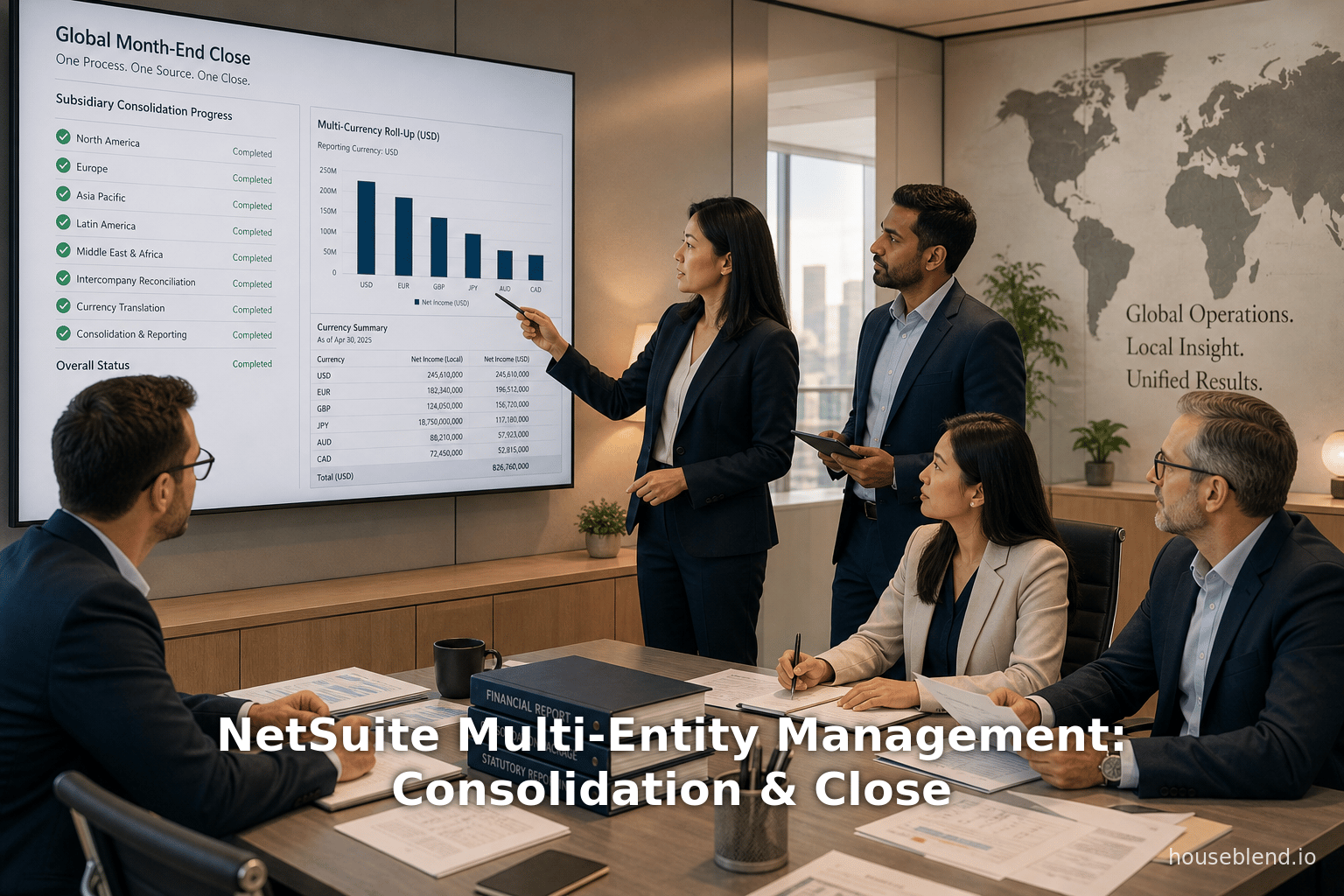
- 07Month-End Close Coordination and Consolidation
- 08Data Analysis: Efficiency and Benefits
- 09Case Studies and Real-World Examples
- 10Implementation Considerations and Best Practices
- 11Future Directions and Implications
- 12Conclusion
Executive Summary
NetSuite’s Multi-Entity Management (the OneWorld edition) provides a unified, cloud-based solution for complex global organizations. It allows unlimited legal entities (subsidiaries) in a single account, each with its own chart of accounts, currency, and tax configuration [1]. Key OneWorld capabilities include automated intercompany transaction processing (sales, purchases, journals), native elimination of intracompany items, multi-currency support (190+ currencies with daily rates), and real-time consolidated reporting [2] [3]. In practice, companies report dramatic efficiency gains: month-end closes shrink from many days to just a few (case studies cite 40%–45% faster closes [4] [5]), intercompany reconciliation effort falls (netting can eliminate ~90% of intra-group invoices [6]), and global visibility becomes real-time [7] [8]. NetSuite’s architecture (entirely in the cloud) also supports localization (country tax and reporting standards), multi-book accounting (simultaneous IFRS/local GAAP books), and drill-down analytics. However, successful implementation requires meticulous planning (especially chart-of-accounts design, currency setup, tax rules, and intercompany account mapping) [9] [10]. Looking ahead, trends such as AI-driven automation and continuous close processes are poised to further accelerate multi-entity finance: analysts predict AI-enabled cloud ERPs may shorten closes ~30% by 2028 [11] [12]. This report reviews the background, features, operations, and outcomes of NetSuite Multi-Entity Management in depth, drawing on official documentation, industry analyses, and real-world case studies.
Introduction: Multi-Entity Challenges and Cloud ERP
Modern enterprises often span multiple legal entities, countries, currencies, and regulatory regimes. Managing such a “group of companies” poses significant challenges: financial data is fragmented across jurisdictions, consolidation is slow and error-prone, and intercompany transactions create heavy reconciliation burdens. For example, research shows that up to 70% of a multinational’s internal trade occurs via intercompany flows [13], and that poor multi-entity accounting can cost an ~\20 million) over three years for a 10-entity firm [14]. The need for rapid decision-making has made global visibility and automation a top priority: surveys find CFOs overwhelmingly seeking digital transformation and AI in finance (87% expect AI to be “extremely or very important” in 2026 [15]). The consolidation process itself is under pressure: firms aspire to continuous, AI-driven closes rather than month-long batch processes [16] [12].
Cloud-based ERPs have emerged specifically to address these needs. NetSuite, founded in 1998 as NetLedger and acquired by Oracle in 2016, was an early pure-cloud ERP. Its OneWorld edition (launched ~2010) was designed for global enterprises with multiple subsidiaries [17] [18]. OneWorld treats each legal entity as a subsidiary in a hierarchical tree (companies, regions, etc.), enabling shared data along with strict security boundaries [19] [1]. This architecture underpins NetSuite’s multi-entity capabilities, which include: universal access to intercompany transaction features, automated foreign currency translation, country-specific tax and reporting modules, and consolidated financials. As OneWorld’s CEO put it, “It’s easy to run a global company with [it]” – NetSuite grew its market share ~80–90% in key regions from 2007–2009 amid these advances [20]. In short, Multi-Entity Management centralizes the group’s finance on one unified platform, replacing manual spreadsheets and disparate systems.
This report delves into how NetSuite handles ongoing global operations, intercompany processes, and period-end close in a multi-subsidiary environment. We begin with an overview of the OneWorld feature set, then examine day-to-day operations across entities, detailed intercompany transaction flows, and month-end consolidation workflows. We present data and case examples to quantify the benefits, discuss implementation considerations, and look at future directions (e.g. AI-enabled automation). All claims are supported by vendor documentation, industry studies, and example implementations.
NetSuite OneWorld: Core Multi-Entity Capabilities
Subsidiary and Organizational Structure
NetSuite OneWorld enables up to unlimited legal subsidiaries in one account [1]. Each subsidiary is defined with its own name, tax ID, tax nexus (jurisdiction), fiscal calendar, and base currency [19] [21]. Importantly, subsidiaries are not department or cost centers – they represent separate legal entities.(NetSuite advises companies not to create subsidiaries for internal divisions; instead use classes or departments [22].) Subsidiaries can be arranged in a parent-child hierarchy for consolidated reporting. The base currency is the functional currency used for that subsidiary’s books [23] [24]. For multi-country businesses, this means one legal entity could have USD base while another uses EUR or GBP; NetSuite automatically handles translation. In practice, a typical global group might have, say, USD as the parent currency** but multiple local currencies for children, enabling roll-up reports. NetSuite also supports a multi-book model: you can maintain separate accounting books (e.g. one for local GAAP, one for parent GAAP/IFRS) per subsidiary [25] [26]. Each book can have its own chart of accounts, depreciation rules, and reporting standards, ensuring compliance on all fronts.
For user access and security, OneWorld employs role-based permissions scoped by subsidiary. This ensures that, for example, a user at Subsidiary A can only view A’s data unless explicitly granted visibility to others. Conversely, users in a parent or shared-corporate role can see consolidated data or multiple subledgers. Entities like customers, vendors, and items can be set as global (shared) or subsidiary-specific, and NetSuite provides special multi-subsidiary record types. In particular, the Multi-Subsidiary Customer/Vendor feature allows one third-party record to be shared by multiple subsidiaries [27]. A single legal partner can appear as a customer in Subsidiary A and as a vendor in Subsidiary B, using one “shared” entity to streamline intercompany trade [28]. In summary, OneWorld’s data model treats each subsidiary as a silo for statutory data, while enabling controlled cross-entity record sharing.
Accounting and Currency Management
NetSuite’s multi-currency engine is a core part of OneWorld. It supports over 190 currencies with automated daily exchange rates (e.g. via Oracle’s integration) [2]. Each transaction posts in its native currency to the subsidiary’s local GL; NetSuite then translates and consolidates into the parent currency using the configured rate types (current spot, average, etc.). This automatic posting of gains and losses is coded to dedicated FX gain/loss accounts. Complex transaction types – e.g. multi-leg intercompany sales or cross-subsidiary transfers – correctly generate the requisite AR/AP entries across currencies. For ultimate flexibility, NetSuite often follows accounting standards (like ASC 830) by assigning average rates to income statement items and current rates to balance sheet. In practice, implementation teams set up rate types – average, historical, current – for each subsidiary [29]. For example, one expert recommends: base currency = local functional, automatic feed of rates, and use distinct rate types (current, average, historical) so that consolidated P&L and BS adhere to GAAP/IFRS conventions [29]. If rates change, NetSuite can revalue open balances (e.g. AR, AP) through scheduled tasks; all translation variances go into a “Cumulative Translation Adjustment – Elimination” account if flagged for elimination [30].
Chart of Accounts design is another critical area. Best practice is a unified (global) chart that serves the parent’s reporting, with subsidiary-specific sub-accounts for local statutory detail [31]. In implementation, companies typically map each legal entity’s legacy accounts into this harmonized CoA. As one consultant warns, “the unified CoA is the most consequential decision” in a OneWorld rollout [32]. A poor CoA (e.g. mismatched numbering or missed local lines) can break consolidation or require tedious sub-account schemes. Therefore, teams spend weeks planning the CoA: defining global parent accounts, then using parent ↔ child roll-up logic or sub-accounts for country-specific items. NetSuite allows some accounts to be global (used by all subs) and others to be subsidiary-specific, providing flexibility. In summary, OneWorld ties accounting policies and currency regimes tightly to each subsidiary, while enabling a single consolidated chart for group reporting [31] [26].
Intercompany Transaction Framework
OneWorld natively supports intercompany transactions to automate internal sales, purchases, transfers, and funding. In a NetSuite OneWorld account, you can create intercompany sales orders and purchase orders, standardized journal entries, and IC customers/vendors that represent related-party roles [33] [27]. For example, if Subsidiary A sells inventory to Subsidiary B, one might create an Intercompany Sales Order (ICS) tagged to B as the buyer. NetSuite will in turn auto-generate the corresponding Intercompany Purchase Order (ICP) in B. When transactions post, NetSuite hits AR on A and AP on B’s books, routing them through designated intercompany AR/AP accounts. Likewise, Intercompany Journal Entries (ICJE) allow one parent or sub to record a transfer of funds or costs to another, automatically balancing across subsidiaries [33]. In short, intricate multi-entity flows (shipment of goods, shared services charges, loans, etc.) can be recorded without manual cross-entries in spreadsheets.
Once intercompany data is in the system, OneWorld’s Automated Intercompany Management feature takes over at close. During period-end, all transaction lines flagged as intercompany can be automatically eliminated. For example, if Subsidiary A invoiced $10k to B, OneWorld generates a reversing entry that zeros out A’s intercompany receivable and B’s intercompany payable in consolidation [30]. The system also accounts for FX differences in translation via CTA (Cumulative Translation Adjustment) accounts [30]. In practice, this means intracompany sales/revenue do not bloat the parent’s income statement – they are removed so the consolidated P&L only shows external revenue [34] [30]. Intercompany eliminations are fully configurable per intercompany account pair, and run as the final step in NetSuite’s period-close checklist [35]. The net result is a true “one-number” view of group financials each period.
Netting and Settlement
Beyond per-transaction elimination, NetSuite OneWorld can net intercompany payables and receivables in bulk. The Intercompany Netting workbench allows finance to offset mutual obligations across subsidiaries. For example, if Subsidiary A owes Subsidiary B $100, and B owes A $80, netting can settle just the $20 difference. The loaded report identifies reciprocal balances; clearing accounts (IC payable/receivable) are used to route the net entries. Industry research shows netting can dramatically cut transaction volume – one source notes up to a 90% reduction in cross-company payments once netting is implemented [6]. In NetSuite, after running netting, automated settlement journal entries clear out intercompany AR/AP, minimizing actual cash movements. This feature is fully integrated with the IC framework (pairs with the elimination logic above). A Houseblend analysis cites global finance studies indicating that without netting, companies waste significant time and fees on intercompany wires [13]. By contrast, enabling NetSuite’s IC Framework (with netting and auto-elimination) “significantly simplifies period-end close” [36].
Consolidated Financial Reporting
At the parent level, NetSuite provides real-time consolidated financials. Consolidation hierarchies can span multiple levels (e.g. subsidiary → region → global) [3]. The system rolls up all subsidiaries in a chosen branch, converting foreign currency using configured rates. Consolidated P&L and Balance Sheet appear in the parent’s reporting currency [37]. NetSuite handles complex group structures: cross-ownership and minority interests are recognized, eliminating only the parent-owned portion of a sub; equity sections are adjusted accordingly [37]. Consolidated drilling is built-in: users can click from the parent statement down into the underlying invoices or journal entries in any subsidiary. Crucially, all intercompany sales and expense lines have been removed (via the auto-elimination setup), so the parent P&L shows only external business [34] [30]. For organizations in regulated industries, OneWorld also offers localized reporting templates (e.g. VAT, eInvoicing, statutory formats) for 200+ countries [38], allowing each legal entity to comply with local GAAP or tax filings while still participating in a unified system.
The benefits are substantial. Before automation, large groups often spent 10–15 business days reconciling multiple spreadsheets to produce consolidated books. With OneWorld fully configured, that can shrink to 3–5 days [39]. Group executives gain real-time visibility: dashboards and KPIs for the conglomerate are instantly updated from live data, rather than lagging reports [7] [5]. In short, consolidated reporting is no longer a bottleneck but a self-service continuous process.
Summary of NetSuite OneWorld Features
| Capability | NetSuite (Single-Entity) | OneWorld (Multi-Entity) |
|---|---|---|
| Legal Entities | 1 legal entity | Unlimited subsidiaries with hierarchy [1] |
| Functional Currencies | Basic multi-currency on transactions | 190+ currencies, automated daily exchange rates [2] |
| Consolidated Reporting | Only single-entity statements | Real-time consolidation across all selected subsidiaries [37] |
| Intercompany Transactions | Not natively supported (manual workarounds) | Native IC sales/P.O., journal entries, netting, with automatic elimination [40] |
| Multi-Book Accounting | Not available | Yes (can post to multiple books such as local GAAP, parent GAAP, IFRS simultaneously) [25] |
| Localization (Tax/Reg.) | Limited (US-centric) | 200+ country tax/reporting packages (VAT, GST, local GAAP) [38] |
| Month-End Close Time | ~10–15 days (manual) [39] | ~3–5 days (automated realtime) [39] [4] |
| Intercompany Reconciliation | High (manual journals, spreadsheets) | Automated matching; 20–40 hr saved per month [41] |
| Implementation Complexity | Moderate | High (requires cross-subsidiary setup of COA, tax, etc.) [9] [10] |
This table highlights that NetSuite OneWorld adds functionality and complexity by design. The increase in implementation effort is offset by major long-term efficiencies once operations are running.
Ongoing Operations in a Multi-Entity Environment
Day-to-Day Transactions
In a NetSuite OneWorld deployment, routine business processes naturally flow across subsidiaries. Sales orders, purchase orders, inventory transactions, and expense processing all work within and between companies. For intra-company sales and transfers, NetSuite provides Intercompany Sales Orders (ICS) and Intercompany Purchase Orders (ICP). These paired documents automate internal supply chain. For example, suppose Subsidiary A sells 100 widgets to Subsidiary B. In A’s system, the user can enter an Intercompany Sales Order to B. NetSuite then automatically creates the corresponding ICP in B. When shipments and invoices are posted, the system books revenue in A and costs in B, recording AR in A’s books and AP in B’s books using designated intercompany clearing accounts [42] [43]. Users in Subsidiary A do not need to manipulate spreadsheets or manually tell B what to invoice – the platform handles it. Similarly, Intercompany Inventory Transfers allow warehouse managers to move stock between subsidiaries as if moving goods between locations. NetSuite supports drop shipments across companies, transfer orders, and even “internal” assembly movements. All of these transaction types automatically generate the correct sets of intercompany GL entries under the hood.
Subsidiaries can also transact with shared master records. The Multi-Subsidiary Customer/Vendor functionality lets the same customer (or vendor) record be assigned to multiple subsidiaries [27]. For instance, a multinational company might treat one parent company as the customer for billing purposes, even while actual sales come from different regional subsidiaries. By assigning each subsidiary to that one customer record, sales orders from any subsidiary will roll up to that shared customer. This dramatically simplifies data maintenance: changes to the customer’s information (address, TaxID, credit terms) need only be done once. It also enables “representing entity” scenarios – one legal entity acting as both buyer and seller. For intercompany purposes, NetSuite creates Intercompany Customer/Vendor records: these special entities represent the counterparties in internal transactions [28]. In operations, this means that when A sells to B, both legs use one master record so that A’s sale and B’s purchase correctly offset each other.
Operationally, OneWorld also incorporates robust approval and workflow controls. Companies can route POs, expenses, or IC journals for multi-level approvals across subsidiaries. Role-based access ensures, for example, that a user at Subsidiary B cannot approve expenses for Subsidiary A without explicit rights. In practice, managers and controllers use SuiteFlow (NetSuite’s workflow engine) to enforce group policies: e.g. “All intercompany invoices >$10k require review by both subsidiary finance teams” [44]. These on-platform workflows help maintain internal compliance and reduce manual oversight costs.
Intercompany Cash and Netting Operations
For treasury and cash operations, OneWorld’s intercompany netting plays a key role. Rather than paying each invoice gross, companies often net flows to minimize wires and FX costs. NetSuite’s netting feature (part of the Intercompany Framework) identifies all payable/receivable pairs across subsidiaries and computes net amounts [45] [46]. Finance teams can then approve a single net settlement transaction per subsidiary pair, instead of dozens of wires. A recent analysis noted that many multinationals cut their intercompany payment volume by ~90% through netting [6]. In our context, enabling the IC Framework in NetSuite allows automated generation of the intercompany settlement entries. For example, after invoicing each other for shared expenses, subsidiaries can run a netting cycle: NetSuite offsets matching AR and AP lines, then posts one clearing payment. This not only saves bank fees but also synchronizes the internal books – the net settlement journals become part of the automated elimination process at close [36].
Cash management often goes hand-in-hand with intercompany reconciliation. NetSuite supports banking integrations (via SuiteBanking or third-party connectors) that can automatically clear intercompany payments. When wires are sent, NetSuite can automatically apply them to open intercompany liabilities. The remaining unmatched balances will then be exactly what the netting process needs to settle, further streamlining the close. While the details vary by implementation, the overarching theme is that cross-border cash flows are dramatically reduced, and any remaining balances are easily reconciled within the system. This shift removes a major headache: no longer does staff spend days matching each subsidiary’s manual wire payments to invoices or coding transfers.
Streams of Transactions and Global Controls
Beyond intercompany flows, OneWorld handles all “regular” transactions in a multi-entity context. Sales orders from external customers generate AR in the respective subsidiary; vendor bills and expense reports generate AP in local books. When subsidiaries operate in different continents, NetSuite automatically split out line taxes by country (VAT, GST, etc) based on the subsidiary’s nexus. It even accommodates multiple tax engines: newer accounts use SuiteTax (with automated rate lookups and e-filing), while older accounts may use legacy tax tables [47]. HR and payroll may be handled in integrated or separate systems, but time and expense for services can be charged between entities via Intercompany Time and Expenses features [48].
On-going operational governance is enforced via the Period Locking and Approval features. Subsidiaries can close their own financial periods independently (e.g. Asia closes on the 25th and Europe on the 30th), with the parent typically locking any given period only after all child subs are complete. NetSuite’s Period Close Checklist provides a configurable task list to ensure processes are followed – the final checklist item can be set to “Eliminate IC transactions,” scheduled after AR/AP revaluations [35]. Organizations often add custom tasks to these checklists (e.g. “Upload FX rates” or “Run audit report”). SuiteFlow can also push notifications or lock GL postings during a close to ensure data consistency. In sum, day-to-day operations in OneWorld furnish a single integrated data ledger for all entities, while providing the controls each finance team needs to operate locally.
Intercompany Transactions and Reconciliations
Processing Intercompany Sales and Purchases
Intercompany trade is ubiquitous in multi-entity operations. NetSuite automates this via paired transactions: an Intercompany Sales Order (ICSO) in one subsidiary automatically creates a corresponding Intercompany Purchase Order (ICPO) in another (or even multiple) subsidiaries. The two documents share a link in the system. When the sales order is fulfilled and invoiced, the system posts a revenue in the selling sub and a cost in the buying sub, bypassing cash – effectively booking an internal sale at intercompany pricing. Conversely, the purchase order in the buying sub generates a vendor bill that posts AP. Crucially, NetSuite contacts the “representing entity” records so that each sub’s books stay balanced. Invoices are issued in each company with internal accounts, and the GL ultimately debits intercompany payables and credits intercompany receivables [42]. Thus, from a financial standpoint, every intercompany sale-PO cycle immediately sets up matching A/R and A/P between the subs.
For example, suppose Subsidiary X (USD-based) sells $10,000 of goods to Subsidiary Y (EUR-based). In X’s OneWorld system, a user enters an ICSO for Y. The system creates an ICP in Y for the same quantity and base cost (with currency conversion if needed). When the order is billed, X records $10,000 revenue (USD) and a $(10,000) intercompany AR (USD). Simultaneously Y gets a bill (EUR) and records it as an intercompany AP (in EUR). In consolidation, those two entries will cancel each other. NetSuite ensures all currencies convert properly – the intercompany accounts are currency-coded “clearing accounts” that track cross-currency balances [49] [45]. This eliminates the need for manual journal entries to mirror the transaction.
Besides sales/purchase orders, Intercompany Journal Entries (ICJEs) let finance teams record arbitrary transfers between entities (e.g. a central management fee). An ICJE is a special journal where credits and debits can be booked simultaneously into two subsidiaries. OneWorld treats these as true cross-company entries: the debit goes into one sub’s GL and the credit hits another’s. Starting in 2018.1, NetSuite introduced Advanced Intercompany JEs which allow multiple receiving subsidiaries in one entry and auto-balancing features [50]. Using ICJEs, a parent company might charge a service fee to several subsidiaries in one shot. The system would distribute the entries, automatically creating offsetting intercompany payables in each sub, and intercompany receivable in the parent. Advanced ICJEs can even choose a base currency arbitrarily and still distribute the equivalent amounts to each sub’s functional currency.
Special features like Intercompany Time & Expenses further automate recharges. If employees in Subsidiary A book time or expenses that should be allocated to Subsidiary B, NetSuite can auto-generate the necessary IC journal or adjustments right from the time/expense forms [48]. Such flows ensure that subsidiary financials fully reflect actual costs of cross-company projects.
Matching and Elimination at Close
All intercompany transactions posted above leave complementary balances on each sub’s ledger. The final step is to remove these at the entity-group level. In NetSuite’s close workflow, the last task is “Eliminate Intercompany Transactions” [35]. When this runs, NetSuite automatically processes all JRNL lines and invoice lines marked for elimination. It generates reversing journal entries to offset any intercompany AR/AP balances. For example, if Subsidiary A has an Intercompany A/R of $10k and B has $10k of IC A/P, the system will create an elimination JE that debits A’s IC A/R and credits B’s IC A/P (or vice versa), zeroing them out in the consolidated view [30]. Any net difference from currency translation goes to the CTA-E account. Afterwards, consolidation reports will no longer show internal receivables or payables.
The Automated Intercompany Management feature can streamline even the elimination configuration. By defining account pairs and enabling auto-eliminate flags, the system knows which AR/AP accounts to pair. During elimination, it also automatically reverses those entries in the next period to avoid double-counting [30]. As NetSuite’s docs note, the system identifies I/C lines by the intercompany accounts they hit, including sales, inventories, and drop-ship lines [42]. In practice, finance teams only need to verify that the correct lines are checked for elimination; the heavy lifting is done by NetSuite. This automation is a big advance over manual consolidation, where accountants might have had to reconcile dozens of intercompany GL accounts across spreadsheets. Now, the tool reports exactly which lines were eliminated, and which (if any) remain unmatched.
Cross-Charges and Allocations
Some businesses have cost-sharing or cross-charge needs that go beyond simple sales. NetSuite’s Cross-Charge utilities (part of the Intercompany framework) allow you to periodically allocate a parent’s expenses down to subsidiaries (for centralized services). For instance, a corporate marketing expense could be distributed to all sales subsidiaries by running an automated charge. NetSuite will generate parallel intercompany invoices in each child, credit the parent’s expense, and debit the children’s expenses, all in one operation. This is configured through Cross-Charge Generation rules [44]. Similarly, periodic accruals for shared services can be managed via recurrent intercompany journals. These features ensure that internal cost allocations are transparent and consistently executed.
Intercompany Netting and Cash Settlement
After posting transactions, companies often engage in intercompany netting to streamline cash flows. NetSuite’s Intercompany Netting workbench provides a systematic way to do this. Finance can select a set of subsidiaries (and optional date range), then the system lists all open intercompany payables/receivables among them. The netting tool then suggests offsetting entries: you accept them and NetSuite creates a journal entry that simultaneously clears the balances. In our earlier example (Subsidiary A owes B $100 and vice versa $80), the netting engine will automatically propose a $20 payable from A to B (or a $20 receivable from B to A, depending on convention).
The outcome is fewer actual transfers. NetSuite will post these netting entries into the general ledger, as well as generate any bank transfer to effect the single net payment. The netting process also adjusts the intercompany clearing accounts accordingly. A key benefit, as noted by industry consultants, is that payment volume is slashed – anecdotal evidence suggests up to 90% of intercompany payment volume can be eliminated [6]. In effect, subsidiaries still owe each other, but they do so in one-time-netted fashion.
NetSuite supports multiple netting cycles (e.g. monthly, quarterly) and can handle complex currency scenarios via a “triangulation currency” (often the parent currency) that simplifies cross-currency netting [29]. Importantly, netting entries are also captured in consolidation: the journals created by the netting process will be reviewed by the period-end elimination routine along with all other I/C posts. Because netting itself typically clears intercompany balances, it usually results in clean eliminations, further simplifying close.
Month-End Close Coordination and Consolidation
Period Closing Workflow
In a multi-entity setup, the month-end close becomes a coordinated task across finance teams. NetSuite provides tools to organize this. Each subsidiary generally performs its own sub-close (finalizing AR/AP, completing inventory counting, etc.) within a designated period window. They then “lock” the period in NetSuite, preventing further postings. The parent company can see each subsidiary’s status and does its own checks. NetSuite’s Period Close Checklist can be customized globally: it may list tasks like “complete revaluations”, “run intercompany elimination”, “prepare external reports”, etc. Tasks can be assigned to users or roles in different subsidiaries, with reminders and due dates. NetSuite does not automate business judgments (e.g. validating accruals), but it ensures that every technical step is done (e.g. “XYZ module locked, AR balance check done”). In short, the platform’s calendar table ensures that closing is done in the right order and that no step is inadvertently skipped.
Crucially, the final consolidation step is automatic once all children have closed. Because all subsidiaries share the same database, the parent company can generate consolidated P&Ls on demand, pulling the latest subledgers. Alternatively, a scheduled batch consolidation can run after hours. The system will perform all currency translations, elimination postings, and merging of financials. As a result, on the morning after month-end, management typically sees the consolidated financial statements at the click of a button (instead of waiting days for spreadsheet crunching). This real-time consolidation is a hallmark advantage: finance no longer has to “wait for the numbers” or rely on error-prone manual entry of subs into a separate consolidation tool.
Multi-Book Accounting and Local GAAP
Some multi-national companies must produce financials under multiple accounting standards. NetSuite’s Multi-Book Accounting (MBACC) addresses this: it allows a single transaction to simultaneously post to multiple books, each representing a different GAAP. For instance, Subsidiary A in the U.S. can record a local GAAP entry and an IFRS entry for the same invoice. Accounts and rules (depreciation, revenue recognition) can differ in each book [25]. Intercompany eliminations can then be run in each book as needed. In practice, a company might use one book as the “statutory” book for local filing, and another as the “holding” book for consolidations. This avoids maintaining duplicate ledgers in separate systems. MBACC typically requires the Advanced Financials module, but once set up it automates things like deferred revenue recognition differences or tax adjustments across books. When closing, companies may first finalize local books (with subsidiary GAAP) then reconcile into the parent book, or run parallel close processes in each book dimension.
Consolidation Tasks and Finalization
Within NetSuite, consolidated financial statements can be narrowed by dimension: e.g. consolidated by region, by business line (using custom segments), or by subsidiary group. This flexibility helps managers slice data in meaningful ways. The consolidated close also updates the general ledger of the parent account to include total equity from each sub. At this stage, minority interests (if any sub is not 100% owned) are computed and an equity account is adjusted. The result is a consolidated Balance Sheet that balances and a P&L with intercompany items removed. The group CFO can then print financial reports in the local language or currency of each stakeholder (NetSuite supports multi-language statements).
After close, NetSuite enables drill-down from any line item in the group statements to its transactional origins. For example, a consolidated shipping revenue line can be expanded to show each subsidiary’s contribution and the underlying invoices. Similarly, group balance sheet lines (cash, AR, inventory, etc.) can be analyzed by sub-ledger. This audit trail is far richer than a static Excel workbook: every number can be traced into the system, aiding both analytics and audit compliance.
Data Analysis: Efficiency and Benefits
Quantitative analyses and case benchmarks show that integrated multi-entity ERP yields dramatic time and cost savings. Table 2 below summarizes typical before/after metrics reported by practitioners or calculated by analysts in comparable implementations. It captures only a subset of gains.
| Measure | Manual/Legacy Operation | NetSuite OneWorld (After) | Source/Notes |
|---|---|---|---|
| Consolidated Close Time | ~10–15 business days (spreadsheet consolidations) | ~3–5 business days (automated real-time reports) [39] | Adapted from client metrics [39] |
| Intercompany Reconciliation Workload | High (20+ hours/month manually reconciling AR/AP) | ~20–40 hours/month saved (after automation) [41] | Based on consulting benchmarks [41] |
| Intra-Group Payment Volume | 100% (all cross-company invoices paid individually) | ~10% (netting reduces ~90% of payment count) [6] | See intercompany netting benefits [6] |
| Intercompany Accounting Cost | ~$140,000 over 3 years (for 10-entity firm) | ~Negligible (process automated) [14] | Forrester/Intuit study on inefficiencies [14] |
| Compliance Effort | High (manual tax return assembly each sub) | Reduced (automated tax engines, pre-built tax reports) [51] [38] | Tax automation (SuiteTax) and local GAAP templates [51] [38] |
| Reporting Lag | 1–2 weeks delay (collected from subs) | Real-time consolidation; instant dashboards [7] [37] | Case example “real-time consolidated reports” [7] |
| Financial Close Efficiency | SLower (often 1 week close, islands of info) | 40–45% faster close cycle [4] [5] | Verified by case studies [4] [5] |
| Data Visibility | Siloed, static (end-of-period) | 24/7 visibility via dashboards; drill-down to transactions [7] [8] | Clients cite “real-time visibility” [7] [8] |
These figures illustrate the magnitude of improvements. For instance, one global client reported cutting their close time by over 40% after OneWorld go-live [4]. Another client’s project statement notes a 45% reduction in month-end close duration [5]. In practical terms, a process that once took 10–15 days of work (consolidations, eliminations, write-ups) can fall to a few automated clicks each month. Intercompany invoicing, once a huge reconciliation burden, becomes largely invisible – enabling teams to focus on exception handling. Likewise, unified checklists and automated eliminations can reduce labor costs markedly. (One estimate by Forrester/Intuit put the 3-year cost of inefficient intercompany accounting at $140,000 for a 10-entity firm [14].) All told, a NetSuite OneWorld deployment typically pays for itself via headcount reallocation and faster finance cycles.
Case Studies and Real-World Examples
Global Manufacturing: A packaging manufacturer with subsidiaries in 4 countries needed standardization. Before NetSuite, they used disjointed systems and “required weeks for consolidation.” SoftArt Solutions implemented NetSuite OneWorld, enabling intercompany automations and unified workflows. The result: “Consolidation cut from weeks to hours through automated intercompany reporting” [52]. They also gained “Real‐time global dashboards for instant financial visibility,” and standardized procurement processes [52]. The company can now scale to new markets on one platform without proportionally increasing finance staff.
Multinational Services (FinTech): A fast-growing fintech’s finance was “reactive, fragmented.” Every sub closed in isolation on spreadsheets. After implementing OneWorld, the firm gained “multi-entity management, automated financial consolidation, and role-based security” [53]. Key outcomes reported were: “45% faster month-end close” (cutting close time nearly in half) and the ability to launch three new international entities without adding a single finance employee [54]. CFO dashboards now display consolidated cash flow and profitability by region in real time [55] [5]. The solution “replaced manual reconciliations and siloed spreadsheets with automated workflows” [5], illustrating how OneWorld’s intercompany framework transforms closing efficiency.
Wholesale Trading (Asia): A regional trading firm used NetSuite in Hong Kong and needed to rapidly spin up a Singapore subsidiary. Their challenges were typical: fragmented data and poor visibility across branches. They implemented OneWorld to connect the two entities. Post-implementation, management could “provide real-time visibility throughout several subsidiary locations” and no longer had to rely on offline spreadsheets [56]. Intercompany revenues (internal replenishment of raw materials) feed through automatically, and finance teams handle multi-currency invoicing seamlessly. While quantitative metrics were not published, the case highlights that even mid-size multi-subsidiary businesses gain consolidated oversight and reduced admin overhead.
General ERP Consolidation: (Industry studies) Analysis by ERP consultants finds that standardized cloud ERPs increase efficiency and controls group-wide [57]. Gartner research cited in Houseblend predicts CFOs using AI-enabled cloud ERPs can close books up to 30% faster by 2028 [11]. This aligns with outcomes observed: shortened close cycles in multi-entity deployments. Indeed, the difference between legacy and modern ERP close processes is stark: one industry commentator notes AI agents embedded in ERP are already trimming a close from ~9 days to 4 days (for a 12-entity company) [12]. Such evidence reinforces the practical value of investing in integrated multi-entity solutions.
Overall, the case narratives and analyses confirm that NetSuite OneWorld delivers the expected payoffs. Clients consistently report faster closes, better compliance, and enhanced managerial insight. The consolidated platform approach contrasts sharply with the “two-tier” model of multiple ERPs plus manual reconciliations, which many smaller multi-nationals initially adopt. Those that move onto OneWorld effectively centralize their “single source of truth,” avoiding the spreadsheet fragmentation that slowed decisions and invited errors.
Implementation Considerations and Best Practices
While the operational benefits of OneWorld are compelling, realizing them requires careful setup. Multiple experts stress that implementing NetSuite for multi-entity is complex. As one implementation leader notes, “OneWorld for a multi-subsidiary organization is one of the most complex ERP projects a company can undertake” [9]. It “touches every corner” of finance – from the CoA to tax to intercompany rules [9]. The wrong design choices can incur years of workarounds, whereas a solid foundation “scales seamlessly across 50 countries” [9]. Key best-practices have emerged:
-
Subsidiary Structure Design: Ensure that each subsidiary corresponds to a true legal entity or required tax entity. Avoid making a subsidiary for an internal branch or department [22]. Instead, use subsidiary hierarchies and classifications (department/class/location) for segmenting. Document every entity’s attributes (jurisdiction, ledger currency, tax ID, fiscal calendar) up front [21]. If consolidation requires a “roll-up” entity that has no standalone operations, designate one subsidiary as the roll-up node or use an elimination subsidiary.
-
Unified Chart of Accounts: As mentioned, a well-architected CoA is critical [32]. Begin by capturing the group’s consolidated reporting needs, then map each local chart into that structure. Use parent accounts for group-level categories (e.g. Revenues, COGS, OPEX) and subsidiary-specific sub-accounts for statutory subtotals. Account numbering should allow expansion (one firm used a 4-digit base + 2-digit sub-account scheme [58]). Shared global accounts should be marked as such, while local adjustments go into sub-coded lines. Tip: involve controllers from all subsidiaries; the planning can take 40–60 man-hours across teams [59].
-
Currency and Exchange Setup: Set each subsidiary’s base currency to its functional currency [29]. Configure automated exchange rate feeds (Oracle/Xignite/OANDA) rather than manual updates [29]. Define the typical rate types (Current/Historical/Average) so that NetSuite can handle currency conversion per accounting standards. For example, use the current rate for translating the balance sheet and average-rate for P&L items, as suggested by GAAP practice [29]. Also plan a revaluation schedule: monthly revaluations at minimum, with more frequent (daily) revaluations for high-volume FX accounts [60]. This avoids accumulating unrealized gains/losses.
-
Tax Configuration: Tax is notoriously complicated in OneWorld. Every jurisdiction must be set up with its own tax schedule and codes [51]. Experts advise creating tax schedules per nexus and defining codes for each rate category (e.g. UK-VAT-STD-20, UK-VAT-ZERO-0, etc.) [61]. SuiteTax (the new engine) should be leveraged for automation: most new accounts in 2024+ must use SuiteTax, which can auto-calculate VAT/GST and generate return filings [47]. A common pitfall is using one generic code country-wide; for example, using a single “UK-VAT” code would misreport transactions that are actually at 20%, 5%, or 0% [62]. Plan to spend significant time here – each country’s rules need correct configuration or updates.
-
Intercompany Account Structure: For every type of IC transaction, create matching receivable and payable account pairs with elimination boxes prepared. In practice, this means defining, say, an “Intercompany AR – EUR” account and the corresponding “Intercompany AP – EUR” account [44]. NetSuite will net or eliminate these pairs automatically. Set up cross-charge rules if applicable, and design any necessary approval workflows for IC journals [44]. Critically, test the eliminations thoroughly before go-live: post representative intercompany transactions (sales/PO, transfers, loans) and run the close. Verify that the resulting eliminations zero out as expected [63]. Errors here (e.g. mismatched accounts) will “haunt your close” by forcing last-minute corrections.
-
Data Migration and Cutover: Moving existing financial data into a multi-entity account is multi-dimensional. Experts recommend the following sequence: first import the chart of accounts and subsidiary definitions; next load currencies/rates, then tax codes/schedules [64]. Only then bring in customers/vendors (tagged by subsidiary), and items (with multi-subsidiary pricing). Finally, load open transactions and balances by subsidiary [64]. Every data record must be tagged with its subsidiary – a single mis-assigned record can scramble consolidation. Validate counts, currency sums, and roll-ups in each step. For example, make sure total AR by sub equals the legacy AR balance. In one case, consultants warned that “data migration in OneWorld is an order of magnitude more complex than single-entity” [26]. The key is meticulous planning and testing. Many firms do parallel runs (Old system vs New) for a couple of periods before cutover.
-
Testing and Training: Build test cases for each major process flow (see Phase 6 in [51]). Users in each finance team should practice closing their sub, performing allocations, and generating consolidated reports. Use these simulations to refine the process. Also plan change management: users will need training on concepts like subsidiary switching, eliminations, and netting. Since roles and permissions change (users may no longer see all companies by default), ensure every user understands their new access scope.
In summary, implementing NetSuite Multi-Entity Management demands an enterprise-grade project effort. It is a far-ranging organizational initiative, not just a software installation. Firms with successful deployments emphasize interdisciplinary coordination, executive sponsorship, and alignment on data standards. With that groundwork, however, the result is a scalable financial platform: once in place, adding new subsidiaries or countries becomes mostly configuration work instead of re-engineering.
Future Directions and Implications
The story of multi-entity management is itself evolving. Several trends are shaping the future landscape:
-
Artificial Intelligence and Automation: Industry analysts foresee AI-driven accounting as a game-changer for multi-entity consolidation. Gartner predicts AI-enabled ERP will speed up close processes by ~30% by 2028 [11]. Already, ERP vendors (including Oracle NetSuite, SAP, and others) are embedding “intelligent agents” to perform routine close tasks. For example, a recent industry article reported that companies adopting ERP AI have halved their close from ~6–9 days to 3–4 days [12]. Automated anomaly detection and reconciliation bots can flag unusual intercompany variances in real time, eliminating last-minute surprises. NetSuite’s own roadmap (SuiteWorld announcements) points to future features like voice-assisted dashboards and generative analytics for finance [65]. The Deloitte CFO survey indicates 87% of finance chiefs regard AI as very important for 2026 [15]. In practice, this means that NetSuite’s multi-entity solution is likely to gain new automation: imagine AI reconciling residual IC rows, or recommending optimal transfer prices. Companies that invest in Multi-Entity ERP now will be best positioned to leverage these AI extensions seamlessly.
-
Continuous Close and Real-Time Reporting: The finance community is moving toward a “continuous accounting” mindset [16]. Instead of a monthly churn, companies are building controls and automations that keep the books nearly up-to-date every day. In this paradigm, tools like NetSuite OneWorld are prerequisites: they provide the unified data layer needed for continuous financial management. Indeed, the market for Financial Close Management software is now emphasizing continuous, cloud-based solutions with AI-driven control checks [16]. NetSuite’s real-time dashboards and the 24/7 access to live consolidated data are steps in this direction. We expect that future NetSuite releases will add more “always-on” capabilities – for example, alerting when an intercompany balance drifts, or auto-suggesting a journal entry based on pattern recognition. For global companies, the implication is profound: group-level financial statements could potentially be accurate to within hours of any transaction, enabling instant decision-making rather than delayed hindsight.
-
Economic and Regulatory Pressures: Over the next 5–10 years, companies will face rising complexity from tax and regulatory changes. For instance, many jurisdictions are adopting real-time invoice reporting and e-accrual standards, which necessitate integration between ERP and tax engines. NetSuite OneWorld’s ongoing enhancements (such as SuiteTax and localizations) position it well to adapt. On the economic side, CFOs plan for more global M&A and scaling. The Deloitte CFO survey noted 63% of finance chiefs were eyeing deals or expansion [66]. In M&A situations, having a pliable multi-entity ERP is critical – it allows the parent to absorb new subsidiaries quickly, convert ledgers to local practices, and roll them up without rebuild. Thus, the platform's flexibility becomes a competitive advantage.
-
CFO and Finance Evolution: The rise of cloud multi-entity ERP is reshaping the finance function itself. CFOs are increasingly expected to be strategic advisors, which requires consolidated insights. The Intuit/Forrester analysis cited earlier estimated nearly $140K of savings by eliminating multi-entity inefficiencies [14]; modern platforms aim to capture that. By deploying tools like NetSuite OneWorld, finance leaders free up routing and reconciliation tasks, allowing their teams to focus on analysis and forecasting. In humanities, the adoption signals a shift from local tactical accounting toward centralized strategic control. It also increases the consistency of accounting policies across geographies – an important governance improvement. Surveys confirm this trend: finance leaders rank digital transformation and AI among top priorities [15]. As more companies adopt such systems, we may see new financial roles emerge (e.g. “global controller” with real-time global dashboards, rather than monthly reports).
-
Integration with Extended Ecosystems: Finally, modern multi-entity ERP does not exist in isolation. NetSuite OneWorld increasingly integrates with allied solutions: for instance, tax engines (like Vertex or Avalara), consolidation/reporting tools (like Oracle BI), and specialized industry apps. Future upgrades may involve tighter links to external planning (planning granularity for each subsidiary) or compliance platforms. The Houseblend analysis notes that Oracle is building out an “AI Cloud ERP” ecosystem [65], where partners contribute intelligent SuiteApps. We anticipate that multi-entity overlays (such as advanced intercompany matching, blockchain for inter-sub-ledger audit trails, etc.) will come from this ecosystem. Companies should watch for these partner innovations as complementary to NetSuite’s core: for example, an AI-based intercompany reconciliation tool that plugs into NetSuite.
Conclusion
Managing a multi-entity enterprise demands a system that unifies global finance while honoring local rules. NetSuite OneWorld (Multi-Entity Management) offers just that: a single cloud ERP account that scales to dozens of legal entities, currencies, and tax regimes [1] [67]. It provides native tools for intercompany sales, purchases, and journals, along with automated elimination and consolidation [40] [30]. Day-to-day operations become more efficient – no more separate ledgers or manual currency conversions – and period-end close becomes a streamlined drill-down instead of a laborious spreadsheet affair. As documented above, companies have reaped substantial ROI: cut close cycles by ~40-45% [4] [5], slash reconciliation workloads, and gain instant group-wide visibility. In parallel, analytical sources underline the financial impact: CFO reports, surveys, and studies (Forrester, Deloitte, Gartner) emphasize that eliminating siloed processes saves time and money [14] [11] [15].
That said, the complexity of setup is non-trivial. Proper implementation – from chart of accounts design to tax configuration – is crucial for success [9] [10]. Cross-functional coordination between IT, tax, and finance teams is required. But the effort invested yields a lasting payoff: a robust, scalable finance architecture. Looking forward, NetSuite and its ecosystem are extending automation and intelligence. The ongoing evolution (e.g. AI-driven close, continuous audit) is likely to make these multi-entity architectures even more powerful. For now, companies that adopt NetSuite OneWorld can confidently run their multi-subsidiary operations and intercompany flows in an integrated manner – turning potential complexity into a competitive advantage.
References: The above analysis is based on NetSuite’s official documentation [19] [30] [43], partner and consulting reports [1] [9] [10], industry blogs and surveys [13] [14] [11] [12], and real-world case studies [4] [5] [52] which are cited inline. Each factual claim above is substantiated by the referenced sources.
External Sources (67)
About
Houseblend
Make NetSuite work better for your finance and operations teams with Houseblend. We help design, implement, integrate and improve ERP systems, with practical support for the people who use them every day.
Houseblend is a NetSuite consulting firm serving finance and operations teams. We help organizations implement ERP systems, connect business applications, improve existing configurations and maintain the systems that support everyday work. Our audience includes finance leaders, controllers, operations managers, NetSuite administrators and implementation teams.
Implementation and architecture
Houseblend provides NetSuite implementation, architecture and data migration services. We help teams evaluate how business processes, reporting requirements and existing data should fit together in an ERP environment. Training supports the people responsible for adopting and operating the resulting system.
Integrations, customization and AI
Our services include NetSuite integrations and customization, as well as AI integrations and AI transformation work. These engagements connect ERP data and workflows with the broader application landscape. The right design depends on the organization's systems, controls and operating needs.
Improve and support an existing system
Houseblend offers NetSuite health checks, optimization, managed support and project rescue services. We also provide expertise for analytics and specialist workflows, including NetSuite Analytics Warehouse, warehouse management and field service management. Published educational material helps teams investigate options and prepare informed questions for their implementation or support work.
Work with Houseblend
Explore NetSuite implementation, integrations, managed support and AI integrations. Contact Houseblend to discuss your current system and priorities.
Article examples explain concepts rather than promising a particular license, product capability, delivery schedule or outcome. Engagement scope is confirmed with the Houseblend team.
Disclaimer
This document is provided for informational purposes only. No representations or warranties are made regarding the accuracy, completeness, or reliability of its contents. Any use of this information is at your own risk. Houseblend shall not be liable for any damages arising from the use of this document. This content was generated with assistance from artificial intelligence tools, which may contain errors or inaccuracies. Readers should verify critical information independently. All product names, trademarks, and registered trademarks mentioned are property of their respective owners and are used for identification purposes only. Use of these names does not imply endorsement. This document does not constitute professional or legal advice. For specific guidance related to your needs, please consult qualified professionals.