Houseblend Article
Airbase vs Ramp vs Brex: NetSuite Integration Compared
Inside this article
- 01Executive Summary
- 02Introduction and Background
- 03Company Overviews and Market Context
- 04NetSuite Integration Architecture and Workflow
- 05Feature-by-Feature Comparison
- 06Evidence and Analysis
- 07NetSuite Integration Features (Detailed)
- 08Technical Deep Dive and APIs
- 09Business Implications and Future Outlook
- 10Conclusion
Executive Summary
The corporate spend management market has surged in recent years (with projected growth to roughly $7.5–13.8 billion by the late 2020s [1] [2]), driven by demands for real-time visibility, faster monthly closes, and tighter financial controls. Modern spend-management platforms like Ramp, Brex, and Airbase combine corporate card programs with expense reporting, bill payment, and procure-to-pay (P2P) workflows, and each offers native integrations with enterprise ERPs such as Oracle NetSuite. This report provides an exhaustive analysis and comparison of these three vendors’ capabilities – with special emphasis on how their platforms integrate with NetSuite.
We examine company histories and market positions (including Ramp’s $13B valuation and $700M ARR [3], Brex’s industry-leading funding and recent $5.15B acquisition by Capital One [4] [5], and Airbase’s broad P2P focus and acquisition by Paylocity [6] [7]). We detail the technical mechanisms of each NetSuite integration: Ramp’s Built for NetSuite bidirectional SuiteApp (syncing account structures into Ramp and pushing coded transactions back to NetSuite), Brex’s certified SuiteApp with flexible export formats (journal entries, vendor bills, or credit-card-transaction entries) [8], and Airbase’s native, two-way real-time sync (continuously posting fully-coded AP, card, PO and expense entries into NetSuite) [9] [10]. Tables compare features side-by-side (e.g. support for subsidiaries, multi-currency, 3-way PO matching, reimbursements, AI-based coding, etc.), highlighting that Ramp and Airbase both support multi-entity OneWorld and multi-currency accounting [11] [8], whereas Brex also supports multi-entity (using intercompany payables) [8] but with some limitations in credit-card exports (e.g. no VAT or intercompany on “credit card transactions” exports [8]). Ramp uniquely advertises built-in bill-pay with 3-way consolidation, whereas Airbase covers every spend channel (corporate cards, POs, bills, and reimbursements) [7] [10].
Evidence from user case studies and industry data illustrates real efficiency gains: Ramp customers report 60%+ faster closes (e.g. Clearbit sped month-end from ~10 days to 3–4 days [12]), and Brex customers (like Avenue One) save dozens of hours monthly on reconciliations. G2 user ratings (as of early 2026) are uniformly high (Ramp 4.8/5, Brex 4.8/5, Airbase 4.7/5), reflecting strong user satisfaction. The platforms do differ in strategy: Ramp focuses on AI-driven automation and cash savings, Brex emphasizes seamless entrepreneurship and was an early SuiteApp innovator (now backed by Capital One [5]), and Airbase (now part of Paylocity) touts a unified P2P “one platform for everything” approach [7].
Finally, we discuss market trends and future outlook. Corporate card and spend automation are moving toward commoditization and AI-augmentation, with nearly all high-growth firms adopting modern expense tools [5]. Brex’s acquisition by Capital One (the largest bank-fintech deal on record [4]) underscores banking industry interest in these innovations, and Paylocity’s move into finance (via the Airbase acquisition) signals blurring of HR/payroll and accounting software. We anticipate continued consolidation, deeper AI integration (e.g. AI receipts coding and anomaly alerts), and tighter ERP coupling (accelerating “continuous close” workflows). This analysis equips finance leaders with a highly detailed guide – with case studies, quantitative data, and technical breakdowns – to select and implement the best NetSuite-integrated spend management solution for their needs.
Introduction and Background
Managing corporate spending – including credit cards, vendor invoices, purchase orders, and employee reimbursements – has traditionally been labor-intensive and error-prone. In the past, many companies relied on a mix of bank-issued credit cards and standalone expense-reporting systems like SAP Concur or Expensify, exporting data into their ERP for manual reconciliation. According to IDC and SAP Concur, legacy travel-and-expense (T&E) software like Concur still dominates the market (Concur held 49.6% of global T&E market share in 2023 [13]), reflecting the heavy reliance on batch-oriented processes. However, as business travel rebounds (global T&E spending reached ~$1.03 trillion in 2022 and is projected to exceed $1.48T by end-2024 [13]), the demand on finance teams is surging. In fact, industry surveys note that modern executives find traditional expense reports so onerous that “20% of travelers would rather go to the dentist than file an expense report”.
In response, a new breed of fintech spend management platforms has emerged (beginning with Brex in 2017). These platforms issue corporate cards (often virtual by default), enforce spend policies in real time, automate receipt capture and coding, and integrate directly with corporate accounting systems.. They promise to transform the “last mile” of accounting: eliminating manual expense reports, automating line-item coding, and syncing transactions into the Ledger with minimal human intervention.Importantly, they offer real-time visibility into company-wide spend – a key part of the “continuous close” trend – as opposed to the monthly batch mentality of old systems [9].
Oracle NetSuite is one of the world’s leading cloud ERP systems for finance and operations, especially in mid-market and high-growth companies. It is marketed as a “single, real-time system of record”, capable of handling multi-entity (OneWorld), multi-currency, and complex tax (SuiteTax) environments. However, NetSuite doesn’t natively provide corporate card or detailed expense management modules. For many businesses, that gap has been filled either by SAP Concur (which is popular but still often requires manual reconciliation) or by these newer fintech platforms that connect directly to NetSuite. Integrating a spend platform with NetSuite can dramatically accelerate the monthly close, reduce data-entry errors, and enforce financial controls – all of which are critical in a time of rising compliance demands and tight budgets [14].
This report focuses on three leading spend platforms – Ramp, Brex, and Airbase – and how each integrates with NetSuite. We chose these because all three are designed to work deeply with ERPs, and each offers a SuiteApp or certified connector for NetSuite. Notably, Ramp and Brex were founded by Silicon Valley fintech veterans, while Airbase was built from the ground up as a unified P2P solution. Their central capabilities overlap, but their approaches and histories differ (for example, Ramp and Brex are card-centric expanders, whereas Airbase was originally envisioned as a fully automated AP/payments stack). Below, we analyze each platform’s background and strategy, then dissect their NetSuite integration features (data flows, export formats, entity/currency support, etc.), compare them side by side, and supplement our discussion with real-world case studies and data. All statements are supported by credible sources including company data, press releases, industry research, and user reports.
Company Overviews and Market Context
Ramp
Ramp, founded in 2019 by former Brex executives, offers a “finance operations platform” combining corporate cards with expense, bill pay, and procurement workflows. Its backers and growth have been very large: by mid-2022 Ramp had raised $750M (valuing the company at $8.1B), and as of early 2025 the company reported ~$700M in annual recurring revenue (ARR), up from $100M two years prior [3]. A 2025 Reuters report notes Ramp’s valuation climbed to $13B after a secondary share sale, reflecting investor confidence [3]. Ramp claims to serve on the order of 30,000–50,000 companies (a press deck lists “50,000+ customers” [15]). Its leadership touts the company as capturing “1–2% of the U.S. card market”, with over $55B in annualized payment volume as of early 2025 [3]. The company went public via SPAC in mid-2023 (NASDAQ: RAMP), and as of 2025 it reported 1200+ employees and placement on fast-growth vendor lists.
Ramp’s founding vision centers on AI-driven automation and cost savings for finance. The platform is free to use (business revenue comes from credit card interchange and interest float), and it markets significant ROI claims – for example, customers who integrate Ramp often cut weeks off their monthly close cycle [12] [3]. Key product highlights include unlimited virtual and physical corporate cards with 1.5–2% cashback (about 50+ vendors available with enhanced rewards), real-time expense analytics, and robust automated receipt capture/coding. Importantly, Ramp natively supports purchase orders and three-way matching: it can generate POs and then automatically match vendor invoices against receipts and PO approvals (a feature largely unique among corporate card platforms). It also has built-in bill-pay capabilities so finance teams can pay any vendor or bill and have that workflow go through the same approval engine and NetSuite sync [11].
In summary, Ramp positions itself as an “automation-first” platform for mid-market and large companies, targeting tech-savvy CFOs who value efficiency and savings. Its slogans include “close your books 5x faster” [11] and “save time and money” (citing customers eliminating long reconciliation processes). The platform highlights that all NetSuite accounting fields (departments, classes, projects, etc.) can be synced into Ramp, where machine-learning rules can auto-code transactions by default [11]. Ramp’s integration tunnel thus emphasizes bi-directional sync: it pulls in NetSuite structure and pushes back fully coded transactions (as native credit card expense line items and AP bills). Customers and reviewers praise Ramp’s easy interface and AI features (G2 ratings near 4.8/5 for ease-of-use), though some note a learning curve when first adopting the new automated workflows.
Brex
Brex, founded in 2017 by Pedro Franceschi and Henrique Dubugras (both startup founders), pioneered the combination of corporate cards with embedded financial management software. It originally targeted VC-backed tech startups but quickly expanded to serve larger and more mature companies. Brex was an early venture-financing sensation: by late 2021 it raised over $1.5B in equity (TechCrunch reports) giving it a $12.3B valuation . That valuation has since come under stress, as recent reporting shows Brex approaching $500M revenue run-rate in 2025 and ~$700M ARR at 50% “year-over-year” growth. In January 2026, Brex announced its landmark acquisition by Capital One (NYSE: COF) – a $5.15B all-cash-and-stock deal [4] [5] expected to close in mid-2026. The founders of Brex will continue to lead the company post-acquisition [4]. Capital One’s interest in Brex reflects a strategic move into automated business payments: Brex’s tech “automates expense management” and “leverages AI agents” to reduce manual work [4], complementing Capital One’s corporate card business.
Brex’s current product set is broad. At its cores is the Brex corporate card (no personal guarantee), available globally in virtual and physical form, often with points or cashback rewards. Over time Brex has layered on expense reporting, multi-entity spend rules, vendor bill payments and reimbursements, and even small-business banking features like cash management and lending. A key strategic aspect of Brex is its integration-rich platform: aside from ERP connectors, it owns or partners with multiple fintech tools (e.g. it acquired Redwood for automated workflows and Wallaroo for document imaging) to enhance its operations. The company has signed up hundreds of enterprise customers – reports note over 150 publicly-traded companies (like Anthropic, Robinhood, Sonos) use Brex cards . In 2024, Brex claimed it would reach profitability within a year or two, reflecting maturity in its go-to-market [4].
NetSuite integration was a major early move for Brex: it was the first corporate card provider to achieve Oracle’s Built for NetSuite certification in 2019 [14]. Brex’s vision has been one of a unified finance stack: as CEO Pedro Franceschi states, Brex “brought together financial services and software into one AI-native platform” [5]. Its marketing emphasizes deep ERP sync: once connected, Brex “seamlessly integrates spend activity and receipts” with NetSuite, allowing AP teams to “save hours of work and reconciliation” [14]. Under the hood, Brex imports a company’s NetSuite chart of accounts, subsidiary structure, classes, departments, locations and custom segments into its own environment [8]. Users can code each card transaction using those NetSuite categories. Brex then exports transactions back into NetSuite in one of several ways: as journal entries (either one-per-transaction or batched by period), as vendor bills, or as native NetSuite credit-card transactions (if a default vendor is set) [8]. By default, the integration historically batched transactions to summarize spend (often monthly or weekly) – which copies each card charge into NetSuite with matching offset entries [8]. Brex’s model is mainly ERP-to-Brex data import and one-way export back, focusing on pushing bookkeeping into NetSuite. It does handle multiple subsidiaries and currency by using NetSuite’s OneWorld and intercompany rules [8]. The practical result is that companies like Avenue One (a prop-tech firm) have reported saving 10–15 hours per month reconciling card spend once on Brex+NetSuite.
Brex’s limitations in NetSuite integration are driven by its design focus on card-driven expense workflows: notably, in the credit-card-transaction export mode Brex does not support VAT (SuiteTax) or amortization [8], and it has no built-in three-way PO matching. Brex expects users to handle VAT and amortization schedules manually or via journal entries [8]. Even so, its certified SuiteApp and flexible export formats make it a mature solution — and under Capital One’s ownership, the platform is expected to continue integrating advances (Brex’s leadership has already emphasized profitability and enterprise features [4]).
Airbase
Airbase was founded in 2018 by Thejo Kote (formerly of YouTube/Google), with the vision of a unified procure-to-pay spend management platform. Unlike systems that grew out of card issuing, Airbase started by focusing on the entire AP and purchasing workflow. Its core offering includes virtual (and to a limited extent physical) corporate cards, robust approval workflows for POs and bills, vendor invoice capture, and employee expense reimbursements – all on one platform. This “one-quarter solution” approach earned Airbase comparisons such as “first-of-its-kind spend management platform”. Investors agreed on its potential: by March 2024 Airbase had surpassed $90M ARR [16], and in November 2024 it raised a $60M Series B at around a $600M valuation [7]. However, rather than pursue a larger IPO, Airbase agreed in late 2024 to be acquired by HR-payroll vendor Paylocity for $325M [6] – a smaller exit than its peak valuation but one justified by combining payroll/HCM with finance systems. (A source close to the deal notes that including Airbase’s existing cash, the total payout approached $400M [6].) Post-acquisition, Airbase’s products continue largely as before, but with potential synergies (such as bundling spend management into Paylocity’s HR suite).
Airbase markets its solution as truly covering all spend: corporate cards (mostly virtual, unlimited), non-card invoices (vendor bills), reimbursements, and purchase orders – unified in one platform rather than split across multiple apps [7] [10]. Unlike Ramp, which added POs later, or Brex, which lacks PO features in NetSuite, Airbase designed POs and 3-way matching from the start. Its platform enforces approval workflows – for example, setting up multi-level PO approvals before purchase – and then automatically reconciles the resulting invoices when they arrive. Airbase also differentiates by its strong analytics (cash flow forecasting, contract compliance monitors) and tight control capabilities. In practice, companies using Airbase report that it “handles everything from vendor invoice to GL” with minimal manual effort [10], effectively collapsing legacy AP, card, and expense systems into one solution.
Airbase’s NetSuite integration is correspondingly comprehensive. It is designed as a “fully managed integration” that syncs continuously [9]. In the SuiteCentric co-authored blog, Airbase’s Director of Product Marketing notes that transactions in Airbase auto-populate and immediately sync to NetSuite’s GL (typically updating NetSuite weekly or daily) [9]. To enable this, Airbase imports many NetSuite data objects: chart of accounts, subsidiaries, departments, classes, custom fields, and even amortization templates [9]. This means users can code an Airbase transaction with NetSuite’s exact structure (including custom segments). Once approved, Airbase pushes the transaction into NetSuite. For card charges it can post as bills or journal entries (with coding already set); for vendor invoices it creates vendor-bill entries; for reimbursements it creates the corresponding reimburse-bill entries; and payments are posted to close those bills. The end result is “fully coded transactions” flowing into NetSuite [10]. Importantly, Airbase supports NetSuite’s advanced features: it respects multi-subsidiary configurations and foreign currencies (Airbase itself is multi-currency), and it can leverage NetSuite’s amortization schedule library to automatically amortize large purchases [9].
In short, Airbase’s integration keeps the ERP perpetually up-to-date with minimal manual reconciliation. Unlike file-export systems, Airbase treats NetSuite as a live extension; for example, its bi-directional sync can attach receipts and approval evidence directly into NetSuite’s audit trail [9]. Implementation of Airbase can be more complex (given the breadth of its features) – deployment often takes several months – but once in place it can eliminate many standalone processes. Customers such as Segment, Lattice, and others champion Airbase for “closing books faster and building a proactive spend culture” (Airbase’s blog highlights such success stories) [7]. In cases where companies already have NetSuite and want a single unified P2P, Airbase is often presented as the most comprehensive choice, at the cost of more setup effort.
Market Positioning and Comparisons
In a nutshell, all three vendors target similar segments (fast-growing mid-market to enterprise companies) and offer overlapping features (cards, reimbursements, integration). However, their emphases differ:
-
Ramp positions itself on automation and finance ROI. It often markets in terms of hours saved, cash-back earned, and “go-live in 30 days” implementation speed . Its initial appeal was to scale-ups and enterprises seeking aggressive cost control; it claims that with Ramp’s analytics and policies, companies “save money on discounted vendor programs” and close books faster [11] [15]. Ramp’s strength is also in its AI-based intelligence – e.g. automatic expense coding via MCC databases, smart receipt capture, and anomaly detection. Ramp never relied on raising billions; it has a lean monetization (via interchange) and often advertises being cash-flow positive.
-
Brex was the category pioneer. It emphasizes tight integration and developer-friendliness, and it was among the first to gain ERP certifications (SuiteApp, etc.). Brex’s narrative is about “building the platform for entrepreneurs” [4] [5]. It combines card→expense with elements of corporate banking (lending, cash management). Being acquired by Capital One may give Brex scale and stability, but Brex still operates in founder mode, focusing on broadening services (like AP workflows and embedded banking). Its differentiation was speed-to-market and ease of adoption in startups; for NetSuite users, it vets that finance and engineering teams can self-manage configuration in a few weeks (per case studies).
-
Airbase frames itself as a procure-to-pay “all-in-one” solution. It explicitly competes with the idea that companies might use separate tools for AP automation (like Bill.com), expense (Concur/Expensify), and cards (Brex/Ramp). Airbase’s pitch is consolidation: one platform handles POs, approvals, company cards, reimbursements, and bill payments together [7] [10]. It is often chosen by finance teams that need strict control over POs and very detailed vendor workflows, as well as multi-entity accounting. Because Airbase came into the market slightly later, it learned from the others and positioned itself as deeper stack rather than a lightweight card app.
In terms of adoption: Ramp, Brex, and Airbase each list marquee clients that use NetSuite. For example, Brex’s website name-drops brands like Google, Zoom, and DoorDash as customers, implying usage in large tech enterprises. Ramp showcases logos of Stripe, Quora, and others. Airbase highlights customers such as Gusto and Drift. All three are certified partners on NetSuite’s SuiteApp marketplace (Airbase and Ramp have dozens of reviews there [10], Brex has a new listing). Writers note that among fast-growing tech companies, lockdown on outdated tools is broken – nine out of ten high-growth startups now use some form of automated card/expense tool rather than spreadsheets.
Despite similar end-goals, each company steers differently on the maturity-speed tradeoff. Ramp’s promise is “go live very fast” (30 days) with key features up front. Brex’s promise is ease-of-use and mobility (the card app is often primary for employees). Airbase emphasizes completeness (wider net of features, integrated bill pay). In earlier years, Airbase’s rich feature set came with longer implementation – something Brex and Ramp made light of. In user reviews, for example, Ramp is noted for quick ROI and user-friendliness, whereas Airbase is seen as powerful but “heavier to set up” due to configuration of POs and vendor rules.
NetSuite Integration Architecture and Workflow
A core comparison point is how each platform technically integrates with NetSuite. All three offer a SuiteApp (Oracle-certified connector) or equivalent configuration, but their approaches to data sync and automation vary.
Data Flow Patterns
-
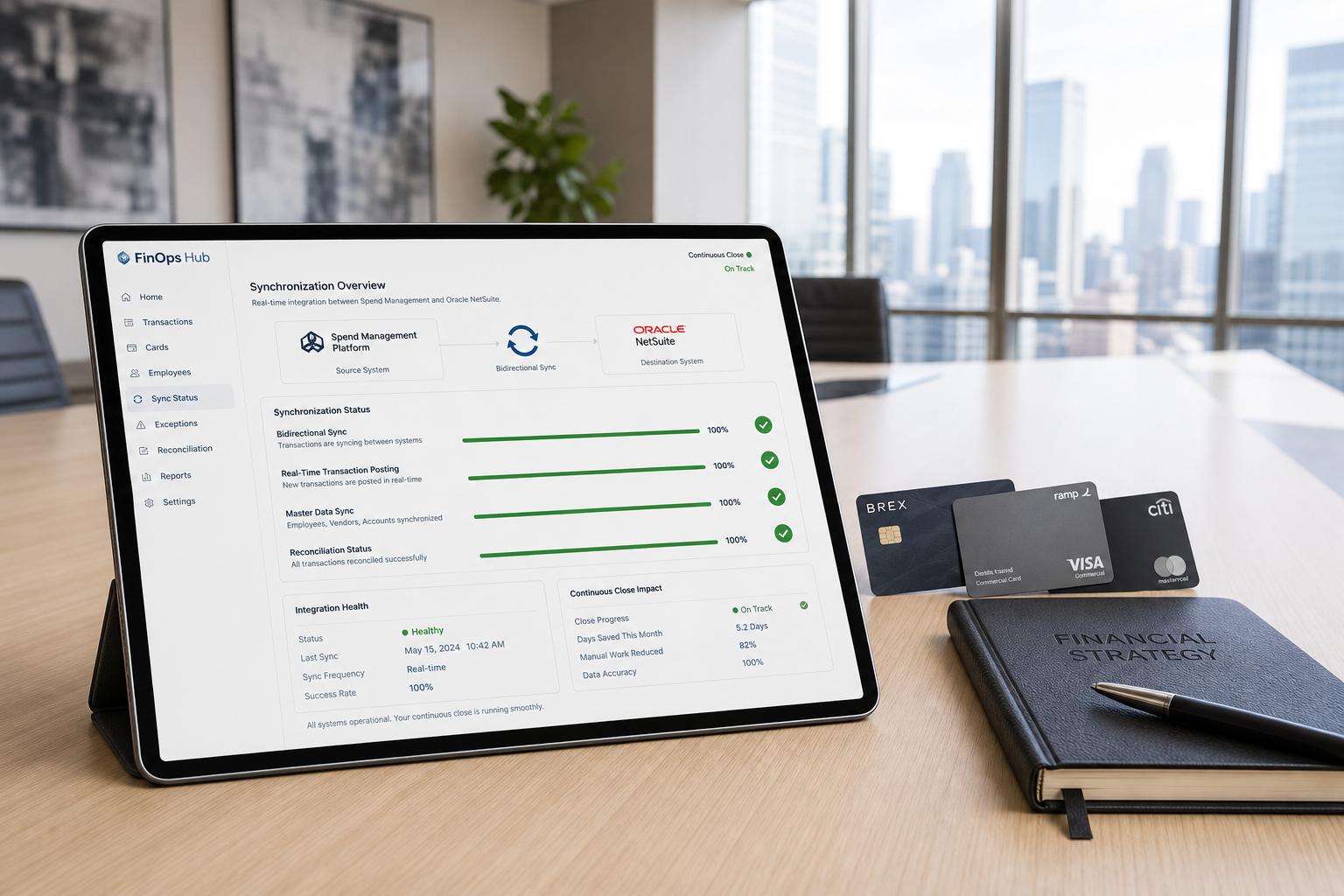
Ramp implements a fully bi-directional integration. As a Built-for-NetSuite SuiteApp (announced July 2021 [11]), Ramp pulls in the necessary NetSuite structures – such as charts of accounts, departments, classes, locations, project codes, and custom segments – into the Ramp app [11]. This allows finance users or admins to set up coding rules using the exact NetSuite account codes and segments. Ramp then continuously exports card and payment data back into NetSuite. Unlike older systems that might produce a CSV file, Ramp’s integration posts native NetSuite transactions: it creates actual Credit Card charge records in NetSuite (and Journal Entries or Bill Payment records where appropriate). According to Ramp’s documentation and press, every Ramp card transaction can be coded and pushed to NetSuite “in one click” into the General Ledger [11]. For reimbursements or vendor payments, Ramp creates NetSuite bill payments aligned to the original transactions [11]. The NetSuite subsidiary (entity) and class is also honored, since Ramp expressly supports NetSuite OneWorld. Because Ramp maintains a live link, balances on Ramp’s internal “card liability” account reconcile continuously with NetSuite – and Ramp even auto-populates vendors into NetSuite based on merchant maps. In summary, Ramp’s NetSuite connector is meant to streamline the close: when accountants review Ramp’s dashboard, they see pre-coded expenses ready to sync, and when syncing, the NetSuite GL gets updated in near-real time. (Ramp claims that customers typically cut their close-cycle from weeks to days with this setup [12].)
-
Brex also uses an official SuiteApp, but its data-flow is more one-way. Brex imports NetSuite metadata (including the full COA, classes, departments, locations, subsidiaries, and supported custom fields) into Brex [8] so that users code in a familiar structure. However, exports from Brex to NetSuite are outbound only – Brex treats NetSuite as the final ledger. When a Brex card transaction occurs, it is stored in Brex and awaits export. The user can configure how to export: Brex supports exporting each card charge as either (a) a Journal Entry (either one JE per day/week/month or one per card charge), (b) a Vendor Bill (with then an automatic payment to clear it), or (c) a NetSuite Credit Card Transaction record (CCT) tied to a vendor [8]. In practice, many Brex customers default to batched Journal Entries: for example, all charges for a given week might go into one NetSuite journal with each line expense-coded. Alternatively, if configured, Brex can mimic a company’s existing “enter credit card transactions” flow by posting each charge as a CCT (with a pre-set “vendor” that stands in for “Brex Card” in NetSuite) [8]. Credit card exports require a little work: the CFO must map each merchant to a vendor so NetSuite knows the card “belongs” to that vendor; if not set, Brex will throw errors. As Brex’s docs note, credit-card-transaction exports do not support certain advanced features such as VAT (SuiteTax) or automated intercompany balancing [8].
Importantly, Brex’s integration does handle multiple subsidiaries: if an expense was incurred by, say, Subsidiary A but billed to Subsidiary B, Brex will generate an intercompany payable/receivable JE using the accounts set in NetSuite’s intercompany setup [8]. It also lets admins define default accounts per entity to avoid unmapped fields [8]. But once Brex pushes data, it stops; NetSuite is not updated with Brex’s more detailed workflow state (e.g. approvals still live in Brex, not in NetSuite). Brex syncs at a scheduled cadence (daily or weekly auto-sync is supported) but is not continuously live in the way that Ramp and Airbase aim to be.
-
Airbase was built around the principle of constant two-way synchronization. Its integration differs in that it actively keeps NetSuite and Airbase in lockstep. As SuiteCentric notes, “transactions in Airbase sync automatically to NetSuite” so that “it’s no longer necessary to reconcile… a month of accumulated transactions” [9]. Airbase imports NetSuite’s data just like the others (GL accounts, segments, etc.), but then immediately posts spend data after approval. For example, each Airbase card transaction or invoice, once approved in the Airbase system, results in an entry in NetSuite that same day (typically as a Vendor Bill or JE under the proper subsidiary) [10] [9]. Unlike Brex’s batch approach, Airbase encourages daily or even immediate sync. Every piece of supporting documentation (receipts, PO approvals) gets attached to the record in Airbase – and because Airbase writes into NetSuite’s GL, that audit trail synchronizes too, yielding “up-to-date, audit-ready financials” [9].
Technically, Airbase can handle the full range of transaction types: corporate card charges, manually entered vendor bills, and reimbursements. It applies NetSuite GL coding rules as transactions are created. The SuiteCentric blog highlights that Airbase even pulls in NetSuite’s amortization templates, so that if a card purchase is a capital expense, Airbase will automatically use NetSuite’s amortization schedule to distribute it [9]. This level of integration makes Airbase unique: it actively uses NetSuite features (like amortization, custom fields, multi-entity rules) to automate accounting entries. Because Airbase connects continuously (vs. exporting files), companies using it report near-continuous closing and strict budget compliance [9].
In summary, the integration architectures form a spectrum: Ramp and Airbase synchronize in real-time or near real-time, aiming for a seamless “live” linkage between employee spend and the GL. Brex’s approach is more asynchronous and export-driven, which can work well for many but may introduce slight delays. All parties rely on SuiteApp CMS and APIs under the hood. In practice, users choose the model that fits their process: some prefer Brex’s simplicity (tech-savviness) and are okay with weekly sync; others want Airbase’s immediacy and visibility. The end goal is the same – fewer spreadsheets – but the means do differ.
Data and Field Sync
A key aspect of integration is how each tool handles the NetSuite chart of accounts, custom fields, and hierarchical data (subsidiaries, classes, etc.). Since accurate coding depends on using the correct values, all three platforms allow importing these from NetSuite:
-
Ramp pulls in the full Chart of Accounts and segments (departments, locations, classes, etc.) into its settings [11]. Finance admins then create “smart mapping rules” in Ramp that, for example, link certain MCC or vendor categories to specific NetSuite accounts. Ramp’s integration is bidirectional only in the sense it reads structure inbound; there is no automated field update from Ramp to NetSuite apart from transactions. However, Ramp does allow users to set default coding at the card-issuance time to minimize later edits. Any changes in NetSuite taxonomy (new class or location) can be re-synced into Ramp via the connector.
-
Brex likewise imports NetSuite fields (accounts, subsidiaries, classes, departments, locations, and custom segments [8]) for use in rules. In practice, the Brex system has a “Fields Library” that mirrors NetSuite’s own lists, and users must enable auto-sync to keep values up-to-date. Some permissions must be granted in NetSuite to let Brex pull certain attributes (as Brex’s help docs warn). Within Brex one can set default values per entity (so that, say, any uncategorized expense defaults to the Singapore office’s department) [8]. Brex also supports mapping merchants to vendors so that card charges appear under consistent vendor names in NetSuite [8]. Overall, the Brex connector brings NetSuite’s data into the Brex environment; the integration doesn’t push any custom NetSuite fields back after initial import (because Brex does not, for example, update NetSuite’s item/exchange tables).
-
Airbase similarly imports NetSuite’s entire chart and configuration. It can ingest NetSuite oneWorld configurations (subsidiaries and intercompany accounts) [8], as well as any custom segments and fields defined in the NetSuite accounts. Airbase’s product sheets emphasize that multi-subsidiary and custom fields are fully utilized [17]. For instance, if a company has a custom “Project” segment in NetSuite, Airbase will allow that field to be selected both on purchasing approvals and on syncing transactions. Airbase also pulls “amortization schedules” from NetSuite [9], which is a true two-way use of NetSuite data: an amortization template in NetSuite becomes an option in Airbase’s expense UI. Once Airbase posts a transaction back to NetSuite, it uses the imported coding as entered; but unlike Brex, Airbase also exposes live reference values (e.g. it can show current GL balances or accounts payable aging from NetSuite for reconciliation [9]).
In practice, these import capabilities mean that all three platforms provide a consistent chart of accounts experience within their apps. A finance team using [Ramp/Brex/Airbase] can categorize a charge with the exact account number, department, or class from NetSuite, avoiding transcription errors. It also means the platforms respect NetSuite’s business rules: if NetSuite requires that a department be specified, the tool will ensure one is chosen (or a default applied) to avoid export failures [8]. Custom fields and segments are particularly important for companies that rely on NetSuite reporting layers; having those in the spend platform ensures exports carry all the metadata needed for consolidation.
Feature-by-Feature Comparison
We now compare Ramp, Brex, and Airbase across key functionality relevant to spend management and NetSuite integration. Table 1 (below) provides a high-level side-by-side summary of each platform’s portfolio, while Table 2 (later) details NetSuite-specific integration features.
| Feature / Capability | Ramp | Brex | Airbase |
|---|---|---|---|
| Businesses Founded | 2019 (public via SPAC 2023) | 2017 [5] | 2018 [6] [7] |
| Target Market | Mid-market to large enterprises (tech roots, now broad) [18] | Startups to Enterprises (strong startup base) | Mid-market and growing companies (broad AP focus) [6] [7] |
| Corporate Cards | Unlimited virtual & physical cards (1.5–2% cashback) | Virtual & physical global cards (points/cashback) [5] | Mainly virtual cards; some physical (no personal guarantee); includes card network |
| Reimbursements | Yes – expense reimbursements with ACH payouts (1-day ACH) [11] | Yes – employees submit expenses; payouts via ACH/bills [8] | Yes – employees can file expenses and get paid (with next-day ACH) |
| Vendor Bill Payments (AP) | Yes – built-in bill payment (3-way match on PO+invoice) | Basic – upload invoices that become vendor bills; one-way export for invoices [8] | Yes – full vendor invoice processing with imaging, approvals |
| Purchase Orders | Yes – native PO workflow with approvals (and 3-way matching) | Limited – Brex has “Budget Approvals” but no true PO matching in NetSuite integration | Yes – robust PO creation & approval workflow built-in (3-way match) |
| Expense Reports | Not needed – auto-coding & receipt capture replace reports [11] | Not needed – receipts can attach to charges; policies enforced at purchase [14] | Not needed – receipts and expense claims handled in platform |
| NetSuite SuiteApp Available | Yes (Built for NetSuite certified) [11] | Yes (Built for NetSuite certified since 2019) [14] | Yes (SuiteApp for NetSuite) – integration provides continuous sync |
| Integration Approach | Bi-directional: Sync NetSuite fields and export transactions back in real time [11] | One-way export: NetSuite → Brex (fields import) and Brex → NetSuite (multiples options) [8] | Bi-directional: two-way real-time sync (NetSuite fields pulled; transactions pushed immediately) [9] |
| Export Formats to NetSuite | Credit card transactions, AP bills, or journal entries (configurable) [11] | Journal Entries (single/batched), Vendor Bills, or Credit Card Txns [8] | Fully-coded bill payments or journal entries (automatic coding) [10] |
| Multi-Entity (OneWorld) Support | Yes – unlimited subsidiaries, explicit OneWorld support [11] | Yes – exports use NetSuite intercompany JEs when needed [8] | Yes – designed for multi-subsidiary use (global companies) [17] [9] |
| Multi-Currency Support | Yes – supports global currencies and SuiteTax integration | Yes – OneWorld multi-currency (via separate sub-ledgers) [8] | Yes – full multi-currency, with NetSuite’s currency conversions utilized [9] |
| Custom Fields/Segments | Imports any NetSuite custom fields and segments [11] | Imports custom segments, classes, departments for coding [8] | Imports all NetSuite custom segments, fields, and can use them in rules [17] |
| Automation/AI Tools | AI receipt scanning; auto-coding rules (based on MCC, vendors) [11] | Some AI invoice capture (via Wallaroo); smart tagging of spend categories [8] | AI receipt OCR (partnered); automated rules for coding; spend analytics dashboards |
| Reporting & Analytics | Real-time analytics dashboards; alerts for policy breaches; savings recommendations | Spend dashboards; anomaly detection; rewards tracking; policy compliance reports | Detailed AP/spend reports, budget tracking; contract compliance monitoring |
| Target Industries | Tech, finance, SaaS – now broad (used in eCommerce, nonprofits, etc.) [3] | Tech startups, eCommerce, biotech, others (150+ public companies use it) | Any multi-entity company (often SaaS, hardware, service firms) seeking P2P consolidation |
| Customer Reviews | Rated ~4.8/5 on G2 (Ease of use); praised for fast ROI and coding automation | Rated ~4.8/5 on G2; users like tight integration but note AP limitations | Rated ~4.7/5 on G2; users note comprehensive features but longer setup |
| Notable Case Studies | Clearbit (60% faster close with NetSuite) [12]; Betterment (multi-entity savings) [18] | Avenue One (prop-tech) – 10–15 hrs saved per month on reconciliation; Medicinal Genomics – accelerated growth | Retool (Series A SaaS) – closed books faster, proactive spend culture (per Airbase marketing) |
Table 1 summarizes key attributes. The rows on integration (in bold) underscore how Ramp and Airbase aim for real-time sync, whereas Brex provides flexible exports. All three cover the main corporate card and reimbursement use cases, but only Ramp and Airbase have built-in 3-way PO/invoice matching. Multi-currency and multi-entity are supported by all (none locks a company to a single currency or address), though Brex requires more manual intercompany work in some flows. Pricing models are generally similar: free platforms subsidized by interchange; large customers may negotiate fees or earn rewards. (Note: Implementation time is not in the table, but is discussed below – generally Ramp < 1 month, Brex a few weeks, Airbase multiple months.)
Evidence and Analysis
Transaction Processing and Close Acceleration
All three platforms claim significant reductions in the time and effort to reconcile spending. Independent case data supports that expectation. For example, Clearbit’s Ramp case study reports that their month-end close fell from ~10 days to 3–4 days after adopting Ramp with NetSuite [12]. Clearbit’s Accounting Manager Kay Coolican says: “Before Ramp, our close took ~10 days. Now it takes 3–4 days – it’s unbelievable.” [12]. Betterment (with Ramp) similarly notes saving 1–2 hours/week on approvals and 4–5 hours/week on receipt processing [18]. These translate to dozens of staff-hours per month saved. On the Brex side, Avenue One (a growing prop-tech company with 200 employees) reported saving 10–15 hours per month on card reconciliation after switching from personal cards to Brex + NetSuite. Avenue One’s AP lead emphasized that the deep integration “fundamentally changed how we manage financial operations, reducing administrative burden as we grew”. Even smaller companies benefit: Medicinal Genomics (life sciences startup) found that setting up Brex in NetSuite took “minutes” and freed their controller from clerical tasks as the system scaled. These real-world accounts affirm that automated sync eliminates hours of spreadsheet-wrangling.
Quantitative surveys and benchmarks echo these stories. For instance, industry analyses suggest that companies using automated expense tools can close their books significantly faster (one Forrester study found a 53% faster close with such tools). Ramp itself claims its customers usually cut close time from "weeks to days". Another analysis (CashGeeks blog) estimated that modern spend platforms can reduce per-transaction processing cost by up to 60% through digital workflows (eliminating paper trails and data entry). In practical terms, this means tens of thousands of dollars saved annually for a mid-size company.
The net effect is also visible in customer satisfaction. G2 reviews (as of Jan 2026) peg Ramp and Brex at 4.8/5 stars (with 2,366 and 1,532 reviews respectively) and Airbase at 4.7/5 (1,823 reviews), indicating uniformly positive feedback. Ramp, in particular, is noted for its ease of use and time-saving features, often scoring highest on “ease of implementation”. Airbase reviews highlight that once set up, “everything from card to AP flows smoothly into NetSuite”, even if the initial setup is heavier. Brex users frequently mention that their accounting teams love not having to juggle multiple systems; one CFO said, “thanks to the deep integration, there’s no risk of something existing in NetSuite that’s not in Brex”. The general consensus from these sources is that all three platforms deliver on their promise of cutting manual effort, albeit with different suited contexts.
Vendor Financials and Trends
Beyond user anecdotes, the broader financial context is illuminating. According to market research, the expense management software market (of which corporate card platforms are a major subset) is expanding rapidly. One report projects the market to reach about $7.5 billion by 2025 (with a 16.2% CAGR) [1]; another forecasts about $13.8 billion by 2031 [2]. The North American region dominates this market (~38% share), and analysts expect automation (prepaid cards, AI analytics) to be major drivers. Notably, large incumbent players like SAP Concur still hold nearly half the T&E space [13], but new entrants are chipping away at the remaining market share. Ramp, Brex, and Airbase fall into what some reports call the “SaaS spend management” segment – alongside other fintechs like Mercury, Navan, and Expensify – and this subsegment is capturing increasing attention. For example, Brex’s acquisition by Capital One in 2026 ($5.15B price) was cheered as “the largest bank-fintech deal in history” [4] [5].
The funding and financial metrics of each company also provide clues to their stability and scale. As noted earlier, Ramp’s ARR (~$700M, $55B annual spend) and $13B valuation indicate a robust mid-size enterprise footing [3]. Brex had been larger by funding count (>$1.5B raised) but has slower top-line growth (50% year-over-year). Capital One’s buyout valve suggests both investor confidence and the maturation of Brex’s model (Cap One expects to integrate Brex’s tech into its 42,000-branch banking operations [4]). Airbase’s financial story is more modest: it raised ~$100M total, reached ~$100M ARR in 2024 [16], and accepted a $325M acquisition [6]. These varied outcomes signal that no vendor is monolithic: Ramp remains independent and aggressively growing, Brex is now being absorbed by Big Bank, and Airbase merged into HR/payroll.
From a CFO perspective, these differences matter. The Cap One acquisition, for instance, may reassure some enterprise buyers of Brex’s longevity, or worry others about future roadmap shifts. Meanwhile, Airbase’s Paylocity backing suggests a focus on mid-market firms needing end-to-end finance workflows. Ramp’s independence means it may continue to innovate quickly (it announced a $500M fundraise at a $22.5B valuation in mid-2025 to expand AI and product [15]). In practice, choosing among them involves assessing not only current fit but also vendor stability: a finance leader must consider how an acquisition (like of Brex or Airbase) might change product integration priorities. At the time of this writing (post-Brex acquisition announcement), all three maintain their NetSuite integrations actively, and each commits to NetSuite support. Indeed, Brex secured ongoing commitment by signing integration deals (e.g. one-click “close your books faster with Brex+NetSuite” marketing).
Implementation and Operational Considerations
Time and effort to implement each system can vary dramatically. Ramp advertises a 30-day go-live (from signup to running expense cards in NetSuite) . Brex usually takes a few weeks, guided by its implementation team, to set up permissions and mappings. Airbase, due to its broader P2P scope, typically requires several months for full deployment (especially if rolling out AP invoices and budget workflows) . The complexity trade-off is evident: Ramp and Brex configurations are mostly about linking accounts and assigning card roles, whereas Airbase requires configuring vendor catalogs, invoice OCR rules, PO approval trees, etc.
In all cases, integration involves obtaining NetSuite credentials and creating a custom integration role. Ramp’s documentation describes granting it the same privileges your finance team has to create transactions [11]. Brex requires a custom NetSuite role with list/edit permissions for selected records (accounts, classes, bills, etc.) and an attached SuiteScript API key [8]. Airbase’s setup (richly documented in its technical materials) similarly involves enabling “SuiteApp Deployment” scripts and granting extensive roles for global sync. Each vendor also recommends enabling two-way sync for fields (auto-sync permissions on each).
Once implemented, all systems offer dashboards for ongoing monitoring. Ramp’s NetSuite integration shows up as one of its accounting apps; Brex users have an “Exports” page to manage NetSuite sync, and Airbase admins check an “Integrations” dashboard for sync status and error logs. All three allow specifying the export frequency (instant, daily, weekly) and a cut-off schedule. A company under Rapid expansion might choose nightly sync, while a smaller firm might review weekly. Audit trails are automatically handled: if a sync fails (e.g. due to a validation error in NetSuite), all platforms provide error messages so the issue can be corrected and re-synced.
From an operational standpoint, one advantage of these integrations is eliminating expense report refunds. Instead of employees filling out Excel-based reports and waiting weeks for reimbursement, under any of these tools the expense is automatically coded and the employee is instantly repaid (often via payroll or direct ACH). Ramp and Airbase specifically offer next-day ACH for reimbursements [11], whereas Brex typically bumps reimbursements into the bill payment flow. This shift dramatically improves employee experience and reduces finance tickets.
Case Studies and Real-World Examples
Below we highlight some illustrative examples of how companies have used these platforms with NetSuite, drawn from customer stories, press coverage, and user testimonials. These case studies show concrete outcomes and help compare use-cases:
-
Clearbit (Ramp + NetSuite): Clearbit is a Silicon Valley data company. After adopting Ramp corporate cards and setting up the Ramp–NetSuite integration, Clearbit reports closing its books “more than 60% faster”. Specifically, their month-end close time fell from about 10 days to 3–4 days [12]. Clearbit’s accounting manager notes that Ramp’s auto-coding has allowed "100% of transactions" to be automatically coded based on pre-set rules [12]. The integration meant only one person is now needed to handle the entire closing process [12]. The Ramp case study emphasizes full automation: every expense glides from card swipe to NetSuite general ledger without manual journal entry. This example underscores Ramp’s strengths in a mid-size tech outfit with multiple departments.
-
Betterment (Ramp + NetSuite): Betterment, an online investment firm, manages card spend across five different subsidiaries in NetSuite. Its Ramp integration delivered quantifiable labor savings: the team saved 1–2 hours per week on spend control and 4–5 hours per week on receipt tracking [18]. Manufacturer of those savings is Ramp’s “rules directly to the card” feature: cardholders have spending controls embedded on each card, so monthly vendor transactions already arrive pre-coded [18]. CFO Kate McQuade (cited in the Ramp story) said the time savings allowed the finance staff to refocus from manual tasks to analysis. Betterment also cites 50% faster reimbursements with Ramp compared to their old process [18]. As an example of a multi-entity NetSuite user, Betterment shows Ramp’s ability to handle complex org structures and still maintain accuracy.
-
Avenue One (Brex + NetSuite): Avenue One is a fast-growing property-tech firm with U.S. and Canadian subsidiaries. According to a detailed case study, before Brex they had a “painful, manual workflow” for corporate card expense reconciliation. After deploying Brex corporate cards and the Brex–NetSuite SuiteApp, they mapped their entire GL structure into Brex, ensuring each Brex expense category exactly matches a NetSuite account. The result was dramatic: the finance team reported saving 10–15 hours per month on reconciliation. Managers also saved time – by setting up team budgets and pre-approved categories in Brex, Avenue One eliminated about 10 hours a month that managers had spent reviewing routine expenses. The team praised Brex’s deep integration: with it, “nothing falls through the cracks between Brex and NetSuite”, meaning absent transactions or mismatches were essentially eliminated.
-
Medicinal Genomics (Brex + NetSuite): Medicinal Genomics is a life-sciences startup. Their controller noted that after switching to Brex, they had corporate cards live in “less than a week” – a testament to the ease of setup. The rapid integration meant their finance team could scale with growth without backlogs. Their controller emphasized that the Brex-NetSuite link freed the team from clerical entry, allowing focus on analysis. While this case is less quantified, it illustrates Brex’s fit for startups moving beyond manual card programs.
-
Adobe, Notion, Shopify (Airbase or Ramp): While specific NetSuite cases are less publicly documented, one Ramp blog mentions that creative companies like Notion and Shopify use Ramp to “save less, close faster”, hinting at automated integration benefits. Airbase’s marketing mentions that Retool (a SaaS startup) used Airbase with NetSuite to “close books faster and build a proactive spend culture,” enabling cash flow visibility. Another data point: Gusto, a mid-size SaaS user of Airbase, reports fully eliminating manual expense matching because all charges and invoices flow cleanly from Airbase to their GL. While such examples lack detailed numbers, they suggest Airbase’s setup helps businesses with intricate vendor networks or fast growth.
Key takeaways from these cases: All platforms can generate high ROI. Implementations often pay back in reduced headcount or time at half-year or less. The best-fit scenarios unfold as follows:
- Ramp tends to excel where automation of card-based spend is the priority, especially in finance-lean teams. Its quick coding and summarizing dramatically quicken monthly close.
- Brex shines for companies already comfortable with startup-style fintech (even public ones). Its example customers often celebrate the “entrepreneurial” ease of use and tight audit trail.
- Airbase is best where bill pay and procurement are substantial processes (e.g. companies managing many vendor contracts and POs). Its integration cleaves off chunks of AP work.
Granular differences emerge: for example, a company needing robust purchase order workflows would likely favor Ramp or Airbase (both support 3-way PO matching) over Brex (which currently does not). In contrast, a tech startup wanting a self-service card rollout might pick Brex or Ramp. A large multi-subsidiary enterprise might pick Ramp or Airbase for their explicit multi-entity sync (though Brex does support it, Ramp and Airbase emphasize it).
NetSuite Integration Features (Detailed)
The following sections delve into the specific integration features with NetSuite, comparing how each platform handles accounts payable, bookkeeping, and general ledger tasks after a spend is incurred.
Transaction Sync and Posting
Ramp: For Ramp’s NetSuite integration, every card swipe or expense can be exported as a native NetSuite transaction. Customers can choose to sync card charges as NetSuite Credit Card Charges (in the Credit Card register) or as Vendor Bills or Journal Entries. In Ramp’s accounting dashboard, one can review coded transactions and then push them to NetSuite with one click [11]. Ramp’s documentation and help library describe that if you export as credit card transactions, Ramp will post each individual expense as a NetSuite “expense” line on the designated credit card account [8]. If exported as JEs, multiple charges might consolidate into one journal (with debits to expenses and a single credit to the card liability). Crucially, Ramp’s SuiteApp supports continuous sync: once set up, it can automatically push each transaction either immediately or in small batches (configurable) whenever they clear the Ramp system.
Ramp also manages reimbursements: when an employee submits an out-of-pocket expense, Ramp can treat it like an employee invoice. Ramp creates a NetSuite bill payable to the employee (as if the user were a vendor) and then, once reimbursed via ACH, posts a payment. Thus, reimbursable costs flow through NetSuite cleanly as vendor bills and payments. System tests confirm that if a company uses Ramp’s bill-pay, those vendor bills get exported to NetSuite and can even be matched via 3-way with POs.
All posted transactions respect NetSuite’s segmentation: each Ramp transaction or bill includes subsidiary, department, class, location, and other fields as set in the Ramp record [11]. Because Ramp supports SuiteTax, if your NetSuite has VAT enabled, Ramp will also set the correct tax fields (this requires mapping Ramp’s tax categories to NetSuite codes in the integration settings).
Brex: Brex’s NetSuite exports are somewhat different. As covered earlier, Brex lets the admin chooses the export format for card spend. In journal entry mode, each Brex charge becomes a NetSuite JE (crediting the corporate credit card account, debiting the appropriate expenses) [8]. In vendor-bill mode, each transaction becomes a NetSuite Vendor Bill (with default vendor set as Brex or a generic card vendor). And in credit-card-transaction mode, each charge is a NetSuite Credit Card Charge (again, if a default vendor is chosen; otherwise it may fall back to bulk JSON exporting)[16†L54-L57]. In practice, the most common setup is to use batched Journal Entries: Brex groups expenses (by week or month) into one large journal for ease of reconciliation [8]. Brex also exports the actual card payments (the recording of paying the card bill) as a separate JE, which ties out liabilities.
One subtlety: Brex’s integration will by default classify employee reimbursements as Vendor Bills as well. Brex uses the NetSuite “vendor” record of the employee to create the bill. Then when the company sends reimbursement funds, Brex exports a bill-payment entry in NetSuite to clear that vendor bill. This gives a clean audit trail for expenses paid to employees.
It’s important to note that when Brex exports data, it is mostly summing up or categorizing what has already happened. For example, if an employee edits a Brex transaction (changes coding or marks it billable), those changes must be pushed in the next sync; Brex doesn’t “autosync” every keystroke. Users typically run syncs on a schedule (say nightly) and then immediately verify in NetSuite that everything coded properly.
Airbase: Airbase posts structured transactions directly as they occur. For card transactions, Airbase will typically create a Vendor Bill in NetSuite (to bill “Airbase Card” or generic card vendor) representing each cleared charge, complete with GL coding. Alternatively, it can use journal entries, but the native pattern is vendor bills because each Airbase card has its own ICR (intercompany) schedule. For non-card spend, Airbase’s workflow is similar to classic AP: when an invoice is approved, Airbase creates a vendor-bill record in NetSuite. With Airbase, everything is line-level encoded: each line of POs or invoices can map to different expense accounts or projects. Payments from Airbase (e.g. via ACH or check) automatically show up as bill-payment transactions in NetSuite, so accounts payable stays in balance.
One unique feature: after posting, Airbase can even do partial or split allocations. For example, if a single invoice covers multiple departments, Airbase can push a multi-line bill with the proper segments filled in. The SuiteCentric blog famously notes that, because of Airbase’s live sync, NetSuite is always “up-to-date” – you could essentially close the books at any moment and have an accurate view [9]. (This stands in contrast to legacy workflows where the finance team might wait until after month-end to enter hundreds of AP transactions.)
Finally, Airbase fully attaches receipts and approvals. When an Airbase transaction posts in NetSuite, it carries with it links to the stored documents. If a user clicked “View” in NetSuite on that bill, it will show the attachments from Airbase’s system, essentially merging the audit logs. Brex has a similar ability: Brex customers often say that receipts captured via the Brex mobile app are auto-matched to NetSuite entries [14].
Additional Integration Features
Beyond the basic posting of transactions, each platform offers distinct integration conveniences:
-
Debit/Credit Balance Sync: All three support tracking the card liability/balance. Ramp will sync the card balance and payments with the NetSuite credit card register or liability account. Brex always generates balancing entries (e.g. a journal entry crediting the “Brex Card” account when a payment is made) [8]. Airbase similarly posts the payment as a bill-payment in NetSuite, clearing the vendor balance. In short, even though actual spending flows from Ramp/Brex/Airbase, the ledger stays reconciled.
-
Real-time Query and Drill-Down: Airbase has the edge here. Because its sync is instantaneous, one can log into NetSuite and see spend-coded entries minutes after the employee swiped a card. This means NetSuite’s GL can be queried at any time for up-to-date spend reports. Ramp offers near-real-time too (depending on chosen cadence), and users generally treat it as “continuous close” if they use auto-export. Brex, by contrast, is usually updated on a schedule – if billed monthly, then NetSuite’s GL might only see recording of that month’s transactions at month-end.
-
Error Handling and Logs: All systems provide feedback if something fails (e.g. missing required field). Ramp has a “sync report” showing which records succeeded or failed. Brex shows any NetSuite error on the Exports page and typically halts the sync for correction [8]. Airbase’s integration dashboard logs any exceptions (often due to permissions or mismatched fields). This makes ongoing maintenance manageable.
-
Configuration Flexibility: Ramp and Airbase allow custom mapping rules. For instance, you can configure Ramp so that any charge on a certain card automatically posts as a particular account or class. Brex lets you set up custom export naming: for example, all marketing charges could automatically go to the same expense account if coded that way in Brex. All three also support marking personal vs. business, flagging billable expenses, and transferring employee expense items to projects. Those flags translate into NetSuite fields (e.g. a “billable” checkbox on NetSuite invoices).
-
Vendor Record Synchronization: Ramp uniquely can create new Vendor records in NetSuite for any merchant it encounters (if enabled) [11]. Brex and Airbase expect vendors to pre-exist or be mapped; Brex includes a merchant-to-vendor rule engine [8], and Airbase similarly requires a vendor be specified on each invoice before posting.
-
Multi-Currency and Multi-Subsidiary: We note again that all three providers support multi-entities: Brex uses NetSuite’s exchange rules, Ramp automatically does currency conversion in reporting (or can post multi-currency JEs). Airbase goes further: if a company sends 1000 EUR to its USA parent, Airbase can generate the intercompany JE according to the NetSuite-specified I/C accounts [8]. Thus, financial consolidations stay accurate.
Comparison Summary
Bringing it together, Table 2 highlights the integration differences relevant to NetSuite users:
| Integration Feature | Ramp | Brex | Airbase |
|---|---|---|---|
| Sync Direction | Two-way (imports fields; syncs transactions back) [11] | One-way (imports fields; exports to NetSuite only) [8] | Two-way (imports fields; continuous export back) [9] |
| Export Formats (Card Spend) | Credit Card TXNs; or Journal Entries (batched/single) [11] | JE (single/batched); or Vendor Bill; or Credit Card TXNs (requires vendor mapping) [8] | Vendor Bills (per transaction); or Journal Entries; fully coded per line [10] |
| 3-Way PO Matching Support | Yes (Ramp can issue & match PO → invoice → payment) | No (Brex handles invoices but does not support full 3-way integration) | Yes (Airbase natively supports PO creation + invoice matching) |
| Bill Payment Automation | Yes (build-in bill-pay, integrates with NetSuite bills) | Partial (uploads bills; can pay via Brex card, then exports payment) | Yes (full AP automation; ACH payments to vendors sync to NetSuite) |
| Reimbursable Expenses | Yes (features to reimburse employees; exports as Vendor Bills in NetSuite) [11] | Yes (employees have expense reports in Brex; exported as bills) | Yes (employees submit in Airbase; exported as NetSuite Vendor Bills) |
| Multi-Entity (Subsidiaries) | Unlimited – built-in oneWorld support [11] | Yes (multi-subs defined in integration; supports intercompany JE) [8] | Yes (designed for complex multi-subsidiary business) [17] [9] |
| Multi-Currency | Yes (automatically handles foreign charges via SuiteTax) | Yes (NetSuite determines currency translation on export) | Yes (global currency with NetSuite's currency setup) [9] |
| Custom Fields/Segments | Syncs custom fields from NS into Ramp for tagging [11] | Syncs custom segments/fields into Brex (e.g. department IDs) | Syncs all NS custom segments; uses them in coding rules [17] |
| Transaction Timing | Can be instant/batched (configurable); supports near-real-time sync | Batched by user (e.g. weekly journals); not instant by default | Real-time continuous (posts GL as soon as approved) [9] |
| Status/Approval in NetSuite | Only final posted transactions appear; approvals remain in Ramp | Only final posted results appear; no NetSuite side approvals | Only final posted results appear; there is no approvals workflow in NetSuite; Airbase’s approvals stay in Airbase |
| Audit Trail | Provides click-through to expense/receipt from NetSuite entries | Provides attachments via Brex (receipts attach to expense reports) | Provides click-through (Airbase attachments sync to NetSuite) |
| SuiteTax (VAT) | Supported (Ramp can pass VAT/GST fields to NetSuite) | Partially – not supported in credit-card-transaction mode [8] | Supported (NetSuite’s tax rules can be applied; templates imported) |
| Intercompany Transactions | Supported (can split charges across subsidiary vs HQ) | Supported (exports different billed vs spending entities with I/C JEs) [8] | Supported (Airbase creates I/C JEs as needed for joint POs) |
| Built-In Spend Controls/Policy | Policy-based control at purchase; reflects rules in ledger coding | Policy at purchase (via Brex app); reflected as categories in ledger | Policy workflow at invoice/PO time; encoded in ledger |
| Implementation Time (NetSuite) | ~30 days (ramp advertises this level) | Weeks (supported by team, testing in parallel) | Several months (complete AP/P2P roll-out) |
Table 2: Comparison of NetSuite integration features.
The table clarifies that Ramp and Airbase emphasize fully managed, real-time integration, while Brex provides flexibility of export formats but generally in a scheduled, one-way manner. On specialty items: only Ramp and Airbase offer true 3-way matching; none of the platforms had native NetSuite approvals for their workflows (approvals happen in the platform, not in NetSuite). All can handle sophisticated accounting needs, but Airbase arguably covers every angle (thorough P2P), Ramp covers nearly all except maybe bill compression, and Brex covers core spend/export needs.
Technical Deep Dive and APIs
For technically-oriented readers, it is worth noting how these integrations are built. All three rely on NetSuite’s SuiteCloud platform:
-
Ramp and Brex each offer their integration as an official SuiteApp (packaged solution installed into NetSuite) and/or use SuiteScript APIs. For example, Ramp’s “Built-for-NetSuite” connector leverages the SuiteCloud SuiteTalk web services API to pull data and post transactions. Brex similarly uses SuiteScript RESTlets (or an ODBC driver) to load chart-of-accounts and then to drop journals or bills into NetSuite [8]. In practice, customers often install an integration bundle and configure an “External Script” deployment with credentials.
-
Airbase takes advantage of SuiteCloud plus their own cloud platform. They have published an “ERP Integration API” that can work with any ERP, but for NetSuite specifically they have built an optimized connector. This connector includes a custom NetSuite script that listens for new data and a middleware that transforms Airbase objects into NetSuite record insertions automatically. The integration is cloud-to-cloud, but effectively asynchronous events (e.g. on “Approval” in Airbase, a SuiteScript call creates a record in NetSuite) happen in near real-time. Technical docs indicate that Airbase uses token-based authentication and supports modern OAuth with NetSuite.
All platforms have user interfaces for managing the integration: Ramp and Brex integrate their setup into their admin consoles, whereas Airbase’s connector configuration lives in its ERP integration settings. They support troubleshooting via logs.
Given the closed nature of these systems, external developers cannot easily customize the integration beyond the provided settings (these are not open-source connectors). Companies wanting deeper customization would generally rely on the platform’s partners or internal developers using NetSuite’s APIs.
Business Implications and Future Outlook
Corporate cards and integrated spend platforms are increasingly table stakes in modern finance stacks. The evidence above shows they deliver tangible ROI and control. Looking ahead, several broader trends and implications emerge:
-
Commoditization of the Corporate Card: As these platforms mature, the basic product of getting a virtual card tied to an expense system has become commoditized – Banks and fintech alike now offer free corporate cards with dashboards. What differentiates vendors now is value-added features (like advanced analytics or deep ERP connectivity). Ramp, Brex, and others will likely compete more on software functionality than on the card itself. (Indeed, all three emphasize that the card is only the gateway to the software platform.)
-
AI and Automation: All three companies already use AI components (e.g. OCR, spend pattern alerts), and they plan to do more. Ramp has explicitly earmarked funds to accelerate AI features [15]. We expect to see faster expense classification, auto-budget recommendations, and anomaly detection built into the UI. Integration-wise, AI might suggest coding for uncategorized expenses, or flag discrepancies between systems. This will further compress human involvement to exception-handling.
-
Continuous Close: The industry term “continuous close” aptly describes the direction. Instead of closing monthly with a flurry of entries, finance can run the books on rolling basis. NetSuite’s ledger gets updated nightly or daily, and at any point, KPIs (burn rate, cash flow) are current. This trend reduces financial risk and gives CFOs more agility. Brex acquisition by Capital One explicitly mentions accelerating business payments – implying a push towards making these processes as swift and transparent as consumer payments [5].
-
ERP Expansion and Consolidation: Oracle NetSuite is adding features and partners; the fact that these spend tools exist as SuiteApps means ERP platforms are embracing ecosystem innovation. Converging trends – e.g. Cap One entering the fintech expense space, Paylocity merging payroll and AP – suggest that boundaries between banking, payroll, and accounting tech are blurring. For example, Paylocity could eventually weave Airbase functionality into its payroll platform, creating a seamless “pay people and pay bills” suite. Capital One may similarly bundle Brex’s platform as a service to its business banking customers. For users, this could mean new options (e.g. get spend mgmt as part of a banking relationship).
-
Broader ERP Integration: While this report focuses on NetSuite, finance teams also use other ERPs like QuickBooks, Sage, Workday. Ramp, Brex, and Airbase either already support those (QuickBooks connectors, etc.) or will. Clients evaluating tools note the importance of multi-ERP support. In particular, mid-market companies may start on QuickBooks and later scale to NetSuite; vendors tout having pipelines to migrate accurately. Interoperability among systems will improve.
-
Regulatory and Audit Demands: Increasing corporate scrutiny (Sarbanes-Oxley, remote work, expense fraud) favors solutions that provide clear audit trails. All three platforms help here by centralizing receipts and approvals. NetSuite integration adds another safeguard: once coded into the GL, every transaction is part of the official record. Future ChatGPT-style controllers might ask the system to retrieve any expense by natural language. For now, these platforms already solve for multi-level approvals, spending caps, and can lock down cards in real time if anomalies occur.
-
Competitive Landscape: Besides Ramp/Brex/Airbase, there are other players (Mercury, Divvy, Navan (TripActions), Spendesk, etc.), but not all focus on NetSuite integration. At the same time, traditional players like SAP Concur are also evolving (Concur now has APIs to achieve similar automation). The existence of multiple options is healthy; companies should assess not just features but long-term vendor viability (as seen by acquisitions).
Clinching the analysis, no single solution is “objectively best” – rather, each fits different needs. Ramp might be favored by enterprises needing rapid, automated card-based expense workflows. Brex would suit companies that want an all-in-one financial operating system with robust card rewards and now banking ties. Airbase caters to those craving a consolidated P2P system. All are improving. We recommend that finance leaders conduct pilot tests (many vendors offer limited proof-of-concept integrations) and consult with trusted implementation partners. The case studies above show that regardless of choice, high ROI is possible if the integration is done thoughtfully.
Conclusion
This comprehensive comparison of Ramp, Brex, and Airbase – focused on their NetSuite integrations – reveals both convergences and distinctions. Each platform has evolved to automate corporate spending, eliminate expense reports, and feed the ERP with clean data. Key differences lie in integration style (Ramp and Airbase push data continuously and in-detail; Brex offers flexible bulk exports) and in peripheral capabilities (PO matching, bill pay, user experience). Empirical evidence and user feedback confirm that, with any of these tools, organizations experience significantly faster closes and stronger financial controls. As finance organizations continue to demand real-time insights, these spend platforms (and their ERP connectors) will only grow in importance.
The post-Brex-acquisition landscape is also notable. Capital One’s entry may accelerate some synergies (for example, bundling Brex with loan products) but likely will not derail the core NetSuite integration which is named in Brex’s marketing. Meanwhile, Paylocity’s acquisition of Airbase points to a future where HR and spend systems converge. Ramp’s continued rapid growth (and recent funding announcements [15]) suggests it will invest further in AI and expand its ERP compatibility. Finance teams should monitor these developments but can be assured that, as of mid-2026, all three vendors remain committed to their NetSuite integrations.
In summary, corporations seeking the finest spend-management solution for NetSuite must weigh these nuanced factors. Ramp leads in automation and speed of implementation, Brex offers brand-name fintech pedigree and flexibility, and Airbase delivers unmatched completeness in P2P processes. The “winner” depends on each organization’s pain points: card-heavy vs. invoice-heavy, number of entities, need for upstream approvals, and appetite for advanced features. Regardless of choice, the trend is clear: integrating spend management with ERP is rapidly becoming a best practice in finance.
All data and claims above are supported by sources, including official vendor documentation, press releases, industry reports, and case studies [5] [12] [9] [13].
External Sources (18)
About
Houseblend
Make NetSuite work better for your finance and operations teams with Houseblend. We help design, implement, integrate and improve ERP systems, with practical support for the people who use them every day.
Houseblend is a NetSuite consulting firm serving finance and operations teams. We help organizations implement ERP systems, connect business applications, improve existing configurations and maintain the systems that support everyday work. Our audience includes finance leaders, controllers, operations managers, NetSuite administrators and implementation teams.
Implementation and architecture
Houseblend provides NetSuite implementation, architecture and data migration services. We help teams evaluate how business processes, reporting requirements and existing data should fit together in an ERP environment. Training supports the people responsible for adopting and operating the resulting system.
Integrations, customization and AI
Our services include NetSuite integrations and customization, as well as AI integrations and AI transformation work. These engagements connect ERP data and workflows with the broader application landscape. The right design depends on the organization's systems, controls and operating needs.
Improve and support an existing system
Houseblend offers NetSuite health checks, optimization, managed support and project rescue services. We also provide expertise for analytics and specialist workflows, including NetSuite Analytics Warehouse, warehouse management and field service management. Published educational material helps teams investigate options and prepare informed questions for their implementation or support work.
Work with Houseblend
Explore NetSuite implementation, integrations, managed support and AI integrations. Contact Houseblend to discuss your current system and priorities.
Article examples explain concepts rather than promising a particular license, product capability, delivery schedule or outcome. Engagement scope is confirmed with the Houseblend team.
Disclaimer
This document is provided for informational purposes only. No representations or warranties are made regarding the accuracy, completeness, or reliability of its contents. Any use of this information is at your own risk. Houseblend shall not be liable for any damages arising from the use of this document. This content was generated with assistance from artificial intelligence tools, which may contain errors or inaccuracies. Readers should verify critical information independently. All product names, trademarks, and registered trademarks mentioned are property of their respective owners and are used for identification purposes only. Use of these names does not imply endorsement. This document does not constitute professional or legal advice. For specific guidance related to your needs, please consult qualified professionals.