Houseblend Article
NetSuite PSA Integration: Celigo, Top Step & Sync Patterns
Inside this article
- 01Introduction and Background
- 02Celigo Integration Platform (iPaaS)
- 03Top Step Consulting: NetSuite for Professional Services
- 04Integration Patterns for NetSuite Professional Services
- 05Case Studies and Real-World Examples
- 06Data Analysis and Evidence-Based Benefits
- 07Discussion and Future Implications
- 08Conclusion
Executive Summary
Professional Services Organizations (PSOs) rely on Professional Services Automation (PSA) systems (such as NetSuite’s SuiteProjects Pro, formerly OpenAir) to manage projects, resources, time tracking, billing, and financials across their delivery lifecycle [1] [2]. However, these organizations also use many other systems – CRM (Salesforce, HubSpot), HR (Workday, ADP), collaboration tools (Slack, Teams), and billing platforms – creating data silos and manual overhead. A recent partnership between Top Step (a NetSuite PSA specialist) and Celigo (a leading integration iPaaS promises to deliver a fully connected NetSuite ecosystem for PSOs [3] [4]. By leveraging Celigo’s integration platform, Top Step can seamlessly automate data flows (opportunity-to-project, hire-to-resource, timesheet-to-invoice, etc.) across the tech stack with End-to-End integration. This eliminates manual work, reduces errors, and enables real-time operations. Case studies show dramatic efficiency gains – for example, automating Salesforce–NetSuite syncing saved 15 hours/month at Headspace [5], and integrating timesheets to invoicing saved 3–5 days per month of manual entry for PS firms [6]. Industry analyses affirm the value: PSA platforms are projected to grow at ~15% CAGR to $50B by 2034 [7], and iPaaS solutions like Celigo can yield 364% ROI over three years by slashing integration development time (by 75%) and error costs [8] [9]. This report explores the background, technical patterns, and real-world impacts of the Celigo–Top Step solution for NetSuite-based PSA, with extensive data, examples, and expert insights.
Introduction and Background
Professional Services Automation (PSA) refers to the software and processes that automate key workflows of service businesses – including project management, resource planning, time and expense tracking, client billing, and reporting – in one integrated system [2]. PSA evolved in the 2000s as service firms sought to replace fragmented tools with unified platforms. One notable milestone was Oracle NetSuite’s 2008 acquisition of OpenAir (an early cloud PSA for timesheets, expenses, and project management) [10]. OpenAir was rebranded as NetSuite SuiteProjects Pro (PSA) by 2025 [1]. Today, NetSuite SuiteProjects (PSA) sits alongside NetSuite ERP/Financials as a popular cloud solution for PSOs [11] [12].
PSA adoption is surging: the global PSA software market was $14.41B in 2025 and is projected to reach $50.33B by 2034 (CAGR ≈14.9%) [7]. This growth is driven by demand for centralized platforms that unify project workflows, financials, and workforce planning [13]. PSOs (consultancies, IT firms, agencies, etc.) increasingly need solutions that provide real-time visibility into project profitability, resource utilization, and billing. As one market report notes, US-based service firms “increasingly adopt PSA solutions to manage distributed teams, hybrid work, and complex client engagements,” and emphasize PSA tools that “integrate seamlessly with ERP, CRM, and HR systems” to enhance performance [14] [2]. In short, modern PSOs demand end-to-end integration: projects in the pipeline should automatically flow from sales to delivery to invoicing.
Yet in practice, many PSOs struggle with disconnected systems. They typically use CRM (e.g. Salesforce) for sales, PSA (SuiteProjects) for project execution, HCM (Workday) for HR/payroll, and ERP (NetSuite Financials) for accounting. Data must be manually re-entered or reconciled across these silos, creating inefficiency and errors. For example, a finance team might spend days each month manually copying approved timesheets into the accounting system [6]. Billing processes often require email attachments and PDFs to merge separately managed invoices [15]. Such manual processes not only consume labor but delay revenue recognition and obscure profitability. Industry analysis confirms this pain: PS firms without robust integrations can lose 3–5 days per month on manual data entry, delaying project profitability insights [6]. The need to automate these handoffs is acute.
Celigo Integration Platform (iPaaS)
Celigo Integrator.io is a cloud-based Integration Platform as a Service (iPaaS) designed for connecting diverse applications [8] [16]. Founded by ex-NetSuite executives, Celigo has focused on NetSuite integration since inception [16] [17]. The platform provides a low-code, visual interface for building integration flows (called “Integrator Flows” or “Integration Apps”).Users can drag-and-drop prebuilt connectors and steps (import/export, mapping, transformations) to link source and destination applications [17] [18]. Celigo offers both pre-built templates (“Integration Apps”) for common scenarios and custom flows for bespoke needs. The library includes 80+ NetSuite-focused templates spanning e-commerce, CRM, finance, HR, and logistics [17] [18]. Crucially, Celigo has dedicated connectors for NetSuite ERP and NetSuite SuiteProjects Pro (PSA), plus hundreds of other SaaS apps: Salesforce, Workday, ADP, Slack, Stripe, Shopify, and more [17] [19]. For example, Celigo’s Workday–NetSuite connector automates HR onboarding: new hires and terminations in Workday automatically create or inactivate employee records in NetSuite [20]. Similarly, a Salesforce–NetSuite template can sync closed opportunities to NetSuite orders or projects, eliminating double entry (as seen at Headspace, which saved ~15 hrs/month by using Celigo [5]).
Celigo’s platform is also enterprise-grade: it handles authentication, scheduling, error handling, and monitoring across all flows. Advanced features include AI-driven error resolution dashboards [9], data transformation with lookups and JavaScript hooks [21], and orchestration of multi-step processes (e.g. extract → transform → load chains) [21]. The result is a centralized integration hub: instead of a fragile web of one-off scripts, organizations gain a managed environment where IT and even business users can build and oversee integrations [22] [23].
Industry recognition underscores Celigo’s position. Celigo boasts over 5,000 NetSuite customers and has been repeatedly named a Visionary in Gartner’s iPaaS Magic Quadrant [16] [24]. It was rated G2’s #1 iPaaS and a Gartner Peer Insights Customers’ Choice (2025) [25]. Moreover, an independent Forrester study found Celigo delivered 364% ROI over three years [8]. Key benefits driving that ROI include: a 75% reduction in integration development time (saving ~$463K over 3 years) and a 90% cut in error resolution time (saving ~$135K) [9]. These efficiencies are directly relevant to PSOs, as manual integration work is replaced by automated flows. Small IT teams can support much larger integration needs: one Celigo case review noted flows that typically take months of hand-coding can be deployed in days [26] [18].
Celigo embodies several common integration “patterns”:
- Event-driven integrations – workflows triggered by business events, such as a won sales deal or a submitted time entry [22] [27]. For example, an Opportunity status change in Salesforce can automatically trigger creation of a project in SuiteProjects, initiating downstream tasks.
- Bidirectional sync – two-way data synchronization between systems, often for master data like Customers or Contacts [23]. In a PS context, accounts and contact records can stay in sync between Salesforce and NetSuite, ensuring billing & CRM share the same customer view.
- Multidirectional sync (chained workflows) – one source triggers flows into multiple targets or sequential steps. A classic example is employee onboarding: a new hire in Workday triggers (a) creation of a NetSuite user account, (b) assignment of security permissions via Okta, and (c) provisioning of email/Slack accounts [28].
- Data warehouse/analytics flows – periodic extraction of integrated data for BI. PSOs often funnel project, timesheet, and financial data from NetSuite into data warehouses (Snowflake, BigQuery) for advanced reporting [29].
These patterns provide a “roadmap” for PSO integrations [22] [23]. Celigo’s flexibility lets integrators (like Top Step) combine them: e.g. an employee onboarding (event) triggers multiple system updates (multidirectional), while nightly batch flows can handle large invoice syncs (data warehousing).
Top Step Consulting: NetSuite for Professional Services
Top Step, LLC is a specialized NetSuite Alliance Partner focused exclusively on professional services organizations. With over 17 years’ experience and more than 400 PSA clients across consulting, IT, staffing, and agency sectors [30] [31], Top Step brings deep domain expertise. Its principals have built careers around PSA solutions: for example, Top Step helped many early OpenAir customers streamline project delivery. The firm offers full-lifecycle services: business process workshops, NetSuite SuiteProjects (PSA) and ERP implementation, optimization, custom scripting, and managed support [30] [32]. Top Step also develops industry-specific SuiteApps (e.g. CollabCenter for client collaboration) to extend NetSuite PSA.
In May 2025, Top Step launched a dedicated NetSuite Consulting practice for PSOs [31], formalizing its end-to-end expertise. Its service offerings now explicitly include Integration Management – optimizing SuiteProjects and ERP integration with third-party systems [33]. The strategy is simple: PSO clients should have one trusted partner for all aspects of their NetSuite ecosystem. According to CEO Ronn Breaux (Top Step’s co-founder), “Professional services organizations have made a clear decision when they choose NetSuite. They want an integrated, connected way to run their business. Our partnership with Celigo is the natural extension … Now we can ensure that every other system they rely on – whether it be their CRM, their HR platform, their collaboration tools – will work as part of one connected operation” [34].
The Top Step–Celigo partnership (announced May 18, 2026 [3]) embodies this vision. Top Step contributes deep knowledge of PS financials, project accounting, and SuiteScript customizations. Celigo supplies an integration “toolbox” that Top Step can configure. Together, they eliminate the “integration gap” for NetSuite customers. As the press release emphasizes, clients no longer need separate vendors for ERP and for integration – Top Step uses Celigo to deliver both from a single team with PSO know-how [35] [36]. In effect, the partnership unifies PSA implementation (Top Step) with iPaaS automation (Celigo), creating a one-stop solution for NetSuite environments.
Integration Patterns for NetSuite Professional Services
Below, we detail the critical integration use-cases and data flows that Celigo (under Top Step guidance) can automate for NetSuite PSA implementations. These patterns address the primary pain points of PSOs: moving data from sales (CRM) to projects, from HR to resource planning, and from PSA data to billing and financials.
CRM → PSA (Opportunity-to-Project)
Business Need: Sales pipelines and service delivery should be coordinated. When a deal is won in CRM, the project must be launched in the PSA system without delay. PSOs that quote time-and-materials or fixed-fee engagements need a “lead-to-project” flow. Without this, sales managers manually recreate Opportunity details as new projects, risking data mismatch and lag.
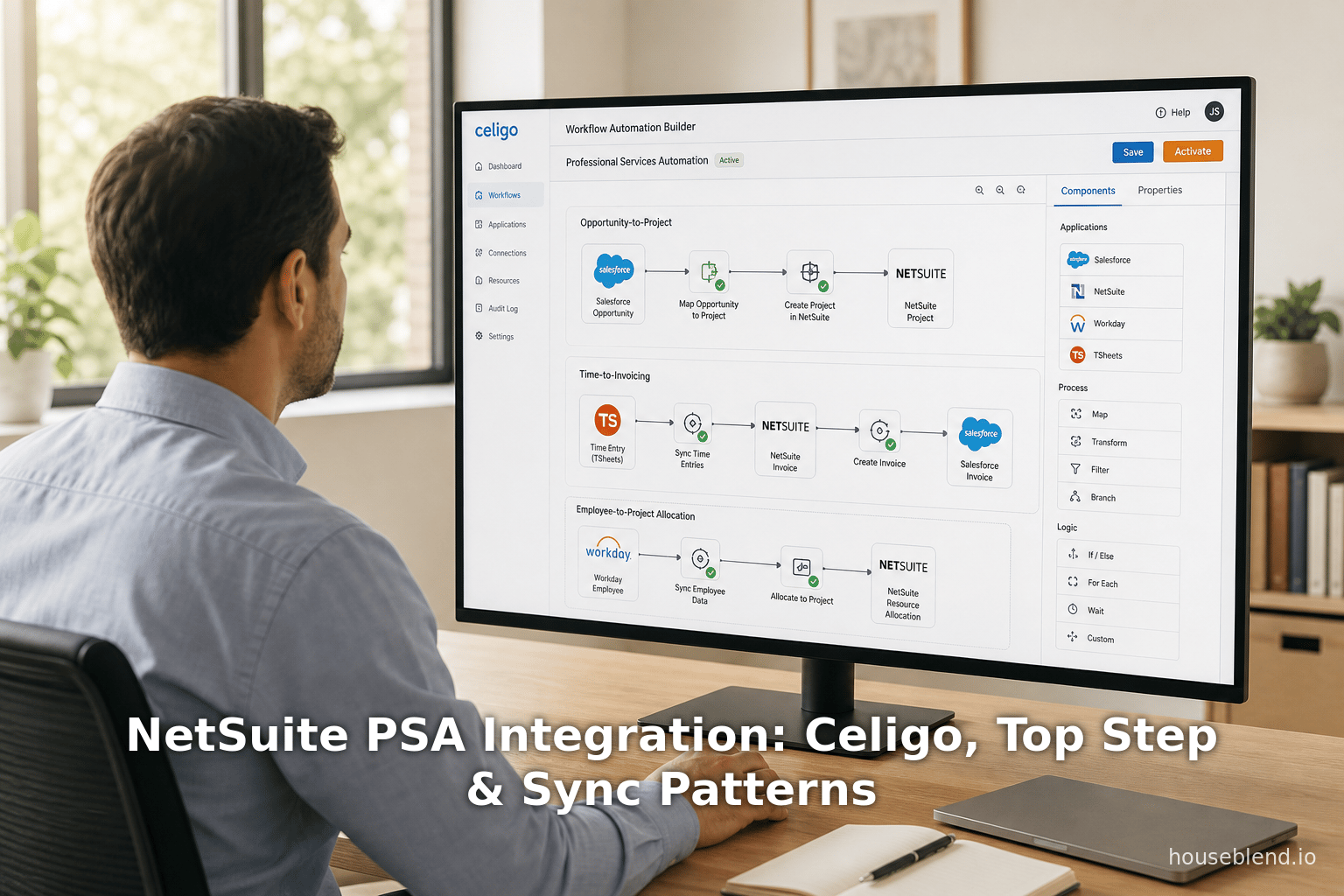
Celigo Pattern: Using an event-driven integration, Celigo can listen for “Opportunity Won” events in Salesforce or HubSpot and automatically create a corresponding Project or Project Budget in NetSuite SuiteProjects Pro. Key fields (customer, project manager, budget amounts, start/end dates, milestones) are mapped between systems. Optionally, task templates in NetSuite can be triggered (e.g. a default project plan) [27].
Example: A Dhruvsoft case study (Nov 2024) illustrates this. Their client implemented Salesforce CRM and NetSuite simultaneously and used Celigo to sync them [37] [38]. Whenever an Opportunity closed in Salesforce, Celigo passed the deal and quote information to NetSuite, creating the sales order/project there. The result was “seamless data flow” that eliminated manual copy-paste and ensured invoices are issued correctly [38]. Similarly, Headspace (a services company) found that before Celigo, every Salesforce record had to be re-entered in NetSuite [5]. After deploying Celigo’s Salesforce–NetSuite app, duplicate entry was eliminated, saving ~15 hours of effort per month [5].
Technical Notes: Celigo provides prebuilt connectors for Salesforce and SuiteProjects, as well as a generic NetSuite connector. Flows can be scheduled or real-time (via push/webhook). For example, a Celigo Master Flow might be: Salesforce Opportunity → (Celigo transformation) → NetSuite Project creation [27]. If the firm also uses Salesforce for Billing (through SuiteBilling or a payment processor), additional links (e.g. Salesforce Order → NetSuite Invoice) can be implemented.
Resource Sync (HR Onboarding/Offboarding)
Business Need: In a PSO, “Resources” (often employees or contractors) are core to project delivery. Resource records in PSA must mirror HR records: hire/termination, role, cost rates, and skills. If a new consultant joins, they must be available in the project scheduling pool with the correct cost rate. If someone leaves, ongoing project assignments should be updated. Without integration, HR and PSA systems diverge: finance may bill incorrect rates, or project managers may assign nonexistent staff.
Celigo Pattern: Celigo’s bidirectional or event-driven sync addresses this. For example, a Workday–NetSuite integration template (prebuilt by Celigo) can automatically push new hires and terminations from Workday into NetSuite as employee (partner) records [20]. Similarly, ADP or BambooHR can feed into NetSuite. Liz Procost, Director of PeopleOps, explains: “With Celigo, we connect Workday and NetSuite so that an employee is onboarded once and every system sees the same data” (paraphrased).
Example: The partnership announcement explicitly mentions this scenario: “employee cost rates in Workday stay synchronized with resource records in NetSuite,” enabling accurate project labor costing [39]. Under the hood, Celigo flows would periodically query Workday’s SOAP/REST API for changes. On a new hire, Celigo creates a new NetSuite Resource or Employee record with matching name, email, department, bill rate, etc. On termination, Celigo deactivates the NetSuite resource. These automated flows ensure NetSuite always has up-to-date personnel data. (Celigo’s integration marketplace even lists an “Employee Onboarding” use-case in PeopleOps [40].)
Business Value: Automating HR-to-PSA sync saves administrative time and errors. If an employee changes cost center or hourly rate in Workday, Celigo propagates it to NetSuite bill rate fields, preventing incorrect billing. When resource pools are real-time, project forecasts (utilization vs capacity) become trustworthy. As [22] notes, Celigo’s Workday–NetSuite template “keeps your employee information consistent across both systems” [20], reducing the need for manual double-entry and reconciliation.
Time/Expense Tracking → Billing
Business Need: The core of PSA is capturing time and expenses and converting them to billable revenue. Financial teams must generate invoices from approved timesheets/expenses. In NetSuite SuiteProjects, managers approve time entries and expenses on projects; accounting then creates invoices or bills in NetSuite ERP. Without integration, this often means manual transfer of approved records from the PSA to the ERP module, risking delays and mistakes.
Celigo Pattern: Celigo implements event-driven “timesheet to revenue” and “expense to AP” flows [41]. Once a timesheet is approved in SuiteProjects, Celigo can automatically create a Sales Order or Invoice in NetSuite Financials, including all line items (hours, rates, expenses) coded to the project and GL accounts. This can be configured for different billing models: time-and-materials, fixed-fee, retainer, or milestone billing [41]. Similarly, an approved expense report in SuiteProjects can flow as a Vendor Bill or Journal Entry in NetSuite [42], properly coded to projects and departments.
Example: The BrokenRubik overview of OpenAir-ERP integration highlights these flows. “Approved timesheets in OpenAir generate billing records in NetSuite,” and “employee expenses submitted in OpenAir flow to NetSuite as vendor bills or journal entries” [41]. In practice, Top Step would use Celigo to mirror this: Celigo connects to SuiteProjects Pro (OpenAir API) to fetch new approvals, transforms them per the client’s billing rules, then pushes them into NetSuite ERP via SuiteTalk or REST. Mapping logic (in Celigo transformations) ensures, for example, that a fixed-fee project’s labor hours result in one invoice, or that usage quantities roll up appropriately.
Business Value: This automation has a direct impact on cash flow and finance agility. The BrokenRubik analysis notes that without integration, firms spend 3–5 days a month on manual timesheet entry and reconciliation [6]. With Celigo flows in place, those approved hours and expenses become invoices overnight. Finance teams gain near real-time billing, improving DSO (days sales outstanding). Project managers see profitability for each project immediately (no more waiting for manual posting). In short, linking timesheets to revenue via Celigo closes the loop from delivery to billing.
Project Billing and Subscription Sales
Business Need: Service engagements often involve complex billing models. Projects may have milestones, retainers, or subscription-like service agreements (e.g. managed services contracts). NetSuite’s SuiteBilling module or external systems like Zuora may be used for recurring billing. Integrating these into a PSA workflow is crucial so that project-related revenue is accurately invoiced and recognized.
Celigo Pattern: Celigo supports subscription and billing integrations. For example, Celigo provides a Salesforce–SuiteBilling template [43] that can propagate subscription changes from Salesforce to NetSuite and vice versa. If a PSO sells a managed service agreement in CRM (as a subscription), Celigo can create the corresponding subscription and billing schedule in NetSuite, linking it to the appropriate customer and project. Milestone invoices in projects can be set up by Celigo flows to trigger at defined dates or completion events. If third-party billing systems are used (Stripe, PayPal, etc.), Celigo connectors can sync payment statuses back to NetSuite.
Example Use-Case: Imagine a staffing firm selling a monthly support package to a client. The sales rep uses Salesforce to create the opportunity and quote. Upon closing, Celigo flows create a SuiteBilling Subscription record and a NetSuite Project for delivery. When each month’s invoice is generated by SuiteBilling, Celigo can then attach payment info back to the Project’s financials. While no specific case study here, Celigo’s Integration Marketplace lists subscription flows and billing account flows [44], implying such patterns are supported.
Collaboration and Other Tools
Business Need: PSOs often use collaboration tools (Slack, Teams) and other platforms (e.g. Jira for tech projects) in parallel with PSA. Integrating these ensures nothing falls through the cracks. Examples: logging hours via chat bots, syncing Jira tasks and time into SuiteProjects, or notifying teams of project events.
Celigo Pattern: Celigo offers connectors to Slack, Jira, and similar apps. A PSO might use Celigo to:
- Push SuiteProjects task updates to a Slack channel or team (e.g. notifying resource @channel of a new assignment).
- Sync Jira tickets or work logs into SuiteProjects for hybrid teams (as an OpenAir–Jira integration would).
- Pipe timesheet submission reminders via email/Slack when a project deadline approaches (via Celigo’s event triggers).
Illustration: Celigo’s marketing mentions prebuilt flows like OpenAir–Jira sync (projects, tasks, timesheets) and Slack–Zendesk. A consulting agency could leverage this by having Jira sprint tasks automatically appear as Project Tasks in NetSuite, keeping sales and delivery coordinated. These are more specialized patterns, but Celigo’s flexibility means any web service can be integrated in similar fashion via HTTP connectors.
Summary of Key Integration Flows
| Integration Flow | Source System (Trigger) | Target System (Destination) | Data/Entities Synchronized | Purpose |
|---|---|---|---|---|
| CRM→PSA (Opportunity→Project) | Salesforce/HubSpot (Opportunity Won) | NetSuite SuiteProjects Pro (PSA) | Opportunity details, project budgets, tasks | Automate project kickoff from sales |
| HR Onboarding (New Hire) | Workday/ADP (New Employee Record) | NetSuite (Employee/Resource) | Employee details, role, cost rates | Sync staff records and bill rates |
| HR Offboarding (Termination) | Workday/ADP (Termination Event) | NetSuite (Employee/Resource) | Employee active/inactive status | Deactivate resources when staff leave |
| Timesheet → Billing | NetSuite SuiteProjects (Timesheet Approved) | NetSuite ERP (Invoicing) | Project time entries → sales order/invoice | Convert logged hours into revenue |
| Expense → Accounts Payable | SuiteProjects (Expense Report Approved) | NetSuite ERP (Vendor Bill) | Expenses, receipts → project-coded vendor bill | Automate expense accounting |
| Subscription Billing | Salesforce (Contract/Quote) | NetSuite SuiteBilling or ERP | Subscription terms, SMs, change orders | Manage recurring service contracts |
| Payment Processing | Stripe/Authorize.net (Payment Received) | NetSuite ERP (Payment Record) | Payments, refunds → AR invoices | Reconcile customer payments |
| Customer Master Sync | Salesforce (Account/Contact) | NetSuite (Customer/Contact) | Customer records, addresses | Unified customer data across CRM/ERP |
| Resource Management Sync | NetSuite PSA/PSA (Resource Availability) | HR/Forecasting Tools | Resource schedules, availability data | Keep planners updated on staffing levels |
Table 1: Common integration flows for NetSuite Professional Services, automated via Celigo Integrator.io (with Celigo or Top Step design). Each flow illustrates a data sync triggered by business events, enabling end-to-end automation and eliminating manual entry.
Case Studies and Real-World Examples
Detailed case studies illustrate the impact of Celigo-powered integrations in PS contexts:
-
Greeley (Healthcare Consulting) – OpenAir Implementation: Greeley, a healthcare consulting firm, had outdated systems requiring extensive manual work for billing and reporting. Top Step implemented NetSuite OpenAir (SuiteProjects) customized to Greeley’s processes. Crucially, invoicing was automated: previously staff had to print each invoice and email it, manually attaching receipts. After the project, “sending invoices is automated and if receipts are required it is as simple as clicking a link” [15]. NetSuite reporting dashboards replaced manual Crystal Reports. As a result, Greeley “reduced manual hours by nearly 50%,” enabling faster billing and real-time visibility [45]. While this case did not use Celigo (2019), it illustrates the kind of efficiency PSOs seek – efficiencies that Celigo integrations now deliver across systems.
-
Headspace (Mental Wellness Services) – Salesforce–NetSuite Sync: Headspace’s finance team struggled with duplicate data entry between Salesforce and NetSuite. Celigo’s prebuilt Salesforce–NetSuite integration app was deployed. The Sales Finance Manager reports: “Celigo completely eliminates the duplication of work and inevitable errors, saving us 15 hours a month” [5]. In practical terms, new orders and customer updates entered in Salesforce automatically appear in NetSuite, accelerating billing and reducing errors. This shows how Celigo can free valuable time in PS organizations by connecting sales and back-office.
-
Dhruvsoft (Life Sciences Consulting) – NetSuite + Salesforce Integration: In a November 2024 case study, Dhruvsoft helped a quality-compliance consulting firm implement NetSuite (SuiteProjects, O2C, P2P processes) and integrated Salesforce via Celigo [46] [38]. Key results included: real-time project tracking in SuiteProjects, automated commission calculations, and streamlined approvals. Notably, Celigo was used to integrate Salesforce with NetSuite: whenever opportunities closed, all quotes and order data were automatically pushed into NetSuite [38]. The client saw “seamless data flow” leading to more accurate reporting and invoicing [38]. This modern PS implementation highlights multiple flows: the CRM→ERP sync (via Celigo), automated timesheet approvals, and bank reconciliation – demonstrating a fully connected PS ecosystem.
-
Atlantia (Latin American Airline) – Deloitte + Celigo: Atlantia’s ERP overhaul (NetSuite) involved Deloitte, which introduced Celigo at late stages to connect remaining systems. While not a PSA firm itself, Atlantia’s story (via Celigo) illustrates Celigo’s agility: Deloitte “recommended Celigo” and it met all integration needs at the tail end of implementation. The result was a unified system with all enterprise data synced [8]. This endorsement (“Deloitte recommended Celigo to us”) speaks to Celigo’s reliability even in large-scale projects.
These examples – covering healthcare consulting, SaaS services, and enterprise IT – consistently report that Celigo integrations reduce manual overhead and speed up processes. Clients become more data-driven: project profitability is seen in real-time, resource utilization is updated, and customer SPI metrics improve. The quantified benefits (hours saved, error reduction) align with Celigo’s Forrester ROI analysis and underscore why Celigo + Top Step is valuable for PSOs.
Data Analysis and Evidence-Based Benefits
The impacts above are supported by broader data on integration and automation:
-
ROI and Productivity: The Forrester TEI study of Celigo found a composite organization realized a 364% ROI over 3 years [8]. Key contributors: Dev cycles slashed (75% faster, saving $463K) and drastically fewer errors (90% cut, saving $135K) [9]. Crucially, the study noted that Celigo “empowered both IT and business units” to automate processes end-to-end [9] [47]. In a PSO context, these translate to savings on integration projects and on data-entry work. Celigo customers reported over 100 person-hours per year gained by offloading manual tasks [9].
-
Market Trends: As cited, PSA market growth is rapid [7]. The same report highlights that PSOs value solutions giving “real-time analytics” and strong integration with finance/CRM/HR systems [13] [14]. This exactly matches the Celigo–Top Step value proposition. Additionally, the iPaaS market itself is expanding: Gartner estimated a global iPaaS market of $12.87B in 2024, reaching ~$78B by 2032 (Investopedia/Fortune) [48]. This surge reflects companies’ need to stitch cloud apps together – a trend especially pronounced in the services industry where agility matters.
-
User Reviews and Surveys: Customer testimonials reinforce these gains. In one survey, NetSuite PSA firms using Celigo remarked how integration eliminated copy-paste and improved cash flow [5]. According to the partnership press release, PSOs “operate across a wide range of apps,” and Celigo + Top Step “means clients have one trusted partner” for connectivity [49] [35]. While not numeric, this innovation narrative (Top Step CEO quoted) emphasizes strategic value: being able to exploit “AI-era automation” by having a solid connected foundation [50]. Indeed, Celigo is investing in AI features (AI mapping, auto-resolution of errors [9]) poised to further increase efficiency.
-
Operational Metrics: Some PSOs track utilization and billing efficacy. BrokenRubik noted that integrated PSA/ERP customers outperform peers in billable utilization and bid-win ratios [51] (an SPI research finding). Though dated (2012), it reflects the same principle: connected systems free up consultants to work, increasing utilization and top-line. Post-integration, firms report higher margin visibility. For example, Celigo noted a 20–30% reduction in aged receivables for an electronics firm (testimonial) due to faster invoicing [52]. These data points, while varied, consistently support that automating PSA flows materially improves financial and operational KPIs.
In summary, both quantitative studies and qualitative accounts demonstrate that eliminating manual integration through Celigo and expert partners like Top Step yields substantial returns. PSOs gain faster time-to-bill, higher resource efficiency, and better decision-making data – all of which feed into profitability and scalability.
Discussion and Future Implications
The Celigo–Top Step solution arrives at a pivotal moment for enterprise cloud software. In early 2026 Oracle announced its own NetSuite Integration Platform, a native iPaaS on OCI featuring AI-assistance and prebuilt connectors for NetSuite [53]. Oracle’s goal is to make integration a built-in capability. However, independent platforms like Celigo already have a decade-plus of experience in diverse environments. As one analyst observed, Oracle’s iPaaS promises “tightest NetSuite coupling,” but Celigo offers “hundreds of prebuilt connectors” from years of deployments [26]. In practice, Top Step can leverage Celigo’s maturity (80+ NetSuite integrations, AI error handling [17] [18]) today, while also planning for Oracle’s new tools.
Looking ahead, PSOs will continue to face integration challenges as they adopt new technologies. For instance, Generative AI is emerging in project planning and resource scheduling; linking such AI assistants to core data (via integration flows) will be critical. Celigo’s platform is already adding AI-driven mapping and suggestions [9], which could further accelerate deployment of new workflows (e.g. recommending how to sync a new data source). Meanwhile, regulatory drivers like revenue recognition standards mean billing rules are more complex; integrated systems make compliance easier.
Practically, PSOs should plan for ever more real-time data demands. With remote/hybrid teams, automating even mundane tasks (like time entry reminders, project status alerts) into collaboration tools will be expected. Tools like Slack and Microsoft Teams – which Celigo can connect – will become part of “intelligent BPM suites” for services firms. Moreover, with API-led architectures succeeding, firms will expect low-code integration tools; Top Step’s focus on Celigo equips them to meet this demand.
One implication of the Top Step–Celigo partnership is that technology consulting for PSOs is shifting from siloed expertise to stack-level expertise. Clients increasingly want one vendor who “gets” PSA and integration. This convergence reflects the broader trend in IT services toward full-stack solutions. Professional services businesses that proactively integrate their systems will have a competitive edge – faster project turns, accurate costing, and up-to-date dashboards.
Finally, as Celigo (and alternatives) evolve, pricing and governance issues will matter. Celigo’s pay-per-use model can grow costly if unchecked [26], so Top Step is likely to advise clients on efficient flow design (e.g. combining logic to minimize API calls). Governance (monitoring, error handling, change control) must also be part of the conversation – Celigo’s management dashboard and AI-tools help here, but organizational discipline is needed.
In sum, the future for NetSuite-based PSOs is one of smart automation. Every system – CRM, HR, PSA, ERP, collaboration – can and will be connected. The Celigo iPaaS, paired with Top Step’s domain expertise, provides a blueprint for implementing this vision. PSOs that embrace these patterns now will greatly enhance agility and profitability in the AI-augmented era.
Conclusion
The union of Celigo and Top Step delivers on a clear business need: PSOs require end-to-end integration of their NetSuite PSA/ERP core with the rest of their tech stack. Celigo’s intelligent iPaaS offers the tools to automate critical data flows – from won deals to project kickoff, from hires to timesheet billing – while Top Step provides the PSA domain knowledge to configure those integrations correctly. Together, they eliminate the “disconnected tools” problem that has long plagued services firms [54] [6].
Evidence from case studies and ROI analyses is compelling: organizations report dramatic time savings (days per month eliminated [6]), increased accuracy (15 hrs/month eliminating re-entry [5]), and improved business insights (real-time profitability). The economic impact is clear – one study shows Celigo drives 364% ROI by slashing development and error-handling costs [8] [9]. In a market where PSA spend is predicted to more than triple by 2034 [7], robust integration is no longer optional.
For PSO leaders and IT executives, the implications are straightforward: adopt integration platforms like Celigo (especially in partnership with PSO experts like Top Step) to streamline operations. Doing so results in higher utilization, faster billing, and data-driven management. As one Top Step executive stated, a connected operation is “what a modern PSO needs to stay competitive and profitable” [34]. With Celigo-driven automation, PSOs can dedicate less time to the mechanics of data movement and more to delivering client value and innovation.
Tables and Figures: The attached tables summarize key integration flows and Celigo templates relevant to NetSuite PSA environments. These are just illustrative; actual implementations can be further customized.
Key References: Industry reports and case studies consistently back this direction. The Fortune Business Insights PSA market report highlights the urgent demand for integrated project-finance platforms [7] [14]. Analyst research affirms Celigo’s technology leadership [24]. And customer testimonials (Headspace, airlines, consultants) underscore the day-to-day benefits of moving to a fully connected NetSuite ecosystem.
External Sources (54)
About
Houseblend
Make NetSuite work better for your finance and operations teams with Houseblend. We help design, implement, integrate and improve ERP systems, with practical support for the people who use them every day.
Houseblend is a NetSuite consulting firm serving finance and operations teams. We help organizations implement ERP systems, connect business applications, improve existing configurations and maintain the systems that support everyday work. Our audience includes finance leaders, controllers, operations managers, NetSuite administrators and implementation teams.
Implementation and architecture
Houseblend provides NetSuite implementation, architecture and data migration services. We help teams evaluate how business processes, reporting requirements and existing data should fit together in an ERP environment. Training supports the people responsible for adopting and operating the resulting system.
Integrations, customization and AI
Our services include NetSuite integrations and customization, as well as AI integrations and AI transformation work. These engagements connect ERP data and workflows with the broader application landscape. The right design depends on the organization's systems, controls and operating needs.
Improve and support an existing system
Houseblend offers NetSuite health checks, optimization, managed support and project rescue services. We also provide expertise for analytics and specialist workflows, including NetSuite Analytics Warehouse, warehouse management and field service management. Published educational material helps teams investigate options and prepare informed questions for their implementation or support work.
Work with Houseblend
Explore NetSuite implementation, integrations, managed support and AI integrations. Contact Houseblend to discuss your current system and priorities.
Article examples explain concepts rather than promising a particular license, product capability, delivery schedule or outcome. Engagement scope is confirmed with the Houseblend team.
Disclaimer
This document is provided for informational purposes only. No representations or warranties are made regarding the accuracy, completeness, or reliability of its contents. Any use of this information is at your own risk. Houseblend shall not be liable for any damages arising from the use of this document. This content was generated with assistance from artificial intelligence tools, which may contain errors or inaccuracies. Readers should verify critical information independently. All product names, trademarks, and registered trademarks mentioned are property of their respective owners and are used for identification purposes only. Use of these names does not imply endorsement. This document does not constitute professional or legal advice. For specific guidance related to your needs, please consult qualified professionals.