

01 — The compliance deadline that’s actually a systems deadline
IFRS 18 is coming, and if you’ve read anything about it already, you know the shape: three new income statement categories, two new subtotals, a new disclosure note for the numbers you report to investors. What most of that coverage doesn’t tell you is where the work actually lands. It’s not in your accounting policy manual. It’s in your NetSuite instance — specifically, in the few thousand rows of your chart of accounts that nobody has opened in years.
IFRS 18 takes effect for annual reporting periods beginning on or after January 1, 2027, replacing IAS 1.1 For any organization that reports under IFRS, that date is fixed. What isn’t fixed yet is whether your general ledger can actually produce a statement in the shape the standard requires. That’s a systems question, and right now, for most mid-market NetSuite users, the honest answer is: not yet.
02 — What actually changes, filtered through “does this touch my system”
IFRS 18 replaces the loose, self-defined income statement structure most companies use today with five required categories: operating, investing, financing, income taxes, and discontinued operations — plus two new mandatory subtotals, operating profit and profit before financing and income tax.2 Every one of those categories is a classification decision your chart of accounts has to be able to express. If your accounts are organized by department, cost center, or a decade-old function-based scheme with no IFRS 18 category tags, the standard isn’t asking you to change your accounting policy. It’s asking you to relabel and re-map your entire GL.
That’s before you get to management-defined performance measures — MPMs. If your investor deck or board packet includes a number like “adjusted EBITDA” or “adjusted operating profit,” IFRS 18 now requires that number to be disclosed in the financial statements themselves, reconciled line-by-line to an IFRS-defined subtotal, with the income tax effect on every reconciling item spelled out.3 Today, that number almost certainly lives in an investor relations spreadsheet, calculated by someone pulling figures manually from multiple systems. Under IFRS 18, it has to be auditable, reconcilable, and traceable back to GL accounts — a MPM has to be a subtotal of income and expenses, not a ratio or a cash flow measure, and it has to communicate management’s view of the entity’s performance as a whole.45 The income tax effect calculation alone is flagged by the IASB’s own effects analysis as one of the standard’s bigger cost drivers.6
The other two required categories get less attention in most coverage, but they’re not optional line items. Income taxes has to appear as its own category, separated from the operating/investing/financing split rather than buried inside whichever bucket a tax provision happened to sit in before. Discontinued operations works the same way: any operation you’ve sold or are winding down has to be pulled out and reported as its own line, not left blended into ongoing results. Neither is a new concept for accountants, but both are new required categories in the specific presentation sense IFRS 18 uses, and your chart of accounts has to be able to tag transactions to them the same way it tags operating vs. investing vs. financing.19
There’s a second-order effect that shows up in a place most IFRS 18 coverage skips entirely: your statement of cash flows. IFRS 18 makes consequential amendments to IAS 7. Under the indirect method, the reconciliation of operating cash flows now starts from operating profit instead of profit before income taxes, and dividends paid and interest paid generally move into financing activities.19 None of that changes how much cash you actually generated. It changes which report the number needs to trace back to, which means any saved search or dashboard built against the old cash-flow reconciliation logic breaks in the same way the income-statement-based ones do.
03 — Where your NetSuite instance is actually exposed
Here’s the part that doesn’t show up in most IFRS 18 coverage: NetSuite already shipped a layout for this. As of the August 2026 minor release (2026.2), NetSuite includes an IFRS18 Standard Income Statement Layout, purpose-built with the five required sections.7
It’s empty by default.
Oracle’s own documentation is direct about this: “NetSuite doesn’t determine the appropriate classification for an account. Your organization determines the appropriate classification and configures the layout accordingly.”8 The layout is a container. It ships with Operating, Investing, Financing, Income taxes, and Discontinued operations as five named, structural sections — and every one of them starts with zero accounts assigned. Someone in your organization has to open Financial Report Builder, go into Edit Layout, and manually assign every account in your GL to the correct section, one at a time.
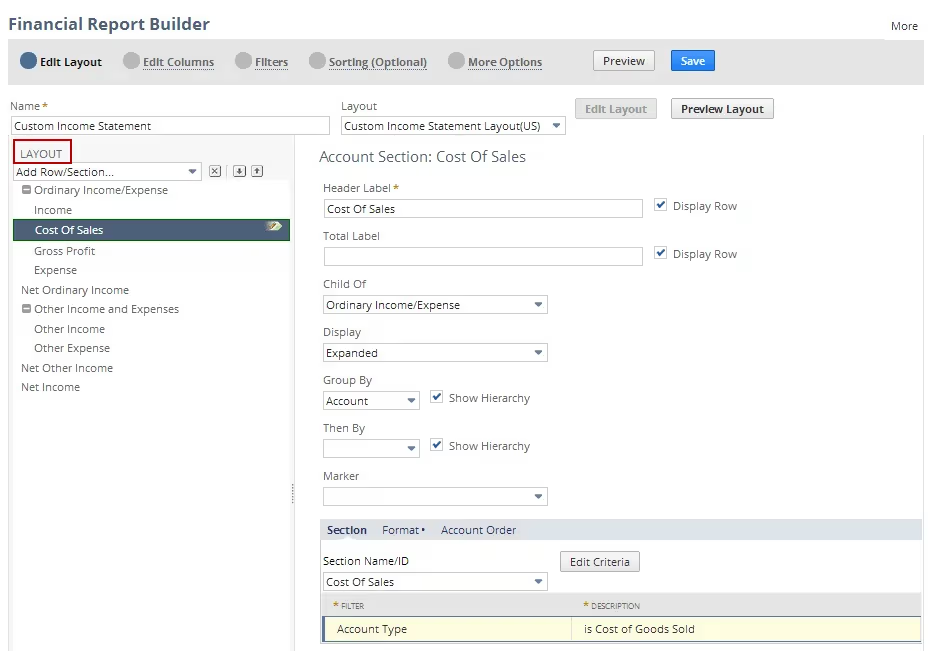
Screenshot: NetSuite’s Financial Report Builder interface (shown here configuring a standard income statement). The IFRS18 Standard Income Statement Layout uses this same builder, but starts with its five sections empty — as of publish date, Oracle’s own documentation contains no example or screenshot of the populated IFRS 18 layout.
Three places this actually bites, in practice:
- Chart-of-accounts tagging.Your existing account structure was almost certainly built for IAS 1-era reporting, or for internal management reporting conventions that have nothing to do with IFRS 18’s operating/investing/financing framework.9 Every account needs a defensible classification decision, documented, before it can be mapped into the new layout.
- Saved searches and standard reports.Anything built against the current income statement shape — saved searches, dashboards, board reporting packages — assumes that shape holds. It won’t.
- MPMs living outside NetSuite entirely. The adjusted metrics in your investor communications are spreadsheet-resident today, untraced to GL accounts, and IFRS 18 requires them to be reconcilable back to the ledger.
A composite example.Take a $60M company running a single NetSuite instance across two subsidiaries — one domestic, one international, both feeding the same consolidated income statement. Under the current setup, “other income” on the P&L is a catch-all: dividend income, a foreign exchange gain, a gain on an asset sale, and a subsidiary’s rental income, all sitting in the same bucket. Under IFRS 18, each of those needs to land in a specific category — and if the two subsidiaries have different main business activities, the same type of income can be classified differently at the subsidiary level than at the consolidated group level, requiring a consolidation adjustment every period.10 None of that is visible until someone actually opens the chart of accounts and starts mapping.
Walk that catch-all bucket account by account and the mapping work becomes concrete. The dividend income lands in Investing, since it’s a return on an asset the company holds rather than income from its main business activity. The foreign exchange gain is a genuine judgment call: if it arose on an operating payable or receivable, it likely stays in Operating; if it arose on a financing arrangement like an intercompany loan, it belongs in Financing, and the IASB’s own implementation panel has flagged FX classification as one of the more contested line items across preparers generally.2 The gain on the asset sale depends on what the asset was and whether disposing of assets is part of how this company runs its business day to day, which for most operating companies routes it to Investing. The subsidiary’s rental income is the one that actually forces a decision at two levels: at the subsidiary level, where real estate might plausibly be that entity’s main business activity, it could be classified as Operating, while at the consolidated group level, where the group’s main business activity is something else entirely, the same income has to move to Investing.10 That’s the “different classification at different levels” problem the example above is built around, and it’s also the specific case where you can’t just tag an account once and be done. The consolidation adjustment has to run every period, for as long as the subsidiary and the group have different main business activities.
04 — Why “we’ll deal with it in 2026” doesn’t work
The retrospective restatement requirement is the part of IFRS 18 that turns a 2027 deadline into a 2026 deadline. Your first IFRS 18 financial statements, filed in 2027, have to include restated 2026 comparatives prepared under IFRS 18 rules — which means IFRS 18-compliant data has to be captured throughout all of 2026, a full year before the standard is technically mandatory.11
And most organizations haven’t started. In a non-representative survey of over 2,600 US respondents conducted for KPMG’s Q1 2025 IFRS 18 webcast, approximately 80% of preparers applying IFRS Accounting Standards had not yet started an implementation project.12 For a December year-end company, the practical implication is stark: system changes, chart-of-accounts redesign, and subsidiary data alignment all need to be operational by January 1, 2026 to capture a full year of compliant data.13 Independent guidance from Grant Thornton corroborates both the effective date and the retrospective restatement mechanics: entities are required to disclose a reconciliation between restated and previously reported comparative-period amounts, and that requirement extends to interim financial statements too.14
Panelists at a December 2025 KPMG preparer forum went further, warning specifically against the instinct to patch this with manual workarounds — particularly for organizations already running automated reporting systems, where manual adjustments become unsustainable for anything on a quarterly or semiannual reporting cadence.15 The same forum flagged a “materiality trap”: teams that let materiality judgments drive scoping decisions early in the project tend to create expensive rework later, because the full scope needs to be assessed first and materiality applied at the end.15
This isn’t a finance-department-only problem, either. BDO’s readiness framework identifies five distinct dimensions organizations need to assess, and once you look at what each one actually asks, none of them are things a controller can close out alone. Presentation and classification asks whether your current income statement already resembles the new IFRS categories, or whether it’s built on entirely different logic. MPM governance asks whether there’s a board-approved policy on how adjusted metrics get defined and labeled, not just a spreadsheet someone maintains. Chart of accounts asks whether your structure can tag transactions to the new categories at the transaction level, not just at reporting time, and whether prior-year data is granular enough to support a restatement. Change management asks whether finance, IT, legal, and investor relations are actually coordinating, or whether each function is planning around IFRS 18 in isolation.16 Systems and integration, the dimension most directly relevant to the NetSuite work above, is the one where ERP configuration, consolidation tooling, and data ownership between finance and IT all need to be resolved before the chart-of-accounts work can even start.16
EY’s IFRS 18 roadmap puts it plainly: “The shift to implementation of IFRS 18 requires integrated, cross functional change. Entities must define a clear vision for adoption and assign accountability across finance, IT, investor relations, and business units.”17 A recent AICPA/FM Magazine roundtable with finance leaders across several companies adds a resourcing dimension that’s easy to miss: IFRS 18 preparation is competing for the same people, technology budgets, and project time as IFRS 17 and sustainability-reporting rollouts already underway at many organizations through 2025 and 2027 — a genuine capacity bottleneck, not just a coordination problem.20 Regulators are saying the same thing from the other direction — Kuwait’s Capital Markets Authority, for instance, has directed listed entities and licensed persons to perform a comprehensive gap analysis, build a readiness action plan with particular emphasis on updating chart of accounts and reporting systems, and begin preparing historical data for retrospective restatement well ahead of the effective date.18
05 — How other companies are already responding
This isn’t playing out only in advisory guidance and readiness checklists. In February 2026, the European Securities and Markets Authority, the EU’s securities regulator, issued a public statement directly to IFRS-reporting companies calling for “high-quality implementation” of IFRS 18 and warning that ESMA and national regulators will be watching how much transparency issuers actually provide about its effects.21 That’s a different kind of pressure than an accounting firm’s advisory content: a regulator is now actively supervising this transition, not just recommending it. Worth noting up front that ESMA oversees EU-listed issuers specifically, so this is evidence of how the broader IFRS-reporting market is being pushed to respond, not a US-specific data point, but the classification questions it’s addressing are the same ones any IFRS 18 preparer runs into regardless of jurisdiction.
The reclassification examples ESMA calls out are concrete, and they’re the same category of judgment call your own chart of accounts is going to face. Long-term provisions split: the effect of a discount-rate change gets classified in financing, while a change in the underlying estimate of what it’ll actually cost to settle the liability stays in operating, two pieces of the same account, two different categories. Hedging and derivative gains generally follow whatever they’re hedging, rather than defaulting to one bucket. And foreign exchange differences on intercompany balances are still an open question even at the regulatory level. ESMA points issuers to the IFRS Interpretations Committee, which hasn’t finished settling how those should be classified.21 If a body actively supervising IFRS compliance across the EU is still waiting on guidance for that one, it’s a reasonable bet your own FX line items deserve more scrutiny than a quick judgment call.
Two of ESMA’s warnings land directly on the MPM material covered earlier in this piece. First, an “operating profit” subtotal you already report today may not survive IFRS 18 unchanged. If it currently includes income from equity-accounted investments, that income has to move to the investing category under the new rules, which means the number itself changes, not just where it sits on the page. Second, ESMA is explicit that “EBITDA” isn’t a label you get to keep by default. IFRS 18 defines a specific new subtotal, operating profit or loss before depreciation, amortization, and impairments, and ESMA states plainly that issuers can only call that subtotal EBITDA if it happens to match what “EBITDA” has always meant, with no investing-category income and no operating-category interest income mixed in. Otherwise the label is doing work the number underneath it doesn’t actually do.21
The clearest signal of how seriously this is already being tracked is the timeline ESMA has attached to disclosure itself, separate from the 2027 effective date. If a company finishes its IFRS 18 impact assessment in the first half of 2026, ESMA expects that assessment to show up in that company’s interim financial statements for the period ending June 30, 2026, not wait for the 2027 annual report to surface.21 That’s a regulator independently arriving at the same conclusion this piece has been making since the opening section: 2026 is the real deadline, not 2027, regardless of which side of the Atlantic is doing the enforcing.
Which brings the question back to your own organization, not a regulator’s.
06 — What to actually do this quarter
This isn’t a twelve-month roadmap. It’s a self-assessment — four questions that tell you whether your organization has even started the conversation this article is about.
- Does your chart of accounts currently support tagging beyond your existing financial-statement groupings?If every account maps cleanly to a department or function but has no way to express “operating vs. investing vs. financing,” that’s the first gap to close.
- Have you inventoried every non-GAAP measure currently shipping in investor decks or board packets — adjusted EBITDA, adjusted operating profit, and similar — and do you know where its source data lives?If the answer involves a spreadsheet built by one person, that’s an MPM disclosure risk waiting to surface.
- Are your saved searches and standard reports built against account type, or do they assume the current income statement shape stays fixed?Anything hard-coded to today’s structure breaks the moment the chart of accounts changes.
- Has anyone in IT or systems actually opened NetSuite’s new IFRS18 Standard Income Statement Layout?If the answer is no, section three of this article is not hypothetical for your organization — it’s exactly where you are right now.
None of these questions require a consultant to answer honestly. They require someone to actually go look. Regulatory guidance on IFRS 18 readiness converges on the same starting point regardless of jurisdiction: assess first, document the gaps, then plan the systems work.18
07 — Where this goes next
This piece is the diagnostic — whether and where your organization is exposed. Three places to go from here, depending on what the self-assessment above turned up:
- For the full breakdown of how the five income statement categories and their subtotals work: our companion piece on IFRS 18’s categories and subtotals.
- For a worked, line-by-line example of how those categories apply in practice: our worked example of how the categories apply line by line.
- For organizations that have already done the assessment above and are ready to scope the actual systems, chart-of-accounts, and consolidation work: our 12-month CFO implementation roadmap — that piece assumes you’ve already done the assessment in Section 06; this one is upstream of it.
08 — FAQ
Do we need to restate 2026 comparatives?
Yes. IFRS 18 applies retrospectively, and your first IFRS 18 financial statements (filed for fiscal year 2027) must include 2026 comparatives restated under IFRS 18 rules — not the IAS 1 rules your 2026 statements are actually prepared under in real time. That means the underlying data has to be captured in IFRS 18-compatible form throughout 2026, a full year ahead of the mandatory effective date.1113
Is IFRS 18 the same as IFRS 15?
No — they’re unrelated standards that get confused because of the adjacent numbering. IFRS 15 governs revenue recognition (when and how much revenue to record). IFRS 18 governs presentation and disclosure — how the income statement is structured and what gets disclosed about it — and doesn’t change any recognition or measurement rules at all.1
Will NetSuite’s new layout do this for us automatically?
No. NetSuite’s IFRS18 Standard Income Statement Layout gives you the structural container — five sections, correctly named, with the required subtotals built in. It does not classify a single account for you. As Oracle’s own documentation states: “NetSuite doesn’t determine the appropriate classification for an account. Your organization determines the appropriate classification and configures the layout accordingly.”8
What’s the difference between this article and the CFO roadmap?
This article is the diagnostic — it’s meant to help you figure out whether and where you’re exposed. The 12-month CFO implementation roadmap is the execution plan for organizations that have already done that assessment and are ready to scope the actual systems, chart-of-accounts, and consolidation work.
This content may be AI-generated and may contain inaccuracies. It is not professional, legal, or financial advice. Verify independently before relying on it.
Sources
- IFRS Foundation, “IFRS 18 Presentation and Disclosure in Financial Statements.” — ifrs.org ↩ ↩
- Finrep, “What Are the Hardest IFRS 18 Implementation Challenges?” — finrep.ai ↩ ↩
- BDO Canada, “IFRS 18 transition and timeline: How to move from awareness to action.” — bdo.ca ↩
- BDO Australia, “IFRS 18 and Management-Defined Measures Disclosure.” — bdo.com.au ↩
- BDO Australia, “IFRS 18 and Management-Defined Measures Disclosure” (as above) — definitional criteria for what qualifies as an MPM. ↩
- IFRS Foundation, Effects Analysis: IFRS 18 Presentation and Disclosure in Financial Statements (April 2024) — ifrs.org ↩
- Oracle/NetSuite, “August Minor Release” (2026.2 release notes) — docs.oracle.com ↩
- Oracle/NetSuite, “Using the IFRS 18 Income Statement Layout.” — docs.oracle.com ↩ ↩
- NetSuite, “Chart of Accounts” explainer — netsuite.com ↩
- KPMG, “Transition to IFRS 18: how to get started.” — kpmg.com ↩ ↩
- Finrep, “What Are the Hardest IFRS 18 Implementation Challenges?” (as above) — retrospective restatement and 2026 timeline discussion. ↩ ↩
- KPMG, “Transition to IFRS 18: how to get started” (as above) — 80% preparer-readiness survey statistic, from KPMG’s Q1 2025 IFRS 18 webcast. ↩
- Finrep, “What Are the Hardest IFRS 18 Implementation Challenges?” (as above) — December year-end company timeline. ↩ ↩
- Grant Thornton, “Get ready for IFRS 18.” — grantthornton.global ↩
- KPMG, “IFRS 18 implementation: insights from preparers” (December 2025 forum) — kpmg.com ↩ ↩
- BDO Canada, “IFRS 18 transition and timeline” (as above) — five readiness dimensions framework. ↩ ↩
- EY, “Roadmap to IFRS 18: Presentation and Disclosure in Financial Statements” (brochure) — ey.com ↩
- Crowe Kuwait (reproducing Kuwait Capital Markets Authority Circular No. 09 of 2026), “Readiness for the Implementation of IFRS 18.” — crowe.com ↩ ↩
- Moore Stephens Channel Islands, “IFRS 18: What businesses need to know before 2027.” — channelislands.moorestephens.com ↩ ↩
- FM Magazine / AICPA & CIMA, “How companies can prepare for IFRS 18 adoption” (Daniel Prendergast and Christian Gagiano, March 2026) — fm-magazine.com ↩
- European Securities and Markets Authority (ESMA), “Reshaping performance: Implementation of IFRS 18 Presentation and Disclosure in Financial Statements” (Public Statement, 17 February 2026) — esma.europa.eu ↩ ↩ ↩ ↩

 Ready to unlock your NetSuite's full potential?