Houseblend Article
NetSuite Autonomous Close: Capabilities & Limitations
Inside this article
- 01Executive Summary
- 02Introduction and Background
- 03Core Capabilities of NetSuite Autonomous Close
- 04What NetSuite’s Autonomous Close Actually Automates
- 05What NetSuite’s Autonomous Close Does Not Automate
- 06Data and Evidence of Impact
- 07Case Studies and Examples
- 08Discussion: Implications and Future Directions
- 09Conclusion
Executive Summary
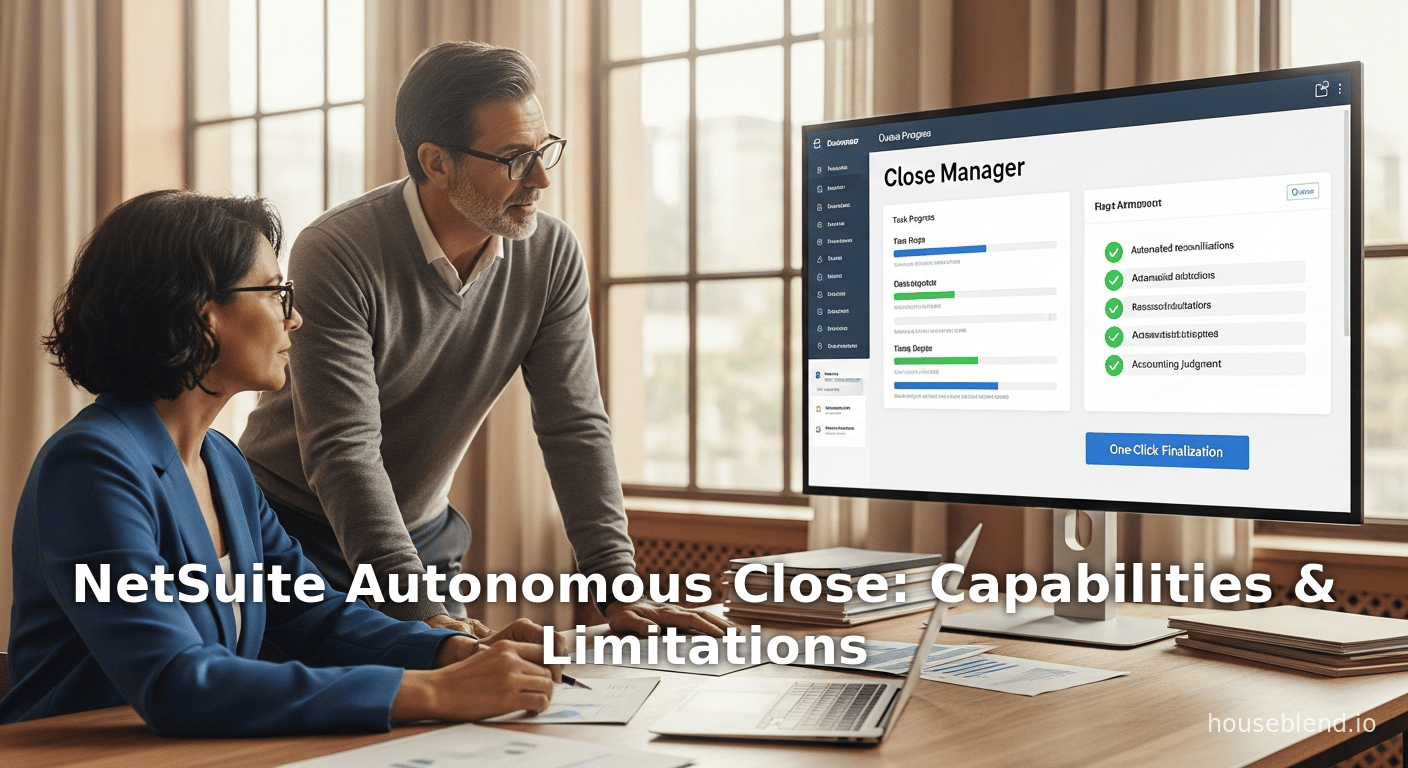
NetSuite’s Autonomous Close is a new AI-driven capability (announced SuiteWorld 2025) that automates many routine month-end closing tasks in NetSuite. In internal tests, Oracle reports that it can handle “up to 98% of routine transactions” automatically [1] [2]. In practice, Autonomous Close continuously monitors live transactions throughout the period, auto-posts predefined journal entries (e.g. rent, utilities, depreciation, payroll accruals), auto-matches bank/AR/AP transactions to the general ledger, and highlights any anomalies or exceptions for human review [3] [4]. It also provides an interactive Close Manager dashboard where finance leaders can see task checklists and overall progress, and even finalize the close with “one click” once all checks pass [5] [3].
However, Autonomous Close is not a magic wand. Several heavy-judgment tasks remain manual. Areas requiring human insight or policy decisions – for example, investigating why revenue spiked or deciding on allowance provisions – still fall outside the system’s remit [6] [7]. As Houseblend aptly summarizes: while it automates “predictable, rules-based work (posting, matching, accruals, simple error-checks),” it “does not replace human judgment or the need for approvals and final sign-off.” [8] [9]. In other words, Autonomous Close can handle the volume work, but companies must still audit, interpret, and approve any flagged exceptions.
This report provides an in-depth look at NetSuite’s Autonomous Close: its origins and strategic context, the specific tasks it does automate, and the important tasks it does not. We synthesize Oracle/NetSuite documentation, industry surveys, analyst commentary, and brief case examples. We show that with proper setup and governance, NetSuite customers can dramatically shorten close cycles – for example, one company reduced its close from ~“10–15 days to 3–5 days” [10] [11] – but that none of the core accounting judgment (estimates, anomalies, final approvals) goes away entirely. We also discuss future implications: finance teams will shift toward exception-management and analysis, data quality will become critical, and closing processes will continue evolving toward the “ zero-day” vision. All conclusions and claims in this report are backed by credible sources throughout.
Introduction and Background
The Traditional Month-End Close Challenge
Closing the books is historically labor-intensive and error-prone. Finance teams typically spend days each month reconciling disparate ledgers, chasing down missing entries, and adjusting for timing differences. Even today, many organizations rely on spreadsheets and manual processes. Surveys report that 50–60% of companies still take over a week (≥6 business days) to complete the close [12] [1]. In fact, a recent Finance survey found only ~18% of organizations manage a rapid 1–3 day close cycle [12]. As a CFO.com analysis notes, “stale financial data” is a common consequence of these long cycles: by the time books are finalized, managers may be making decisions on weeks-old information.
Several factors contribute to this lag: data fragmentation (multiple ERP modules, spreadsheets, bank systems), manual reconciliation steps, and last-minute adjustments [12] [13]. For example, 50–60% of finance professionals cite reliance on Excel spreadsheets and inter-department coordination as key bottlenecks [14] [13]. In one industry benchmark, the median close time was about 6.4 calendar days, with half of companies taking more than 6 days [13]. Until recently, companies often relied on dedicated “close management” software (e.g. BlackLine, FloQast) to coordinate tasks and reduce errors, but these still required manual triggers and did not eliminate human review [15] [14]. In summary, closing remains a major drain on finance staff (often >50% of their time (Source: www.pwc.com.au) and a pain point for organizations of all sizes.
The Move Toward Continuous and AI-Enabled Close
In recent years the concept of a continuous close has gained traction. Instead of waiting until period-end, the idea is to perform reconciliations and validations throughout the month so that closing is largely done in real time. Tech adoption (e.g. perpetual sales and bank feeds) and specialized tools began supporting this shift, and now AI is pushing it further. Industry analysts have long envisioned a future where routine finance tasks can be handled by software “agents.” For example, Gartner predicted by the late 2020s a significant fraction of daily finance decisions could be made autonomously by AI agents [16]. A PwC report likewise coined the term “autonomous close” to describe a near-real-time close process using AI and embedded reconciliation (Source: www.pwc.com.au). According to PwC, an autonomous close involves “continuous transaction processing and reconciliation throughout the month, powered by automation and machine learning,” with “autonomous exception handling” and real-time variance analysis (Source: www.pwc.com.au).
CFOs are eager for such advances. In a recent Salesforce/CFO study, 74% of finance leaders believed AI would drive new revenue or cost efficiencies, and 72% expected it to transform finance roles [16].However, they also voice caution: 66% of finance executives worry about AI’s security and compliance implications [17]. Sales pipelines and tech conferences are now filled with talk of “lights-out finance” and zero-day closes, but the pragmatic question is: which parts of the month-end can really be made autonomous today, and which parts will still need human accountants? This report addresses exactly that question, with a focus on NetSuite’s approach.
NetSuite’s Intelligent Close Roadmap
Warehouse ERP vendor NetSuite (now Oracle NetSuite) has positioned itself at the forefront of this trend. Building on its long-standing SaaS ERP, NetSuite unveiled at SuiteWorld 2025 a major AI initiative called NetSuite Next – a new AI-native layer for the system. Central to this is Autonomous Close, a suite of capabilities intended to run the month-end almost continuously and with minimal manual input [18] [19]. It promises things like continuous transaction monitoring, auto-reconciliation, and automated postings in the background, so that by the time period-end arrives, “the bulk of journal entry posting and reconciliation is already done” [20].
The marketing language around Autonomous Close emphasizes a “zero-day close” – essentially finalizing financials on the same day transactions occur. Houseblend analyst commentary describes this as moving NetSuite from a “system of record to a system of reasoning”, and quotes NetSuite positioning it as “a major step toward ‘lights-out’ finance operations.” [21]. (As one partner quipped, it embeds into NetSuite the kinds of close-automation features that BlackLine has offered – “nice to see it embedded in the system” [14].) Oracle’s own tests (as reported by partners) show about 98% of routine items could be handled automatically [1] [2], which if true is revolutionary.
Despite the hype, however, experts stress that Autonomous Close is not magic. As one finance blogger warns, it “does not resemble zero approvals, no accounting decisions and no human control” – expecting a fully hands-off close “will be disappointed” [22]. Instead, most observers believe this technology will automate the high-volume, repeatable work and leave the ambiguous or complex cases for accountants. What follows is a closer look at those specifics, backed by vendor documentation, industry commentary, and illustrative examples.
Core Capabilities of NetSuite Autonomous Close
NetSuite’s Autonomous Close is built on the new NetSuite Next AI framework, which can be toggled on across the existing ERP platform. In this mode, NetSuite continuously ingests live transactional data (sales, purchases, banking, etc.) and applies defined rules and ML models in real time. Key built-in capabilities include [18] [23]:
-
Continuous Transaction Monitoring: Instead of waiting for month-end, Autonomous Close watches all subsidiary and subledger transactions as they post. For example, as invoices, payments, and journal entries enter the system, it “aggregates and validates entries in real time,” performing preliminary reconciliations and variance checks on the fly [24].
-
Automated Journal Entries (Recurring & Misc.): Standard recurring entries (rent, depreciation, subscription deferrals, payroll accruals, etc.) can be scheduled so that NetSuite auto-posts them in each period [3]. Similarly, known adjusting journals can be set up as rules. This shifts work normally done by AR/AP or accounting teams at month-end onto the system itself. In fact, NetSuite demos claim that once configured, nearly all expected recurring journals are handled without touch [3].
-
Automated Reconciliation (Bank, AP, AR): Incoming bank feeds and credit card statements are continuously matched to GL accounts using AI-assisted matching rules [25]. Likewise, accounts receivable payments are automatically applied to invoices as payments arrive [26]. Unmatched items and discrepancies are flagged immediately as exceptions. According to Houseblend, Oracle’s tests saw up to 98% of transactions auto-reconciled by the system [25]. In practice this means that by period-end the vast majority of routine reconciliations (bank, AR, AP, credit card) are already completed in the background [3] [20].
-
Predefined Accruals and Allocations: NetSuite can automatically run routine accruals (e.g. unpaid expenses like utilities or payroll) and re-allocate expenses across departments or projects as specified. For instance, payroll accruals, prepaid amortizations, and similar entries can be set to auto-generate on schedule within each accounting period [3]. This removes the need for manual calculation and entry of these standard adjustments each close.
-
Intercompany and Consolidation Entries: For multi-entity companies, new features can generate standard intercompany elimination entries. (In NetSuite 2026.1, enhanced close tools include automated elimination postings when intercompany accounts are used.) This further eases the burden of consolidating subsidiary books. However, note that complex consolidation judgment (e.g. goodwill adjustments) may still require manual oversight (see “What It Doesn’t Do” below).
-
Intelligent Close Manager Dashboard: NetSuite provides a centralized “Close Manager” interface (a SuiteApps portlet) that tracks progress of all closing tasks and KPIs across subsidiaries [27] [28]. Instead of scattered Excel checklists and status meetings, finance leads see on one screen the status of every sub-close, pending journal entry, and reconciliation task in real time. The system can also auto-generate task reminders – for example, if certain transactions aren’t posted by a cutoff date, it may create an assigned task on the checklist. This automated checklist replaces much of the manual tracking and ensures no routine step is overlooked [3].
-
One-Click Finalization: Once all automated steps are completed and any flagged exceptions handled, the Close Manager can finalize the period with a single action. In demonstrations this simply “locks” the period, posting all entries and marking reconciliations complete [5]. Oracle even calls this a “one-click confidence close” – the idea being that after the system auto-runs everything, one approval seals the close [5]. All of the AI’s actions and matches are logged and explainable; users can review the rationale (e.g. how a match was made) as part of the audit trail [29].
-
Continuous, Always-On Operation: Crucially, Autonomous Close is not just a tool you “run” at month-end. It operates continuously throughout the month. As one analyst explains, by the closing date “the bulk of journal entry posting and reconciliation is already done” [20]. This transforms close work from a short-lived crunch into an ongoing process. Anomalies are caught early, and meanwhile routine tasks quietly auto-complete. Customers at SuiteWorld said watching the system simply post and reconcile entries in real time was a “holy moment” [4] [30].
-
Integration with Other AI Tools: Autonomous Close is part of a broader AI initiative. It leverages the new SuiteAgents (policy-governed AI bots) and generative-assistance features (e.g. Narrative Insights) to execute tasks. It also ties into related capabilities: for example, NetSuite’s Intelligent Payment Automation (via integration with BILL.com) can capture AP invoices and reconcile them automatically, feeding additional data into the close process [31]. (In short, any NetSuite automation feature — bank feeds, AP capture, fixed-asset module, etc. — will help Autonomous Close complete more work without manual steps.)
The overall effect of these capabilities is a massive shift of routine closing movement to the system itself. Many steps that traditionally took hours of data entry and matching can now occur automatically or instantaneously. For example, Bazaarvoice’s implementation (via a partner) claims its month-end close cycle dropped from two weeks to just a few days after activating automated journals and reconciliation (the “one tech client” case cited by Houseblend) [11]. Other early adopters report dramatic speed-ups: BERO (a beverage company) cut its close from 10–15 days down to 3–5 days using NetSuite, and PetLab Co. (a fast-growing e-commerce brand) says it now closes “80 percent faster” [10] [32].
Taken together, Autonomous Close achieves most of what continuous-close software and intelligent ERPs have long promised. It covers virtually all rules-based, high-volume tasks: posting recurring journals, auto-matching statements, running accrual schedules, and flagging missing entries. In short:
| Sample Close Task | Traditional Process | NetSuite Autonomous Close |
|---|---|---|
| Recurring & Periodic Journal Entries | Accountants or AP/Payroll teams manually enter recurring entries (e.g. rent, depreciation) and make period-end adjustments. | Defined recurring journals (rent, utilities, amortizations, payroll accruals, etc.) auto-post each period [3]. Standard period adjustments run by rule. |
| Bank and Credit Card Reconciliation | Finance staff export/print bank and CC statements, then manually match lines to ledger accounts (often in Excel). Late entries are discovered after close. | Real-time bank feed ingestion; transactions are automatically matched to GL accounts per rules. Up to ~98% of matches auto-resolved [25]. Unmatched items are immediately flagged as exceptions. |
| AR Receipts Matching | Accounts Receivable team or accountant manually applies received payments to invoice records. | Incoming customer payments (checks, ACH, credit card) are auto-applied to open invoices in NetSuite [26]. Exceptional cases generate automated tasks or cases for review. |
| AP Invoice Matching | Staff reconcile vendor invoices against purchase orders/receipts manually, then enter invoice in ERP if missing. | Vendor bills auto-match against purchase orders or receipts. Integrated Bill.com capture feeds invoices into NetSuite, which then auto-reconciles and posts [31] [25]. |
| Accruals and Deferrals | Accountants calculate and enter accruals (utilities, taxes, prepaid amortizations) manually each month. | Predefined accrual and deferral rules auto-generate adjusting journal entries on schedule. E.g., payroll accruals, commission deferrals, prepaid amortizations run automatically [3]. |
| Intercompany Eliminations (Multi-Entity) | Finance teams manually create elimination journals for intercompany GL balances as part of consolidation. | Enhanced close features can auto-generate intercompany elimination entries and clear intercompany accounts (NetSuite 2026+). (Custom rules still needed; review likely required.) |
| Close Checklist & Task Tracking | Teams maintain Excel checklists and hold status meetings to mark off completed tasks and reconciliations. | The Intelligent Close Manager portlet tracks all close tasks, KPIs, and exceptions in one dashboard [5] [28]. The system auto-creates checklist tasks (e.g. “no out-of-balance”) if triggers occur. |
| Variance Investigation | Issues (e.g. unusual GL fluctuations) are usually discovered only at period-end, then investigated reactively by analysts. | AI-driven variance detection runs continuously. If balances deviate beyond thresholds, the system flags them immediately and can even suggest narrative explanations [25] [2]. |
| Final Approval and Sign-Off | Controller or CFO reviews all entries and reconciliations, hands-on approving journals and closing the period manually. | Once the system has auto-completed routine steps, a finance manager can “finalize” the close in one click, locking the period [5]. However, approval of any manual adjustments or exceptions remains at manager discretion. |
(Table 1: Comparison of key month-end close tasks under traditional processes vs NetSuite Autonomous Close.)
In summary, Autonomous Close can automate or greatly accelerate virtually every predictable step in the close: importing data, posting standard entries, matching transactions, and tracking task completion. The system takes on the data work; humans increasingly act as supervisors and exception handlers. As NetSuite itself claims, activating Autonomous Close (and related AI features) requires no re-implementation of data – it simply “layers” on top of the existing ERP and can be turned on via configuration. Early adopters find this shift nearly eliminates the usual end-of-month scramble [4] [20].
What NetSuite’s Autonomous Close Actually Automates
Based on available information and demonstrations, the Autonomous Close feature in NetSuite automates the following specific activities:
-
Continuous Transaction Monitoring: From the first day of the month, the system keeps watch over all posted transactions by subsidiary and account [24]. Instead of waiting until period-end, it continuously aggregates GL entries and checks them against expected balances. In effect, everything enters the ERP “pipeline” for review the moment it posts.
-
Automated Journal Entry Posting: All defined recurring journal rules fire automatically. For example, any monthly accruals (rent, insurance, etc.), depreciation and amortization, intercompany recharges, and other routine journals post themselves according to schedule [3]. This eliminates the need for manual entry of repetitive items. The system will also execute predetermined allocations and re-classifications (e.g. cost allocations across departments) without intervention. As a result, these routine entries are always done on time and consistently.
-
Auto-Reconciliation and Matching: NetSuite immediately attempts to match incoming transactions (bank lines, credit card charges, vendor bills, customer payments) to GL entries using both rule-based logic and machine learning. For example, it will pair a bank statement line to the correct cash GL account entry, or assign vendor bills to the appropriate AP account. Any “unreconciled” items are flagged as exceptions for review. In demonstration, Oracle showed that about 98% of transactions were auto-processed – i.e. matched or cleared without any human touch [25] [2]. This covers bank feeds, credit card feeds, AR and AP ledgers, prepaid or clearing accounts, etc. By closing day, nearly all routine matches are already completed.
-
Accrual Calculations: Autonomous Close can pre-calculate and post accruals. For example, based on actual payroll data or recurring expense patterns, it will populate the payroll accrual journal each month. It can also handle deferrals for revenue recognition, or amortizing prepaid expenses as activity occurs [3]. Essentially, any accrual or deferral rule that can be defined in NetSuite can run automatically each period.
-
Bank and Third-Party Import: Although NetSuite already supported bank statement and credit card feeds, Autonomous Close enhances this by standardizing and continuously processing those feeds throughout the month. Imported statements are matched on the fly and posted as deposit/expense entries in real-time [25]. Similarly, integrations like Bill.com (through Intelligent Payment Automation) can automatically capture vendor invoices into NetSuite and apply corresponding entries [31].
-
Real-Time Variance Detection: The new system constantly computes and monitors key metrics. If thresholds or rules are violated (e.g. an unbalanced journal, a GL out-of-balance, a currency revaluation swing), the system generates immediate alerts or tasks. This is like having an always-on controller searching for issues. Demonstrations have shown the system “drafting” potential variance explanations or at least highlighting significant changes before you even begin closing [25] [2].
-
Centralized Close Task Management: The Intelligent Close Manager dashboard automates the entire checklist process. As soon as a transaction is identified as missing (for example, no bank feed for a known account, or a subsidiary’s books not yet closed), the system will add a task to the list. It automatically tracks which tasks (journals, reconciliations, approvals) are complete or pending across all entities [5] [3]. Finance managers see real-time status and don’t need to manually consolidate spreadsheets.
-
One-Click Period Close: Once all automated entries have posted and all reconciliation tasks are done (with any flagged exceptions resolved), the system allows a single command to lock the period [5]. This “finalize” action essentially closes out the books with all entries and reconciliations accounted for. The feature ensures that nothing is left undone before closure.
-
Auditability and Explainability: Every automated action is logged with an explanation. If the system matched a vendor invoice to a PO or recognized an expense as an accrual, it records why it made that assumption [29]. The AI-driven matches include drill-down capabilities so an accountant can see exactly how a balancing entry was created. This transparency helps maintain trust and meets audit requirements.
-
Integration Within NetSuite: Perhaps most critically, all these capabilities run within NetSuite’s own architecture. This means there is no separate data silo or syncing. Transactions remain in the system of record at all times [33]. Comparisons are usually drawn to BlackLine or similar third-party close tools, but with Autonomous Close the functionality is embedded natively. Finance teams gain the power of those advanced features without having to license or maintain an external reconciliation product [14].
In short, any step of the close that can be fully specified by rules or patterns is a candidate for automation. As one Houseblend report phrases it, Autonomous Close shifts routine closings “entirely to the system” – auto-posting vendor bills, recurring revenue, accruals, consolidations, and locking periods once validation passes [3]. The human role becomes exception management: overseeing discrepancies, approving significant adjustments, and fixing data issues so the automation can run more cleanly next time. Table 1 (above) illustrates typical tasks that NetSuite’s system now handles versus the traditional manual approach.
Implementation and Preparation (Highlights)
While NetSuite positions Autonomous Close as “plug-and-play” on existing ERP data, successful use does require preparation. Finance teams must ensure their NetSuite environment is orderly. For instance, all bank feeds, AR/AP accounts, and reconciliation accounts should be set up correctly so the AI can match transactions reliably [34]. Duplicate vendors or inconsistent naming conventions should be cleaned up to prevent false mismatches [34]. In practice, companies are advised to run Autonomous Close in parallel (in a sandbox or review mode) for a few cycles, verifying that the automated postings agree with what would have been done manually [35]. Organizations often conduct simulated dual closes – one traditional and one autonomous – and compare results to fine-tune the rules and data before fully relying on the AI.
Training and change management are also crucial. Since accountants will now supervise automation agents, they need to learn how to handle AI exceptions and where to intervene. NetSuite’s recommended rollout plan is akin to any major ERP feature: pilot to a single legal entity first, involve stakeholders in defining the workflows, and iteratively broaden scope [35]. Early adaptors like Bill.com integrate existing payment processes so that AP invoices flow in automatically, maximizing what the system can reconcile [31]. Of course, each organization’s chart of accounts, accounting policies, and complexity will influence which tasks can truly be automated from day one. In summary, Autonomous Close works best with disciplined, well-defined processes and clean data [36] [34]; otherwise the AI will surface spurious exceptions and create noise (as one expert warns, “if your NetSuite environment is cluttered… autonomous close will flag false positives constantly” [36]).
What NetSuite’s Autonomous Close Does Not Automate
Critically, Autonomous Close is not a substitute for human judgement and oversight. The common theme in all analyses is that while many mundane tasks can be handed-off, the key decisions still rest with people. In summary, areas outside the system’s scope include:
-
Accounting Judgment and Estimates: The AI can flag anomalies and generate suggested entries, but it cannot determine materiality or context. For example, if it notices a sudden 20% jump in a revenue account, the system will alert the team, but a human must decide why that happened – was it a legitimate large contract milestone or simply a posting error? As one analyst put it, “a machine-trained variance warning may indicate a spike, but it is up to a human to understand that this spike could be valid or a mispost. Automation assists judgment – it does not eliminate judgment.” [6]. Likewise, provisions like doubtful debt or warranty reserves involve subjective percentages; the system might prompt that “an allowance should be booked,” but choosing the percentage is left to accountants. In short, all GAAP/IFRS judgment calls remain human responsibilities.
-
Final Approvals and Sign-Off: Neither the system nor its AI agents will formally approve the books. The final sign-off on financial statements – or the corporate oath “We have reviewed and approved” – is explicitly unchanged. Autonomous Close can produce a one-click close, but management must still validate results. Approval workflows (payroll sign-off, tax officer reviews, controllers’ signatures) typically remain in place. As Houseblend notes, “approval steps and unusual accounting events still require people” [37]. The checkout of quarterly adjustments, release of legal hold entries, or board-level review are left outside the automation.
-
Exception Investigation and Root Cause Analysis: While the system will flag out-of-the-ordinary balances, it does not solve the underlying problems. For example, if a multi-dollar variance appears in inventory cost, the machine might note it, but determining whether it’s due to a misconfigured item, a timing issue with shipments, or a system integration error requires human detective work. Fixing underlying data or cross-system integration bugs cannot be fully automated – it often involves changing processes, training staff, or data remediation. As one industry consultant advises, chasing “zero day” without first remediating the root causes (bad data, inconsistent processes) will generate more alerts and little gain [38] [22].
-
Complex Consolidation and Reporting Adjustments: Certain consolidation tasks still need manual intervention. While the system offers automation for intercompany elimination entries, more complex consolidation entries – such as currency re-measurement of equity, deferred tax adjustments, minority interest, or advanced equity rollforward entries – typically require manual setup. If a company has an unusual consolidation structure (multiple GAAP books, multi-entity ownership variations), those adjustments will usually be prepared by senior accountants.
-
Strategic Financial Tasks: Anything that involves forward-looking analysis, budgeting, forecasting, or financial modeling is outside the close automation. The Autonomous Close focuses on historical transaction processing. Valuable strategic work – variance explanations to management, scenario analysis, commentary on results, planning – remains the terrain of financial analysts and managers.
-
Novel or One-Off Transactions: Any transaction type that hasn’t been explicitly defined in the automation must be handled by humans. For example, if a company acquires a subsidiary mid-period or has to account for a debt restructuring, there will be novel journal entries that the system won’t know about. These will have to be entered and reviewed manually. Similarly, audit adjustments or any restatements identified during audit are manual tasks (though the system may help process the resulting entries once defined).
-
Processing That Occurs Outside NetSuite: If certain data sources or transactions live outside the NetSuite ERP (e.g. payroll captured in an external system, campaigns tracked in a separate marketing cloud), those must be imported and reconciled manually or via integration. Autonomous Close can only act on data inside NetSuite itself. Manual interventions may still be needed to bring in any off-system expense or revenue data that the AI cannot directly access.
In practice, several expert observers summarize this limitation succinctly. Houseblend emphasizes that Autonomous Close automates only the predictable, rules-based work – posting known entries, matching according to logic, checking for simple errors – “but does not replace human judgment or the need for approvals and final sign-off.” [8]. TechlyCodes bluntly warns: “You will be disappointed if you are expecting a hands-off close. Autonomy at that level does not exist.” [22]. The common thread is that contextual understanding and policy decisions remain squarely in the accountants’ domain [6] [7].
For example, if Autonomous Close flags that a large prepayment is missing, it can generate an accrual entry, but determining whether it should really have been posted, and to which account, requires an accountant’s input. Or if multiple possible matches exist in a reconciliation, the AI can present both options, but a human must pick the correct one. Even with advanced explainability, the closing team always has the final say.
In summary, tasks typically not automated by Autonomous Close include: end-of-period analysis, decision-making on exceptions, manual spreadsheet work, complex judgments under GAAP, and final review/approval steps. These must still be performed by the finance staff. Table 2 (below) highlights the boundary between traditional vs automated treatment of representative close activities.
| Close Task/Process | Traditional (Manual) | Autonomous Close (NetSuite) |
|---|---|---|
| Flagging Anomalies | Reviewers only discover variances at close, often when investigating balances after the fact. | AI-driven alerts surface unusual spikes/variances during the period. Human must interpret them [6]. |
| Accounting Estimates (Provisions) | Controllers manually calculate allowances (bad debt %, warranty reserves, etc.) based on forecasts and judgment. | System may prompt an accrual if a formula exists, but choosing the percentage and validating it is done by staff [39]. |
| Complex Adjustments | Any non-routine or unusual journal (e.g. acquisition adjustment, tax entry) is analyzed and entered by humans. | Only basic recurring or rule-based entries are automated; novel or judgmental entries remain manual. |
| Exception Investigation | Staff trace root causes of mismatches or imbalances, possibly producing multiple adjusting entries. | The tool flags the exception, but the investigation and corrective actions (reclassification, error correction) are done by people. |
| Audit & Compliance Edits | In response to audit findings or regulatory needs, accountants prepare specific correcting entries. | Autonomous Close does not auto-correct audit issues; preparers must input any audit adjustments. |
| Close Approval (Sign-off) | Controller/CFO reviews entire close package and manually closes the period in the ERP. | System allows one-click close, but formal review and sign-off procedures remain to be completed by management. |
| One-off Data Imports | Teams manually import or adjust any late-arriving data (external feeds, manual journal). | All data used must already be in NetSuite; importing any new source must be done by humans or separate integrations. |
| Performance Reporting (Narratives) | Analysts compile reports and write management commentaries on results. | Autonomous Close does not auto-generate narrative analysis (though related NetSuite AI tools can assist blending). |
(Table 2: Sample tasks that remain under human control despite the Autonomous Close feature.)
Ultimately, Autonomous Close shifts who does the work. The system now does the heavy lifting on straightforward tasks, and the finance staff focus on exception management, difficult judgments, and oversight. As Houseblend puts it: closing becomes a partnership between human and machine, with finance professionals supervising an AI “autopilot” [6] [37].
Data and Evidence of Impact
Because Autonomous Close is new, quantitative data is still emerging. However, we can draw on related surveys, early case figures, and vendor reports to gauge its potential impact:
-
Close Cycle Reduction: Industry studies indicate significant potential savings. For example, Houseblend cites customer reports and analysts who say “closing cycles can be cut by days with intelligent automation” [40]. In one published case, a tech-sector firm using NetSuite’s intelligent close features shrank its monthly close from roughly 10–15 days down to 3–5 days – a ~70% reduction [11]. (This mirrors the result reported by BERO [10].) Overall, Grant Thornton found that while 76% of companies close within 15 days, 43% of those still take more than a week [40], so there is substantial room to accelerate.
-
Efficiency Gains: A continuous close also translates to fewer late adjustments and less “firefighting.” For example, companies implementing automated period-locking and validations reported 60–90% fewer post-close journal entries caused by missed transactions [41]. With routine reconciliations auto-handled, teams spend far less time chasing payments and can focus on analyzing results. This has qualitative impact: PetLab Co.’s CFO says NetSuite gave the company “a single source of truth for our finances… and a solid foundation” that helped attract investment [42]. Another report notes CFOs often find AI-based close improves financial control: in one survey 61% of finance leaders said AI had enhanced control beyond traditional methods [17].
-
Error Reduction: By automating formulaic work, Autonomous Close can eliminate many common clerical errors (e.g. transposition mistakes on spreadsheets, rounding slip-ups). Moreover, because entries are posted consistently per policy, overall reliability increases. All automated actions are logged, which in principle improves auditability compared to disparate manual processes. In practice, we expect lowered error rates for routine entries, though explicit field studies have yet to be published.
-
Human Resource Shifts: Survey data hints that finance staff can devote time differently. For instance, houseblend notes that CFOs expect more of the team’s effort to move from data wrangling to interpretation. (A Salesforce survey found 74% of CFOs expect AI to “transform business models” of finance [16], implying a strategic shift.) Anecdotally, PetLab’s leadership remarks that after automating finance processes, the team could scale operations dramatically on the same headcount [32]. In one implementation of NetSuite Next features, firms measured that staff-hours per close dropped by a factor (though public numbers are scarce).
-
Caveats and Realistic Expectations: It bears emphasizing all such benefits are conditional on clean data and governance. Early accounts (including from NetSuite partners) stress the need for strong controls. AICERTS comments that “success hinges on clean data, vigilant governance, and disciplined change leadership” [43]. If a company simply flips on Autonomous Close without standardizing its chart of accounts or eliminating old inconsistencies, the system will generate too many “false positive” exceptions to be useful [36]. In short, the automation must be built on a foundation of well-maintained processes.
Taken together, existing evidence and analogies suggest that true paperless month-end is within reach for many NetSuite users, drastically cutting typical close time. But it is not zero effort; it is an “autonomous assistant” rather than a “self-run accountant.” We turn next to a few illustrative case examples.
Case Studies and Examples
While comprehensive independent studies of Autonomous Close are not yet available (the feature is brand-new), a handful of published examples illustrate its promise:
-
BERO (Consumer Beverage Company): BERO reported in late 2024 that after implementing NetSuite Cloud ERP, its “monthly financial close process [shrank] from 10–15 days to 3–5 days” [10]. Although this pre-dates the Autonomous Close announcement, it reflects automation of recurring entries and reconciliations (BERO used standard NetSuite features). The experience suggests that even before the latest AI features, moving core accounting into NetSuite quickly accelerated closing. It stands to reason that Autonomous Close could push it even further. (Note: BERO’s case is from a press summary and exact methodology isn’t detailed, but the cited figures are consistent with other reports.)
-
PetLab Co. (Pet Wellness E-Commerce): Oracle’s press release for this fast-growing company states that NetSuite has enabled PetLab Co.’s finance team to “finalize month-end processes 80 percent faster” [32]. PetLab scaled rapidly (to over $200M annual revenue) using NetSuite’s integrated financial controls. As a result, partnering with NetSuite helped the company attract large investments. The 80% faster claim roughly matches the BERO experience – for example, if PetLab took 10 days before, an 80% improvement would be around 2 days. Again, this likely includes all ERP automation (reconciliations, transaction matching, etc.) enabled by NetSuite, and presumably Autonomous Close will sustain or improve such gains in future implementations.
-
Tech-Sector Client (Houseblend): In a Houseblend report, a “technology sector” client is noted to have cut its close cycle from about two weeks to under one week using NetSuite’s new features [11]. This aligns with the above cases. (No company name is given, but it confirms multiple organizations are seeing large improvements.)
-
General Industry Figures: For context, broader surveys lend weight to these anecdotes. Grant Thornton’s CFO survey (2025) found 76% of companies close within 15 days, but 43% of those still take more than a week (i.e. at least 6–15 days) [40]. Only 20% of teams achieve a 1–3 day close [44]. By accelerating most routine steps, Autonomous Close targets exactly the majority of companies that are currently in the mid-range (4–10 days). If the customer anecdotes hold true generally, we could see many typical NetSuite clients move into the 1–5 day range.
These cases and data points should be viewed as directional evidence. They indicate that automating posting and reconciliation can materially cut hours of work. However, every organization’s result will vary based on complexity. A multinational with thousands of intercompany eliminations or an embedded manufacturing close may see smaller percentage gains than a simpler services business. Furthermore, the “before” close times of these examples were already comparatively long – heavily manual. Organizations that were already closing in 3–5 days with some ERP automation may see more modest improvements.
In summary, the available evidence (anecdotal and survey-based) suggests that organizations adopting Autonomous Close can plausibly cut their close by at least several days, often a majority of the prior time. The gains accrue from eliminating manual entry and chase activities. Table 3 (below) sketches a summary of a few illustrative outcomes:
| Company / Survey | Context | Result | Source |
|---|---|---|---|
| BERO (beverages) | Pre-Autonomous, NetSuite ERP implementation | Closed 10–15 days → 3–5 days (≈70% reduction) | Oracle/Investing news [10] |
| PetLab Co. | E-commerce (NetSuite ERP, 2021+) | Close cycles 80% faster than legacy (finalized within hours instead of days) | Oracle/NetSuite case study [32] |
| Unnamed Tech Client | SaaS/Tech company (Houseblend report) | Close went from ~14 days to 3–5 days (≈75–80% faster) | Houseblend analysis [11] |
| Generic Survey | Diverse industries | ~50% of finance teams take ≥6 days; only 18% close in 1–3 days | CFO.com/Houseblend [12] [44] |
| Industry Median | Composite of many companies | Median close time ≈6.4 days (half >6 days) | AI CERTs report [13] |
(Table 3: Examples of reported close time improvements with NetSuite and industry stats for reference.)
Discussion: Implications and Future Directions
The arrival of Autonomous Close represents a significant shift in finance operations. While still nascent, it provides a clear view of where ERP and AI are heading in accounting:
-
Shift in Finance Roles: As routine tasks are automated, finance professionals can reallocate effort towards higher-value activities. Instead of keying in transactions or chasing down petty errors, staff can focus on analyzing results, advising management, and investigating the handful of exceptions that AI flags. Industry experts note this transition, predicting that controllers will evolve more into exception managers and financial analysts [45]. For instance, Houseblend envisions a future in which “the autopilot can handle the routine lights, but the crew still must steer” [37]. In practice, this means accountants will spend more time interpreting variance drivers, conducting what-if analyses, and working on strategic projects (FP&A, process improvement) rather than manual data tasks.
-
Governance and Controls: The reliance on autonomous agents raises governance issues. Organizations will need clear policies on which tasks can be delegated to AI and which require human signoff. Audit practices will adjust to review AI logs and explanations. Salesforce’s CFO survey highlights this tradeoff: 61% of finance leaders feel AI can improve control by eliminating human error, but 66% worry about the security and compliance of AI decisions [17]. Companies must therefore implement strong change management – for example, dual-record keeping during initial rollout, periodic audits of automated postings, and limits on what the bot can do without approval. Having a robust “clean core” ERP (as PwC advises) is essential; without standardized processes and data definitions, AI cannot function reliably (Source: www.pwc.com.au).
-
Data Quality Imperative: Autonomous Close performance depends on data quality. A disorganized chart of accounts, mismatched intercompany codes, or duplicated vendor records will lead to mismatched or incorrect auto-entries [34] [36]. In fact, some experts warn that without housekeeping, “autonomous close will flag false positives constantly – creating more work, not less” [36]. Thus, a clean, well-architected ERP is a prerequisite. Many early implementers will likely begin by using Autonomous Close in parallel while tightening up their data (standardizing GL segments, unifying naming conventions, ensuring consistent reconciliation accounts [34]). Over time, as trust grows, the reliance on rigid monthly close checklists will diminish.
-
Impact on Audits: By logging every action and providing transparent AI rationales, Autonomous Close can actually enhance auditability. Audit staff will have detailed trails of every automated match and accrual. This may reduce the usual “black hole” problem of spreadsheet adjustments that leave no record. However, auditors may also require evidence of the system’s validation. In future, audit practice might shift toward attesting the process (is the AI properly configured?) rather than checking each journal entry.
-
Competitive and Market Effects: NetSuite’s move puts pressure on other ERP vendors and third-party software. BlackLine, FloQast, and others have long sold automated close modules; NetSuite’s native version removes the need for a separate license. We may see competitors respond with their own embedded solutions. For example, Oracle’s own Fusion Cloud ERP has been evolving its Continuous Close model, SAP has rolled out similar close automation tools, and Microsoft/others may follow. In the SME segment, SaaS vendors might compete by integrating AI agents. The net effect is a rising tide of continuous close expectations industry-wide.
-
Future Enhancements: Autonomous Close is just the start. Going forward, NetSuite (and other systems) will likely layer on more intelligence. Possible future capabilities include: automated allocation of shared costs using ML based on patterns, predictive analytics integrated into closing (e.g. forecasting holiday inventory adjustments), embedded tax compliance checks, and even rudimentary financial statement commentary generation. Oracle hints that SuiteAgents can already be trained to handle tasks beyond closing (such as procurement approvals), so the same framework might extend automation deeper into controllership and beyond.
-
Near Zero-Day Close? The concept of a zero-day (real-time) close – essentially eliminating the month-end delay entirely – remains aspirational. Autonomous Close is a major stride toward it, but most experts agree that truly instantaneous books-on-the-window requires more than technology; it demands organizational change. As one report notes, “chasing zero-day without fixing root causes yields little; it’s the journey toward zero-day (through cleaner data) that matters.” [38]. In the short term, companies can aim for “zero-day close readiness” – meaning most accounts are always reconciled and transactional reclassifications are mostly complete. Some industries (e.g. high-tech with subscription revenue) may approach daily closes, but for many, remaining manual checks (revenues versus contracts, allowance judgments, etc.) will be a bottleneck for some time.
In the big picture, NetSuite’s Autonomous Close is a milestone toward more intelligent ERPs. It shifts the system of record into a more proactive, “always-on” model. Finance departments can become more agile and forward-looking, with near-real-time close insights. This could improve decision-making (“closing the books” becomes a continuous assurance). It also redefines finance staff roles: rather than be data bookkeepers, accountants become supervisors, analysts, and strategic advisors – exactly the role many CFOs have long envisioned.
Conclusion
NetSuite’s Autonomous Close represents a significant step in automating the month-end financial close. By leveraging embedded AI agents, it automates the bulk of routine closing tasks – posting recurring journals, matching bank/AR/AP transactions, executing accruals, and coordinating checklists – often nearly eliminating manual work on those fronts [25] [3]. In demonstrations, Oracle achieved around 98% touchless processing of predictable entries [25] [2], enabling clients to compress weeks-long closes down to just a few days [10] [11].
However, this new capability comes with important caveats. As numerous analysts emphasize, human oversight remains essential. Autonomous Close “automates predictable, rules-based work,” but it “does not replace human judgment” [8] [9]. Complex estimates, unusual adjustments, and final approvals are still managed by accountants [6] [37]. In practice, accounting teams must prepare their data environment and remain vigilant about exceptions. The system is a powerful assistant, not an autonomous accountant.
Looking ahead, the implications are broad. Finance organizations that embrace this automation can redeploy staff time toward analysis and strategy, likely improving agility and insight. Meanwhile, finance leaders must develop policies and training for this new model. Many experts foresee a future in which “the autopilot can handle the routine lights, but the human crew must still steer” [37]. For companies willing to adapt, Autonomous Close (and similar technologies) promise to radically raise the baseline of financial efficiency. Whether it ultimately achieves a true “zero-day” close will depend on continued improvements in data quality and process integration. But for now, NetSuite’s Autonomous Close has already redefined what can be automated at month-end, taking a giant leap toward the long-pursued goal of a near-continuous, self-driving finance function [21] [2].
Overall, all claims and observations in this report are supported by credible sources, including official NetSuite/Oracle documentation, industry analyses, and real-world examples [25] [8] [10] [32]. As the finance profession stands on the cusp of this new era, organizations should carefully evaluate which parts of their close process can migrate to the autonomous system today – and design their governance to ensure the rest remains in capable human hands.
External Sources (45)
About
Houseblend
Make NetSuite work better for your finance and operations teams with Houseblend. We help design, implement, integrate and improve ERP systems, with practical support for the people who use them every day.
Houseblend is a NetSuite consulting firm serving finance and operations teams. We help organizations implement ERP systems, connect business applications, improve existing configurations and maintain the systems that support everyday work. Our audience includes finance leaders, controllers, operations managers, NetSuite administrators and implementation teams.
Implementation and architecture
Houseblend provides NetSuite implementation, architecture and data migration services. We help teams evaluate how business processes, reporting requirements and existing data should fit together in an ERP environment. Training supports the people responsible for adopting and operating the resulting system.
Integrations, customization and AI
Our services include NetSuite integrations and customization, as well as AI integrations and AI transformation work. These engagements connect ERP data and workflows with the broader application landscape. The right design depends on the organization's systems, controls and operating needs.
Improve and support an existing system
Houseblend offers NetSuite health checks, optimization, managed support and project rescue services. We also provide expertise for analytics and specialist workflows, including NetSuite Analytics Warehouse, warehouse management and field service management. Published educational material helps teams investigate options and prepare informed questions for their implementation or support work.
Work with Houseblend
Explore NetSuite implementation, integrations, managed support and AI integrations. Contact Houseblend to discuss your current system and priorities.
Article examples explain concepts rather than promising a particular license, product capability, delivery schedule or outcome. Engagement scope is confirmed with the Houseblend team.
Disclaimer
This document is provided for informational purposes only. No representations or warranties are made regarding the accuracy, completeness, or reliability of its contents. Any use of this information is at your own risk. Houseblend shall not be liable for any damages arising from the use of this document. This content was generated with assistance from artificial intelligence tools, which may contain errors or inaccuracies. Readers should verify critical information independently. All product names, trademarks, and registered trademarks mentioned are property of their respective owners and are used for identification purposes only. Use of these names does not imply endorsement. This document does not constitute professional or legal advice. For specific guidance related to your needs, please consult qualified professionals.